
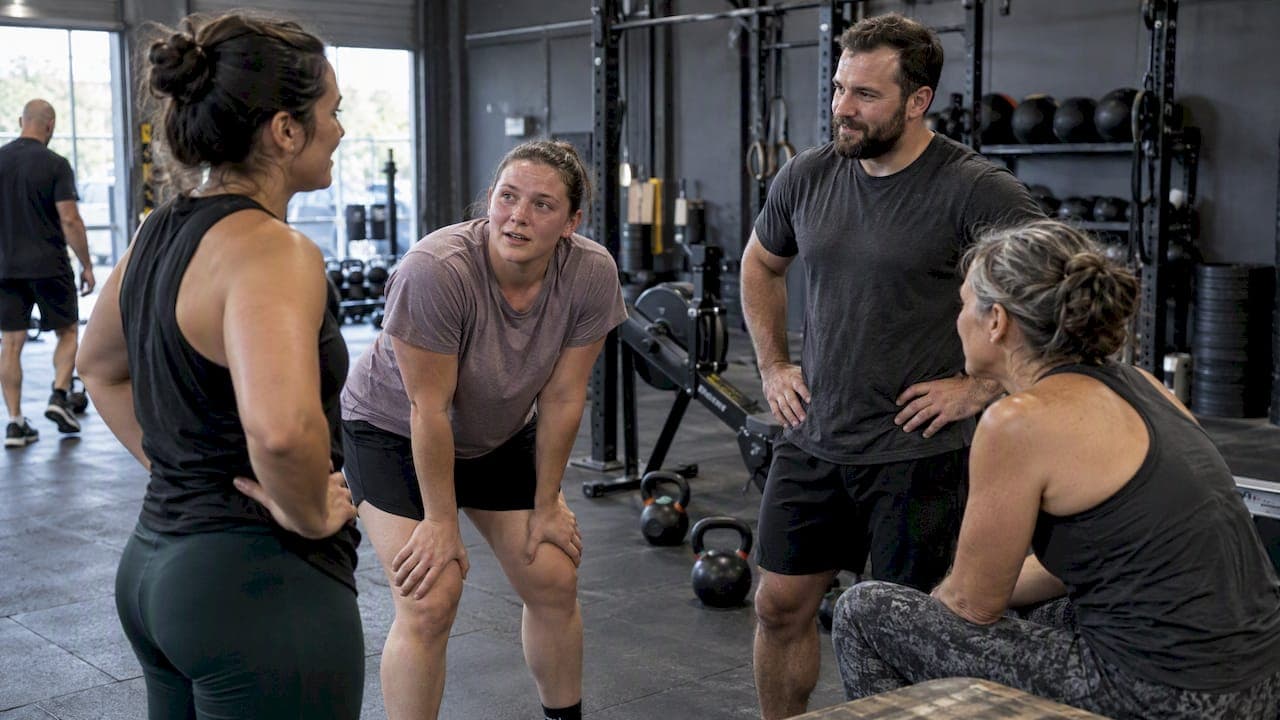
You build a gym community by making it easy for members to meet each other, easy to be known by name, and easy to see that they belong. That comes from small, repeated systems, not one big event: a first-90-days plan, coaches who connect people, shared goals, and a way to notice who is drifting away. Below is how to do each one, with the evidence behind it and the numbers to watch.
TL;DR
- Community is built in the first 90 days. Introduce new members to each other, learn their goals, and watch their attendance from week one.
- Social support works: a CDC guide reports that community social-support programs raised time spent active by a median of 44%.
- Community builds loyalty, but results keep people. Pair every social tactic with visible progress.
- Use challenges, milestones and member spotlights, then measure attendance, referrals and churn to see what is working.
- Track it all in one system, not in spreadsheets and group chats.
Table of Contents
- Why community is worth the effort
- Start with the first 90 days
- Build community inside the class
- Use challenges and milestones to give people a shared goal
- Create reasons to meet outside class
- Spot the members who are drifting
- Let members bring their friends
- Measure whether it is working
- Our perspective: community needs data behind the warmth
- Put the system in one place
- FAQ
- Sources
Why community is worth the effort
The market is large and getting more social. The Health & Fitness Association reports a record 77 million US fitness facility members in 2024, with one in four Americans aged six and older holding a membership. Median revenue grew 9.9% that year. The same data shows facilities retaining about two-thirds of their members. The other third is the opportunity.
The case for community rests on three findings:
- Social support increases activity. A CDC guide to community physical activity strategies reports that social support interventions, such as buddy systems and walking groups, raised time spent active by a median of 44% and energy expenditure by 20%.
- Boutique settings feel more supportive. A University of Oslo-affiliated study on exercise adherence found boutique gym members report higher autonomous motivation and perceived social support than members of multipurpose or fitness-only gyms. The same work points to attrition of 40 to 65% in the first six months across the industry.
- Group exercise shapes identity. Research on group exercise, social support and exercise identity explores why group members tend to be more active: they get several kinds of support, including emotional and companionship support.
One caution before the tactics. Industry consultant Jim Thomas argues in Health & Fitness Business that results are the number one retention factor. Community creates emotional loyalty, but members leave if they see no progress. So the community you build has to be about progress, not just parties.
Start with the first 90 days
Most community advice jumps to events. The better starting point is the new-member window. A CrossFit presentation on retention calls the first 90 days the most critical period, and recommends spotting at-risk members by name, goal and absence rather than waiting for a cancellation request, which comes too late.
A simple 90-day plan looks like this:
| When | What happens | Who owns it |
|---|---|---|
| Before day 1 | Welcome message, goal question, first class booked | Owner or admin |
| First class | Coach learns name and goal, introduces them to two regulars | Coach |
| Week 1 | Check-in message after the second visit | Coach |
| Weeks 2 to 4 | Invite to one social touchpoint: a partner workout, a Saturday session | Coach |
| Day 30 | Goal review and first visible progress marker | Coach |
| Day 60 | Personal call if attendance has dropped | Owner |
| Day 90 | Milestone recognition, referral ask | Owner |
The point of the table is ownership. Community fails when everyone assumes someone else is welcoming newcomers.
Pair people on purpose
New members rarely walk up to strangers. Do it for them. Put a newcomer next to a friendly regular for the warm-up, and ask the regular to stay for the cool-down chat. Tell the regular why: you are building the gym, and they are part of it. Most regulars take pride in the role.
Learn names and goals fast
A coach who says "nice work, Dana, that's your first unassisted pull-up" does more than any poster. Write the goal down where every coach can see it. If it lives only in one coach's head, the member loses that relationship when the schedule changes.
Build community inside the class
In a functional fitness gym, the class is the community's main stage. People already suffer through the same workout together. Your job is to make that shared effort visible.
- Run the whiteboard like a story. Celebrate the last finisher as loudly as the first.
- Use partner and team workouts weekly. Rotate partners so people meet beyond their usual circle.
- Debrief for 60 seconds. Ask for one win from the session. It teaches members to notice each other.
- Show effort, not only scores. Live heart rate data on a screen lets a newer athlete see their effort count the same as a veteran's. That is one reason we built biometric monitoring into our software.
Use challenges and milestones to give people a shared goal
Shared goals turn a room of individuals into a group. A four- or six-week challenge with a clear finish line does this well. Good challenges reward showing up, not only performance, so beginners can win too. We keep a library of formats in our guide to gym challenge ideas and templates.
Milestones work the same way at the individual level. Visit counts, personal records and anniversaries are natural moments to celebrate. Our write-up on milestone notifications shows how automated messages can lift check-ins, and the CrossFit presentation above suggests a monthly attendance threshold, tracked in your gym software rather than a spreadsheet, with rewards like branded gear, perks or a social spotlight.

Keep rewards cheap and personal
A handwritten card or a shout-out beats an expensive prize. Gym Membership Tips makes the same practical point: a member who has friends at your gym is harder to lose, across boutique studios and large clubs alike.
Create reasons to meet outside class
Some of the strongest bonds form away from the barbell. Pick low-pressure formats that fit your members:
- A monthly social: a potluck, a cookout or a post-workout coffee.
- Volunteer or charity workouts: a shared cause bonds people fast.
- Skill sessions: a Saturday mobility or gymnastics clinic for anyone curious.
- Run or ride clubs: easy to start, and open to members who find group lifting intimidating. If you want a primer, this guide on how to find or start a running community covers practical ways to make a group welcoming.
Start with one event a month and hold it for three months before judging it. Events need repetition to become habits.
Spot the members who are drifting
Community is also a safety net. When someone has friends at the gym, others notice their absence. You should not depend on that alone.
Set a rule: any member who misses two weeks gets a personal message from their coach, not a template. Then look at patterns. Our guide to member segmentation explains how to group members by attendance and goals so each group gets the right nudge. If you suspect cancellations are quietly eroding revenue, read our piece on gym churn and hidden cancellations.

Let members bring their friends
A community grows fastest through its own members. Friends who join together tend to hold each other accountable, and referrals cost less than ads. Make the ask at a high point, such as a milestone or a challenge finish, and make it simple. See our ideas for automated gym referral programs for structures that fit US gyms.
Also respond fast to new leads. A warm community means little if inquiries sit for two days. Our conversion benchmarks and response playbook shows what to aim for.
Measure whether it is working
Community feels soft, but you can track it. Watch these numbers monthly:
- Attendance per member per month. The clearest early sign.
- 90-day retention of new members. Shows whether your onboarding works.
- Referral count. Members who bring friends are members who feel at home.
- Churn rate. The lagging result of everything above.
- Event and challenge participation. Tells you which formats earn their time.
Our guide to six gym KPIs shows how to calculate them against HFA benchmarks. Keep pricing and billing tidy too: surprise charges damage trust faster than any event repairs it. Our membership pricing playbook and billing automation requirements cover that side.
Our perspective: community needs data behind the warmth
We build software for functional fitness gyms, and the pattern we hear most from owners is this: the community is real, but the tracking is scattered. Attendance is in one tool, billing in another, messages in a group chat, and workout scores on a whiteboard that gets erased. When a member quietly fades, nobody sees it until the cancellation arrives.
Our view is that community is a habit system. Warm coaches matter most, and software should free them to be warm. If a coach does not have to enter scores by hand, they spend that time talking to the person who just finished last. If milestones send themselves, no one's 100th class goes unnoticed. If heart rate shows effort live, a newer member feels part of the same workout as the veteran next to them.
We also agree with the point that results keep people. The best community is one where members can see themselves improving, with personal records and performance history in one place, and where friends cheer for that improvement.
— Marcus
Put the system in one place
If you want one platform for scheduling, billing, check-in, messaging, personal-record tracking, and live in-class heart rate with automatic workout scoring, that is what VO2WOD is built for. We offer free data migration and a month of complimentary service, with a dedicated team to help you switch. If you want to see how it fits next to the tools you use now, read why gyms switch to VO2WOD, or look at our Vo2hub group-fitness hardware.
FAQ
How long does it take to build a gym community?
Expect to see early signs in two to three months, such as members arriving together and greeting each other by name. A durable culture usually takes longer. Judge progress by attendance and 90-day retention, not by how busy your events look.
How can I make friends at the gym as a member?
Choose a class format rather than solo floor time, and go at the same time each week so faces become familiar. Introduce yourself to your partner at the start of a team workout. Say yes to one social invitation in your first month.
Does community actually improve retention?
The evidence points that way, with a caveat. A CDC guide reports that social support programs raised activity time by a median of 44%, and boutique members report more perceived social support. Industry experts also stress that members need to see results to stay long term.
How much should I spend on community events?
Less than you think. Recognition, introductions and consistent coaching cost almost nothing. Start with one low-cost monthly social and a quarterly challenge, then add only what members actually attend.
Sources
- New HFA Data Shows How 77 Million US Fitness Facility Members Work Out
- The CDC Guide to Strategies to Increase Physical Activity in the Community
- Exercise adherence and boutique gym study (PMC)
- Group exercise membership, social support and exercise identity (PMC)
- Health & Fitness Business: retention feature
- The 3% Shift (CrossFit)
- Boost Gym Retention: Member Engagement Strategies