

Most gyms leak members faster than that because of two fixable problems: sloppy measurement that hides how much churn is really just failed payments, and weak onboarding in the first 90 days. Fix those two things before you touch anything else.
TL;DR:
- Improving payment recovery by fixing dunning processes can recover this revenue and significantly reduce involuntary churn.
- Targeting new members within the first 90 days with structured onboarding and regular milestones minimizes early cancellations.
- Focusing on attendance frequency and behavioral segments allows gyms to identify members most at risk of leaving and intervene effectively.
- The industry benchmark for annual retention is 66.4%, meaning roughly 33.6% of members cancel each year, with most churn happening within the first 90 days.
- Using real-time attendance and payment data from integrated platforms like Vo2wod supports accurate measurement and faster retention improvements.
Table of Contents
- What's a Good Gym Churn Rate by Industry Benchmark?
- How Do You Calculate Gym Churn Rate Correctly?
- When Do Most Gym Members Actually Quit?
- Why Do Gym Members Actually Cancel?
- Are You Measuring Voluntary and Involuntary Churn Separately?
- Which Members Are Most Likely to Churn Next?
- What Actually Reduces Gym Member Turnover?
- What Should a 0 to 90 Day Onboarding Plan Include?
- What KPIs Should a Gym Retention Dashboard Track?
- A Measurement-First Take on Retention
- How VO2WOD Supports the Playbook in This Guide
- Sources
- FAQ
What's a Good Gym Churn Rate by Industry Benchmark?
The Health & Fitness Association's 2025 benchmarking report puts industry-wide annual retention at 66.4%, drawn from 175 companies and more than 17,000 facilities. That number matters because it replaces the older 71.4% figure many owners still quote from IHRSA's earlier global reports — a stat that circulates constantly but no longer reflects how the industry performs.
By the numbers: 66.4% annual retention translates to roughly 33.6% annual churn, or about 3% monthly churn when you account for compounding losses month over month.
Segment matters more than most owners assume. The financial upside of small gains here is real: shaving a few points off annual churn on a 300-member gym at $150 a month can preserve significant annual recurring revenue, since retained members compound in lifetime value the same way lost ones compound in cost.
How Do You Calculate Gym Churn Rate Correctly?
Most owners calculate this wrong by mixing new joins into the denominator or comparing monthly and annual figures as if they're interchangeable.
- Monthly churn = (members lost during the month) ÷ (members at the start of the month) × 100. Use the starting count only. Never include members who joined mid-month in that denominator.
- Monthly retention = 100% minus monthly churn.
- Annual retention = monthly retention raised to the 12th power, not multiplied by 12. Compounding matters.
- Annual churn = 100% minus annual retention.
Compounded over 12 months, that's 0.97^12, which equals about 69.4% annual retention, close to the 30% range many gyms report annually. A 1 point swing in monthly churn moves annual retention by several points once compounding runs its course.
When Do Most Gym Members Actually Quit?
Roughly half of members who cancel do it inside their first 90 days, according to industry retention data. That single window carries more churn risk than the rest of the membership lifecycle combined, which is why gym owners chasing retention gains almost always find the fastest wins there.
Attendance frequency tells you almost everything else. Think of the membership base in three rough cohorts: the 90-day newcomers still forming a habit, the low-frequency drifters who signed up but never built one, and the established regulars who've already crossed into loyalty.
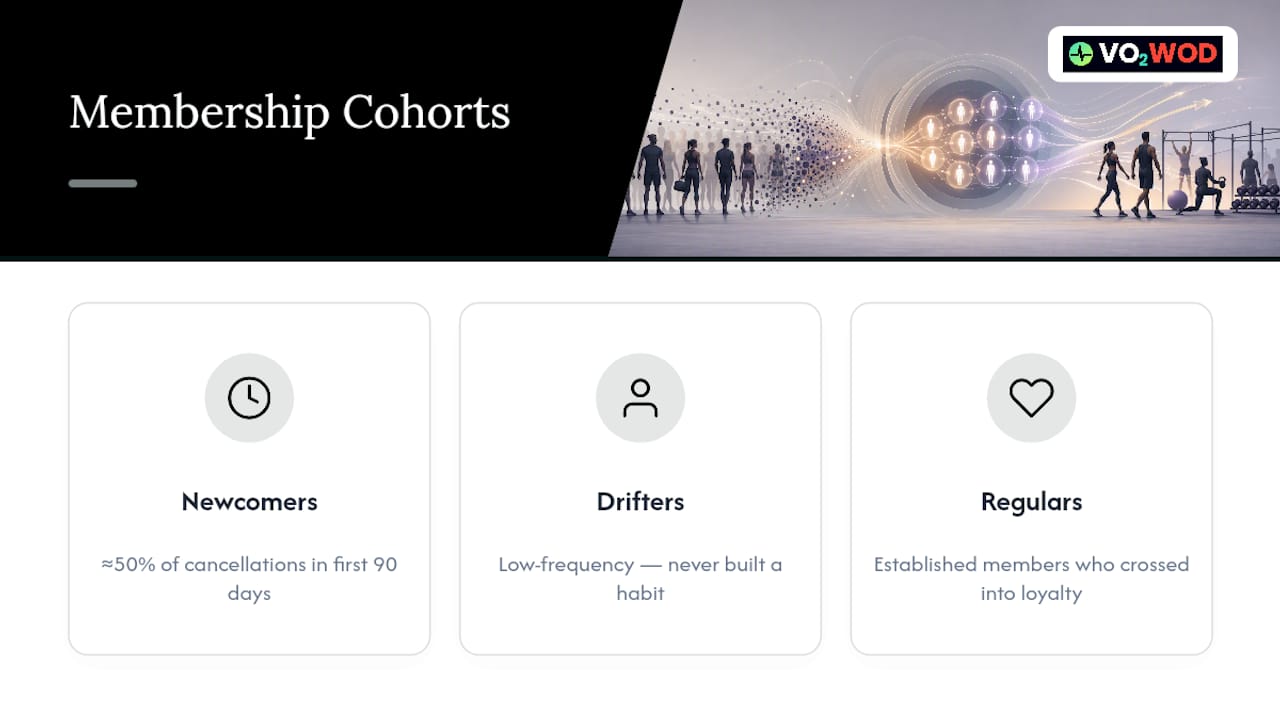
The implication is blunt: an intervention in week two is worth ten interventions in month eight. If you're only building win-back campaigns for members who've already gone quiet, you're solving the wrong end of the timeline.
Why Do Gym Members Actually Cancel?
Members rarely quit for one clean reason. The pattern usually traces to a handful of recurring factors affecting gym loyalty:
- No visible progress. Members who can't see or feel improvement lose motivation fast, especially without a coach flagging wins along the way.
- Weak onboarding. A member handed a fob and a class schedule with no orientation rarely builds the habit that keeps them paying.
- Scheduling friction. Overbooked classes, long waitlists, or a schedule that doesn't match their work hours push people out quietly.
- Price versus perceived value. A $180 monthly membership feels fine when someone's using it four times a week and painful when they're using it once.
- Life disruption. Moves, injuries, new jobs, and new babies account for a real share of cancellations that have nothing to do with the gym itself.
- Failed payments. A significant share of recorded cancellations aren't decisions at all. They're expired cards and declined charges that never got resolved.
That last one deserves its own section, because it's the easiest to fix and the one owners most often ignore.
Are You Measuring Voluntary and Involuntary Churn Separately?
Lumping every cancellation into one churn number hides your biggest quick win. Industry estimates suggest roughly 30% to 40% of raw cancellations trace back to payment failures rather than a member choosing to leave. That's involuntary churn, and it's recoverable in a way voluntary churn never is.
- Tag every cancellation as voluntary or involuntary at the point it's recorded, not after the fact.
- Audit your CRM for members marked "canceled" who actually just had a card decline with no follow-up attempt.
- Build a dunning sequence: automated retry on failed charges, then an email, then a text, then a personal call if the card still hasn't updated after a week.
- Reconcile your payment processor's failed-transaction report against your member management system monthly, not quarterly.
Pro Tip: Run your last six months of "canceled" members through your payment processor's decline log before you report a churn number to your investors or partners. Most owners find their real voluntary churn is lower than they thought, and their involuntary churn is a fixable revenue leak sitting in plain sight.
Which Members Are Most Likely to Churn Next?
Attendance frequency and consistency predict churn far better than surveys asking members how satisfied they feel. Behavioral segmentation research found that low-attendance segments churn at close to double the rate of the broader membership population, which means the data you already have in your check-in logs is more useful than a feedback form.
Three practical segments cover most gyms:
- Dissatisfied casuals: low attendance, high risk, usually gone within 60 days without intervention.
- Enthusiastic absentees: members who loved onboarding but whose visits have quietly dropped off. Watch for two or more missed weeks in a row.
- Dedicated reliables: consistent 3+ visits a week, the lowest-risk group, and your best source of referrals.
You don't need machine learning to act on this.
What Actually Reduces Gym Member Turnover?
Ranked by impact and effort, here's where to spend your time:
- Fix dunning first. Recovering failed payments is the single lowest-effort, highest-return move on this list because it doesn't require changing anyone's experience, only your billing process.
- Build structured onboarding. A defined 90-day path with milestones beats a friendly hello at the front desk every time.
- Automate booking reminders. A text 24 hours before class and another two hours before cuts no-shows, and no-shows are often the first sign of drift toward canceling.
- Create small-group accountability. Cohorts of 6 to 10 members who start together and check in with each other retain longer than members who train alone.
- Manage capacity with waitlists, not overbooking. A member who can never get into their preferred class time will find a gym that lets them.
- Run targeted re-engagement flows. A message to someone who hasn't checked in for 10 days needs different language than one for someone still in week two.
- Celebrate milestones publicly. First 10 classes, first personal record, one-year anniversary. Recognition costs nothing and reinforces why they joined.
Pro Tip: If you can only build one of these seven this quarter, build the automated no-show and drift alert. It catches the enthusiastic absentee cohort before they become a cancellation, which is a cheaper problem to solve than winning them back after they quit.
What Should a 0 to 90 Day Onboarding Plan Include?
The first 90 days deserve a specific plan, not a general policy. Break it into three phases:
- Days 1 to 30: a welcome call within 48 hours of joining, a guided intro session with a coach (not just a tour), and a short goal-setting conversation that gets documented somewhere you'll actually look at it again.
- Days 31 to 60: a progress check-in tied to whatever goal they set, an invite to a community event or group session, and a class recommendation based on their actual attendance pattern so far.
- Days 61 to 90: a retention-focused touch, whether that's a referral ask, a milestone celebration, or a renewal conversation before the decision point arrives on its own.
Space your touches roughly every 10 to 14 days across the window rather than front-loading everything into week one. Run small experiments as you go: test a phone call against a text message for the day-2 welcome, or compare a group intro session against a 1:1 session for onboarding completion rates. Track which version keeps more members past day 90, and keep the winner.
What KPIs Should a Gym Retention Dashboard Track?
Four numbers belong at the top of every gym's dashboard: monthly churn rate, annual retention, 90-day attrition rate for new joins, and involuntary churn as a percentage of total cancellations. Below those, track average visits per member per month, booking-to-attendance conversion, and no-show rate, since all three tend to move before a cancellation happens.
- Set an alert threshold: if a member's 30-day visit count drops by half compared to their own trailing average, flag them for outreach.
- Set a second threshold on involuntary churn: if it climbs above 30% of total cancellations, your dunning process needs attention immediately.
- Update attendance and payment data weekly at minimum; monthly reviews miss the drift patterns that matter most.
- Assign dashboard ownership to one person, whether that's the owner or a retention-focused manager, so metrics don't quietly go unwatched.
A Measurement-First Take on Retention
Most retention advice in this industry skips straight to tactics: run a challenge, throw a party, send a birthday email. None of that works if you can't tell voluntary churn from a declined card, or if you don't know which members are drifting before they've already decided to leave.
The gyms that move their numbers fastest are the ones that fix measurement before they touch programming. Split your churn, flag your risk cohorts, and build a well-structured 90-day onboarding path deliberately. Everything else is optimization on top of a foundation that either exists or doesn't.
— Marcus
How VO2WOD Supports the Playbook in This Guide
Every tactic above depends on data you can actually see: who's attending, who's drifting, and whose payment just failed. Vo2wod was built for functional fitness gyms specifically, tracking real-time attendance and heart rate data during class so you're not reconstructing attendance patterns from a sign-in sheet after the fact.

The platform also handles membership billing and payment recovery, addressing involuntary churn hidden in unresolved failed charges. If you're currently juggling a separate CRM, a separate scheduling tool, and a spreadsheet for attendance, Vo2wod consolidates that into one system built around gym operations rather than generic subscription management. Switching platforms is the usual friction point, so the platform includes free data migration and a complimentary trial period to cover the transition, plus a dedicated support team for setup. If you're weighing this against what you're using now, the feature comparison page breaks down how it stacks up. Book a demo to see your own attendance and payment data mapped onto the dashboard fields covered in this guide.
Sources
This guide draws on the HFA 2025 benchmarking report, behavioral segmentation research on fitness center churn, membership churn benchmarks from Churnkey, and fitness studio retention statistics from Regulr. For attendance and check-in tracking outside functional fitness formats, KWOON's club management tools cover a similar approach for martial arts studios.
- Who churns from fitness centres? Evidence from behavioural and attitudinal segmentation
- Gym retention rate benchmarks 2026: The number, methodology — Nutripy
- Membership churn: benchmarks, calculator and best practices to improve churn — Churnkey
- Fitness Studio Member Retention: Key Stats (2026) | Regulr Blog
FAQ
What Percentage of Gym Members Quit Each Year?
Based on the HFA's 2025 industry benchmark, roughly 33.6% of gym members cancel annually, since average retention sits at 66.4%. That figure varies by format, with budget clubs often running higher and boutique studios often running lower.
What Does a 20% Churn Rate Mean for a Gym?
If a high churn percentage is measured monthly instead of annually, it signals a serious problem, since even moderate monthly churn compounds to a large annual attrition.
Is $40 a Month a Lot to Pay for a Gym?
$40 a month typically sits below the national average for full-service gyms and is considered reasonable for a standard membership without added coaching or specialty programming. Whether it feels expensive to a member depends far more on how often they use it than on the price itself, since underused memberships are the ones most likely to get canceled regardless of cost.
Is the Gym Industry Profitable?
The gym industry is profitable overall, but margins depend heavily on how well a facility controls churn, since acquiring a new member typically costs far more than retaining an existing one. Gyms that separate voluntary from involuntary churn and fix payment recovery tend to see the fastest profitability gains without adding new marketing spend.
How Do I Reduce Gym Member Turnover Fastest?
The fastest wins come from fixing involuntary churn through improved payment recovery and building a structured 90-day onboarding path, addressing the early window when many cancellations occur. Tools like Vo2wod that combine attendance tracking with billing and dunning in one system make both of those fixes easier to execute consistently.