

Price your memberships from the fixed-cost floor first, then package outcomes into three or four tiers. That's the whole rule. The immediate move, before you touch a single number, is turning on automated recurring billing and dunning in your management software, because manual billing is where gyms bleed revenue nobody notices.
Before you set or change a price, check three numbers:
- Your total monthly fixed cost (rent, payroll, software, insurance, equipment)
- A realistic, sustainable member count, not your best month ever
- Your current churn rate or payment failure rate
Pro Tip: If you don't know your payment failure rate off the top of your head, that's your answer. Go find it before you do anything else.
Key Takeaways
Defensible gym membership pricing starts at the fixed-cost floor, earns its premium through tiered outcomes, and only holds up long term when billing automation and dunning are running from day one.
| Point | Details |
|---|---|
| Calculate the floor first | Divide monthly fixed costs by a realistic average member count, then add your target margin. |
| Build three to four tiers | Sell outcomes like onboarding and coaching, not just access, to justify each price jump. |
| Automate recurring billing | Separate promo and initiation fees as distinct line items so reporting stays accurate. |
| Run a structured dunning sequence | Combine email, SMS, retries, and staff outreach before freezing access, never immediate cancellation. |
| Review pricing annually | Test small increases with cohort tracking on churn, conversion, and lifetime value before scaling changes. |
| Match software to the strategy | Vo2wod supports tiered billing, dunning automation, and member self-service, with free migration and a month of complimentary service for gyms switching systems. |
Table of Contents
- How Do You Calculate Gym Membership Pricing From Your Cost Floor?
- How Should You Structure Gym Membership Tiers?
- What's the Best Recurring Billing Setup for Gyms?
- How Do You Recover Failed Payments Before Losing the Member?
- How Often Should You Review and Test Gym Pricing?
- Which Software Features Actually Protect Gym Membership Revenue?
- What's the Checklist for Rolling Out New Gym Pricing?
- How Do You Benchmark Gym Membership Pricing Against Competitors?
- Do Charm Pricing and Decoy Tiers Actually Work for Gyms?
- How Do Discounts and Promotions Affect Gym Revenue Long Term?
- What Legal and Regulatory Rules Affect Gym Billing?
- Should Gym Pricing Change by Season or Member Demographic?
- Do Contract Commitments Beat Month-to-Month Memberships?
- Get Your Gym's Billing and Pricing Running on Vo2wod
- Frequently Asked Questions
- Sources
How Do You Calculate Gym Membership Pricing From Your Cost Floor?
Your price floor is the minimum you can charge and still run the business. Below it, you're subsidizing memberships out of your own pocket. Above it, everything is margin and positioning.
Start by listing every mandatory fixed cost: rent, payroll, your management software subscription, insurance, equipment replacement reserves, and utilities. Skip variable costs like one-off marketing pushes. Those get layered in later.
Then divide by a realistic average membership count, not peak capacity. A 200-capacity gym that averages fewer members needs to price based on that realistic average, not peak capacity. Pricing off your best month sets you up to lose money in your average month.
The formula:
- Add up monthly fixed costs
- Divide by realistic average member count
- Add your target margin (most operators aim for 20 to 35 percent)
- That's your base price
Example: a boutique studio with $18,000 in monthly fixed costs and 140 average members has a floor of about $128.50 per member. Add a 25 percent margin and the base tier should land near $160 to $165.
How Should You Structure Gym Membership Tiers?
A few tiers—generally three to four—tend to balance revenue and member decision-making effectively, as demonstrated in EmpowerFit Women's workout and recovery approaches. Fewer, and you leave money on the table from members who'd pay more for more. More than four, and prospects freeze up trying to compare options. Tiered pricing built around distinct member needs, rather than arbitrary feature bundles, converts better and retains longer.
A structure that works for most functional fitness gyms:
- Access tier: open gym hours, class booking, basic app access
- Standard tier: adds an onboarding session and a quarterly progress review
- Premium tier: adds small-group coaching and priority class booking
- Concierge tier (optional): 1:1 programming, direct coach access, guest passes
Each price jump needs a deliverable a member can point to. Onboarding sessions, measurable progress checks, and small-group coaching are the standard justifications. Selling outcomes instead of bare access is what makes a $220 tier feel cheap next to a $140 tier.
When migrating existing members to new tiers, grandfather current pricing for 60 to 90 days and communicate the value gap before the price gap. Resist adding low-use perks like merchandise discounts or occasional guest passes as tier differentiators. They dilute the pitch without moving revenue.
Pro Tip: If a perk shows up in less than 15 percent of member usage data, cut it from the tier description. Nobody upgrades for a benefit they'll never touch.
What's the Best Recurring Billing Setup for Gyms?
Monthly billing keeps cash flow steady and lets members leave without a big financial commitment, which sounds risky but usually improves member trust and referrals. Prepaid annual plans improve upfront cash flow and tend to reduce churn since members have already committed, but they concentrate your renewal risk into one date instead of spreading it across twelve.
Most gyms run both: monthly as the default, annual as a discounted alternative for members who want to lock in.
On payment methods, accept cards and ACH transfers at minimum, and consider digital wallets for younger demographics. ACH often cuts processing fees compared to card transactions, which matters at scale. Subscription-aware billing platforms handle this better than generic payment processors built for one-time transactions.
Keep promotions and initiation fees as separate line items in your billing catalog instead of folding them into the monthly rate. This keeps your reporting clean when you need to see true recurring revenue versus one-time fees.
| Billing element | Recommended setup |
|---|---|
| Default cadence | Monthly, with annual as an opt-in discount |
| Payment methods | Cards, ACH, digital wallets |
| Promo pricing | Separate line item, auto-expires |
| Initiation fee | Separate line item, one-time |
| Freeze/hold | Automated request, capped duration, auto-notify |
Freezes and holds should be self-service where possible, capped at a set duration (30 to 90 days is typical), and automated to notify both the member and your front desk when a freeze starts and ends.
How Do You Recover Failed Payments Before Losing the Member?
Involuntary churn, meaning a card expires or a payment simply fails, is often larger than voluntary cancellations, and it's the easiest kind of churn to fix because the member never actually decided to leave.
A dunning sequence that works:
- Day 0: automatic retry plus an email notification of the failed charge
- Day 2 to 3: SMS reminder with a self-service update link
- Day 5 to 7: second automated retry, timed to typical payroll or benefit deposit dates
- Day 8 to 10: staff outreach call or personal message
- Day 12 to 14: access freeze (not cancellation) paired with an empathetic message
Use an automated card updater service so expired cards refresh without member action. Structured retry logic and automated recovery tools recover a meaningful share of payments that would otherwise become full cancellations. Freezing access, rather than canceling outright, creates urgency without burning the relationship, and it gives your staff time to intervene.
Pro Tip: Document every dunning step in your system notes. If a member disputes a charge later, a timestamped record of attempted retries and outreach is your best defense.
How Often Should You Review and Test Gym Pricing?
Review pricing at least once a year, and prefer small, incremental increases to large sudden changes. Small percentage adjustments often go unnoticed, while large jumps risk member cancellations and dissatisfaction.
Test changes carefully:
- Raise prices for new sign-ups first, and grandfather existing members for a defined window
- Roll out added value (a new class format, extended hours) before or alongside a price increase, not after
- Track conversion rate, churn by cohort, lifetime value, and engagement shifts for at least 60 to 90 days before drawing conclusions
- Segment your data by join date so a price change doesn't get muddled with normal seasonal churn
Small sample sizes mislead you. If your gym has 150 members, wait for a full billing cycle across the whole base before deciding a price change worked or flopped.
Which Software Features Actually Protect Gym Membership Revenue?
Pricing strategy dies in a spreadsheet if your billing software can't execute it. The features that matter operationally:
- Product catalog setup with separate line items for base tiers, promotions, and initiation fees
- Recurring billing configured by cadence (monthly, annual) per tier
- Automated dunning rules with configurable retry timing
- Card updater integration so expired payment methods refresh automatically
- Member self-service portal for updating payment info, requesting freezes, and viewing invoices
- Reporting dashboards that tie billing data to churn and engagement, not just revenue totals
Platforms built specifically for automated gym billing handle promo-to-full-price transitions and freeze automation without manual spreadsheet work, which is where most billing errors originate.
Vo2wod builds these into its core setup for functional fitness gyms, and pairs it with free data migration and one month of complimentary service when you switch, which removes most of the operational friction owners worry about when changing systems. Wearable integration (Garmin, Apple, Fitbit, Samsung) is optional but useful if your premium tiers include performance tracking as a deliverable.
Pro Tip: Set up your promo line items to auto-expire into full price. If that step is manual, someone eventually forgets, and you either undercharge for months or blindside a member with a jump they didn't expect.
What's the Checklist for Rolling Out New Gym Pricing?
Work through this in order, ideally over one week:
- Calculate your fixed-cost floor and set a defensible base price
- Design three or four tiers with clear, specific deliverables at each level
- Configure products, billing cadence, and payment methods in your software
- Enable dunning automation, retry logic, and freeze rules
- Draft member communication explaining any changes, sent at least 30 days ahead
- Schedule your next pricing review on the calendar now, not "sometime next year"
How Do You Benchmark Gym Membership Pricing Against Competitors?
Competitive benchmarking tells you where the market ceiling sits, not what you should charge. Those are different questions, and confusing them is how gyms underprice themselves into a margin crisis.
Start by mapping three to five direct competitors within your service radius, meaning studios or gyms targeting a similar member profile, not every fitness business within driving distance. A CrossFit affiliate shouldn't benchmark against a $20 big-box membership; different value propositions, different buyers.
Collect their tier structure, not just their headline price. A competitor advertising $150 a month might include unlimited classes and open gym, while your $150 tier includes four classes weekly. Compare apples to apples on what's actually delivered.
Use benchmarking to answer two things: are you dramatically underpriced for comparable value, and is there a service gap (like small-group coaching or recovery amenities) nobody nearby offers that justifies a premium? Gyms that discover they're 20 to 30 percent under market for equivalent coaching depth usually have room to raise prices with minimal churn risk.
Revisit competitive positioning during your annual pricing review, not more often. Reactive price matching every time a competitor runs a promotion trains members to wait for deals and erodes your pricing authority over time.
Do Charm Pricing and Decoy Tiers Actually Work for Gyms?
Charm pricing, ending a price at $149 instead of $150, has a measurable if modest effect on perceived value, mostly because the eye reads the leftmost digit first and registers "one-something" rather than "one-fifty." It works better on lower-commitment purchases than on recurring memberships, where members do the math eventually. Still, for a base access tier or a first-month promotional rate, shaving that last dollar off costs nothing and rarely hurts.
Decoy pricing is the more useful lever for gyms. This means deliberately pricing your middle tier close enough to your premium tier that the premium looks like the obvious upgrade. If your standard tier is $175 and premium is $195, the $20 gap for coaching and priority booking looks trivial next to the base tier's $95. Most members will stretch for the twenty when the alternative comparison makes it look free.
The decoy only works if the middle tier's value is genuinely thinner than the jump suggests. If members feel tricked into premium, you'll see it in churn within 90 days. Anchor your top tier's price by listing it first on your pricing page or intake conversation, then let the lower tiers look like savings rather than compromises. This is a real technique with real limits. It nudges a decision that's already close; it won't sell $220 concierge programming to someone who came in comparing $80 gym rates.
How Do Discounts and Promotions Affect Gym Revenue Long Term?
A discount that gets someone through the door and a discount that trains someone to never pay full price are the same mechanism with opposite outcomes, and the difference is almost entirely in how you structure the expiration.
Time-boxed promotions, like a discounted first two months, work because they create urgency and a clear endpoint. Set the promo as its own line item in your billing catalog so it auto-expires into the full rate without staff intervention. Ongoing or repeatable discounts, like referral credits that stack indefinitely, tend to erode your average revenue per member over time even as your total membership count grows.
Perceived value drops fastest with percentage-off language repeated too often. A member who's seen "20% off" advertised three times in six months starts assuming the real price is the discounted one, and the full rate starts to feel like a penalty rather than the baseline. Flat promotional pricing framed around a specific outcome ("first month includes a full assessment and program design") holds perceived value better than a generic percentage cut.
Track discount usage against churn cohorts. Gyms that discount aggressively to acquire members often see those same members churn faster once the promo ends, because the relationship was built on price rather than the coaching or community experience. Reserve deep discounts for slow enrollment periods and keep the standard rate visible everywhere else.
What Legal and Regulatory Rules Affect Gym Billing?
Membership contracts and recurring billing fall under consumer protection rules that vary by state, and several states specifically regulate health club and gym contracts, including cancellation rights, cooling-off periods, and required disclosures before a member signs. Some states mandate a written contract with specific cancellation terms spelled out, including notice periods and refund conditions for prepaid annual memberships.
Card-on-file recurring billing also intersects with payment network rules. Card networks require clear disclosure of recurring charge terms at signup, and mishandling this (auto-renewing a promo into a higher rate without adequate notice, for instance) is a common source of chargebacks and disputes. Transparent billing terms disclosed at signup reduce dispute rates significantly compared to vague or buried terms.
None of this is a substitute for reviewing your specific state's health club statutes and your payment processor's card network agreements with a qualified professional before finalizing contract language. But operationally, the practical fix is the same regardless of jurisdiction: keep cancellation terms, promo expiration dates, and freeze policies in writing, disclosed at signup, and stored in your billing system where you can retrieve them if a member disputes a charge.
Should Gym Pricing Change by Season or Member Demographic?
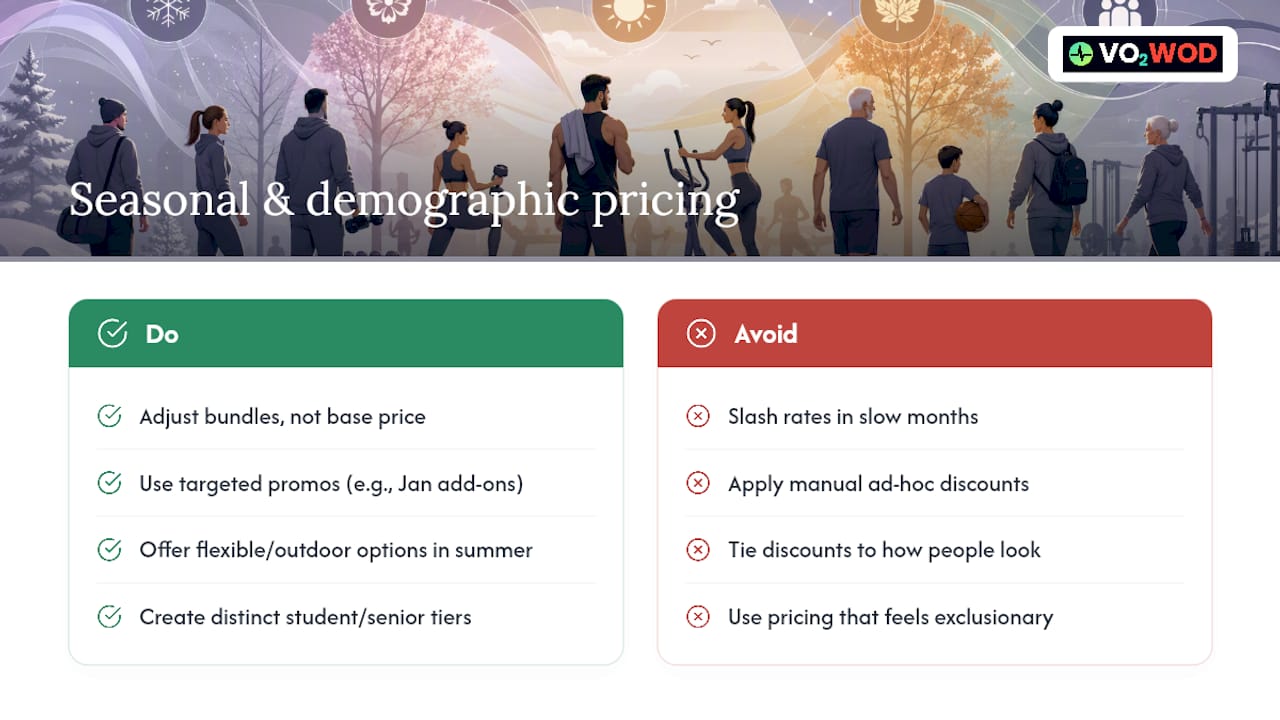
Seasonal demand for gyms is real and predictable: January enrollment spikes, summer often dips outside of outdoor-adjacent programming, and back-to-school season brings a secondary bump. Pricing around this doesn't mean slashing rates in slow months. It means adjusting what's bundled.
A January promotion that includes a free assessment and goal-setting session converts better than a flat percentage discount, because it addresses the actual motivation (New Year goals) rather than just lowering the number. Summer retention often benefits more from flexible scheduling options or outdoor/hybrid class formats than from a price cut.
Demographic pricing needs more care. Student and senior discounts are common and generally well accepted, but structure them as a distinct tier with its own line item rather than an ad hoc discount applied manually, so your reporting stays accurate and the policy is consistent across every front desk interaction. Corporate or group rates for employers sending multiple employees work well as a separate tier with a minimum headcount requirement, since that protects your per-member margin while still winning volume.
Avoid demographic pricing that could read as exclusionary rather than accessibility-driven. A senior or student discount tied to verifiable status is standard practice; informal "if you look like you need a deal" pricing invites both revenue leakage and fairness complaints from other members paying full rate.
Do Contract Commitments Beat Month-to-Month Memberships?
Twelve-month commitments and flexible month-to-month plans solve different problems, and the mistake most gyms make is picking one and applying it to every member instead of matching it to member intent.
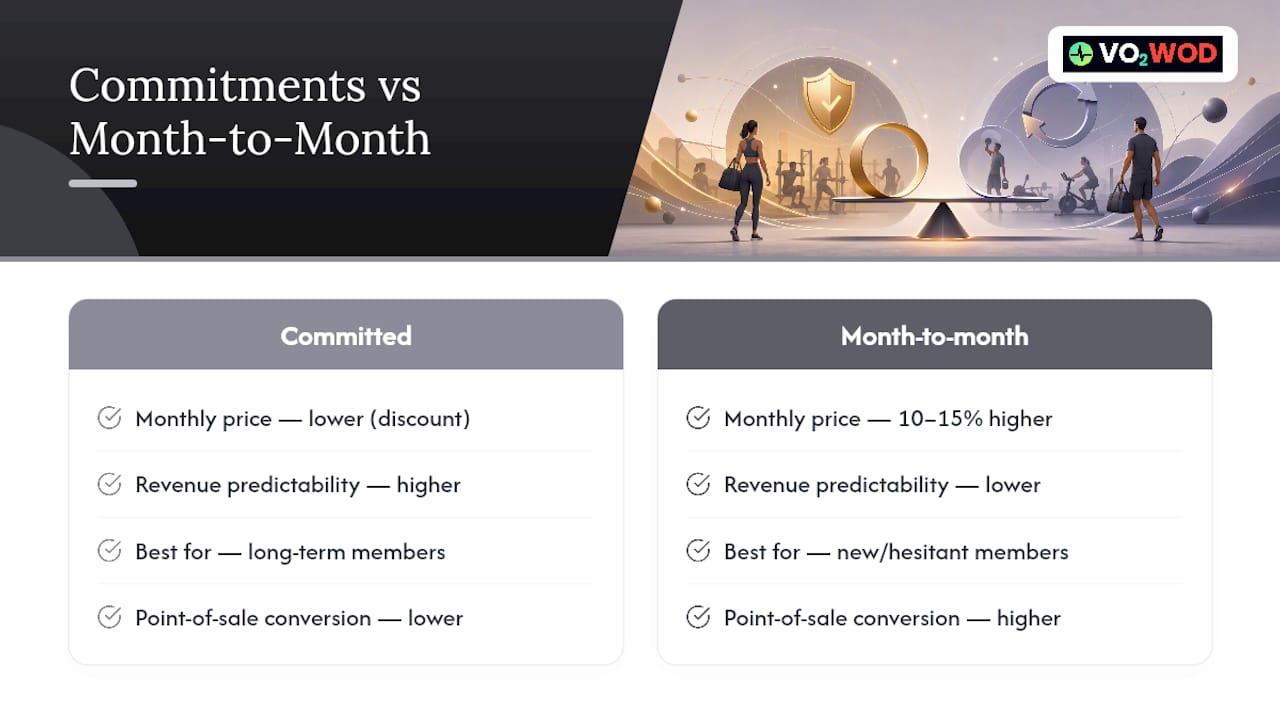
Committed terms (six or twelve months) improve revenue predictability and typically come with a lower monthly rate as the trade-off, since the member is accepting more risk in exchange for a discount. They work well for members who've already decided fitness is a long-term habit, not something they're testing.
Flexible month-to-month pricing removes the biggest objection for new or hesitant members, and it tends to convert better at the point of sale because there's no long-term risk to weigh. The trade-off shows up later: month-to-month members churn faster on average, since nothing structurally prevents them from leaving after a bad month or a scheduling conflict.
The stronger approach for most functional fitness gyms is offering both, priced to reflect the actual trade-off. Price the month-to-month option 10 to 15 percent above the committed rate, framed not as a penalty but as the cost of flexibility. This lets members self-select based on their real commitment level rather than you guessing wrong for the whole membership base. Track churn separately by commitment type. If your month-to-month churn is dramatically higher, that's a sign to build stronger onboarding for that group specifically, since they're the ones most likely to leave before the habit sticks.
A note on why this matters more than it looks
Pricing and billing decisions aren't back-office details. They're the mechanism that turns member effort into retention and revenue you can actually forecast. Get the cost floor wrong, or leave dunning to chance, and no tier design fixes it.
Get Your Gym's Billing and Pricing Running on Vo2wod
Everything in this guide, tiered pricing, automated dunning, freeze policies, clean reporting, only works if your software actually executes it without daily manual babysitting. That's the gap Vo2wod closes for functional fitness gyms specifically. It handles recurring billing by tier and cadence, runs dunning sequences automatically, gives members a self-service portal for updating cards and requesting freezes, and ties billing data to real engagement metrics like class attendance and heart rate performance, so you see churn risk before it shows up as a canceled membership.

Switching systems is usually the excuse gyms use to delay fixing their billing setup. Vo2wod removes that excuse with free data migration, one month of complimentary service, and a dedicated support team for the transition. If you're weighing Vo2wod against other functional fitness gym platforms, that comparison page breaks down the differences directly, and you can see the full migration and support offer before deciding. Book a walkthrough and see your current pricing structure mapped into the platform before you commit to anything.
Frequently Asked Questions
What's a fair starting point for gym membership pricing?
Start from your fixed-cost floor, not a competitor's rate card. Divide total monthly fixed costs by a realistic average member count, add a 20 to 35 percent margin, and that's your defensible base tier before any positioning or packaging.
How many pricing tiers should a gym offer?
Three or four. Fewer leaves revenue on the table from members willing to pay for more; more creates decision fatigue and slows sign-ups at the front desk.
How often should gyms review membership pricing?
At least once a year, using small, incremental adjustments rather than large jumps. Track churn and conversion by cohort for 60 to 90 days after any change before deciding it worked.
What should a gym's dunning sequence include?
An automated retry, an email notice, an SMS follow-up, a second retry timed to typical pay dates, and staff outreach before freezing access. Cancellation should be the last step, not the first response to a failed charge.
Does gym management software actually reduce billing errors?
Yes, when it's built for subscription billing rather than one-time transactions. Automated dunning, card updaters, and separate line items for promos and fees eliminate most of the manual errors that come from spreadsheet-based billing.
Sources
- Gym Membership Pricing Strategy: Your 2026 Profit Guide — Gym Membership Tips
- Using an Automated Billing System for Gyms: A Complete Guide — FitnessPaymentServices