

Run a 28-30 day attendance streak or a team points challenge first. Both formats convert casual members into regulars, capture new leads through referral entries, and create a clean revenue path once you layer in an entry fee or premium tier. Track attendance and scores in a spreadsheet if you're just starting, or automate the whole thing with a platform like Vo2wod so leaderboards update themselves and your staff isn't buried in manual entry.
TL;DR:
- Attendance streak challenges are the easiest to run and automate, with high sign-up rates and low barriers, especially when lasting 28 to 30 days.
- Team points relays and small group challenges improve follow-through through social accountability and can be scaled with simple tools like spreadsheets or platforms like Vo2wod.
- Longer-term transformation and body composition challenges generate significant revenue but require premium pricing, coaching, and measurement components.
- Automated tracking tools that sync with wearables and provide real-time leaderboards significantly increase engagement and completion rates compared to manual methods.
- Promoting challenges two weeks in advance and tying completion to a clear next offer sharply improves long-term membership retention and revenue.
Table of Contents
- Gym Challenge Ideas: 12 Templates You Can Launch This Month
- How to Design and Run a Successful Gym Challenge
- Tracking, Automation, and Tech Options for Gym Challenges
- Promoting Your Challenge and Converting Finishers Into Long-Term Members
- A Live-Tracking Example: How Hybrid Challenges Run on Vo2wod
- The Real Skill Isn't the Challenge Idea, It's the Follow-Through
- Sources
Gym Challenge Ideas: 12 Templates You Can Launch This Month
Every one of these gym challenge ideas below solves a different problem: some build habits, some drive revenue, some just get people talking about your gym online. Pick the ones that match what you actually need right now, not what looks impressive on a flyer.
1. Attendance Streak Challenge (28 Days)
This is the easiest challenge to run and the one with the broadest appeal. Members check in daily or hit a minimum of 20 out of 28 days, and you track it on a visible board or app leaderboard. Set the threshold low enough that a busy member can realistically hit it. Charge a small entry fee that funds a prize pool, or run it free as a pure retention play during a slow month. Attendance-based formats in the 21 to 30 day range are the easiest challenge type to automate and consistently pull the highest sign-up numbers because the barrier to entry is just showing up.
2. Team Points Relay
Split your gym into teams of four to six people, mixed by skill level so nobody's team is stacked. Score points for visits, personal records, and trying a new class format, then post team totals weekly. Team challenges beat solo formats on both sign-up numbers and completion because social accountability inside a small group materially improves follow-through. A member who skips leg day still shows up because their teammates are counting on them.
3. 30-Day Habit Challenge
Pick one daily task. Ten minutes of mobility work, a glass of water before coffee, a single set of push-ups logged in the app. The point isn't intensity, it's repetition. Completion criteria should be simple: check a box, snap a photo, tap a button. This works well as a low-stakes on-ramp for new members who aren't ready for a full transformation program yet.
4. 6-to-8 Week Body Composition Transformation
This is your premium offer. Take baseline measurements (weight, body fat estimate, progress photos, a few key lifts), run a mid-point check-in at week three or four, and finish with a final assessment and a small celebration. Price it in a premium range when it includes coaching check-ins, nutrition guidance, and measurement sessions. Transformation programs in that range are consistently the top revenue generator among challenge formats because members are paying for structure and accountability they can't get from a free app.
5. PR & Strength Progression Challenge
Focus on the big three: bench, squat, deadlift. Members log a verified starting number in week one (a coach has to witness it, no self-reported maxes) and attempt a new max in the final week under the same conditions. Build in a mandatory deload week around the midpoint so people aren't grinding max attempts for six straight weeks. Require a spotter or coach sign-off on every attempt, and disqualify any lift performed with visibly compromised form. Safety here isn't optional. A pulled back three weeks into a strength challenge kills your completion rate and your member's trust.
6. Skills Progression Challenge
Pull-ups, handstand holds, mobility benchmarks, whatever skill your membership base is chasing. Break the skill into three or four checkpoints (band-assisted pull-up, jumping pull-up, strict pull-up, for example) and have a coach verify each checkpoint in person. This gives members a visible ladder to climb instead of a single pass/fail outcome, which keeps people engaged even if they don't reach the top rung by the deadline.

7. Virtual or Hybrid Challenge
Not every member trains in your building every day. A hybrid format lets people log home workouts, runs, or wearable data alongside in-gym sessions. Verification can be as simple as a wearable sync or a photo of a completed home workout log. Hybrid formats that accept verified home training expand your addressable participant pool and keep traveling or remote members from going dark during the challenge window.
8. Charity or Fundraising Challenge
Tie a fitness metric (total miles run, total pounds lifted collectively, total classes attended) to a donation amount, either flat per member or matched by the gym per milestone hit. Promote the cause heavily on social media in the two weeks before launch. These challenges tend to pull in members who wouldn't otherwise sign up for a competitive format, because the motivation is external rather than personal.
9. Nutrition Plus Fitness Combined Challenge
Layer a minimum nutrition tracking requirement (logging meals three days a week, or hitting a protein target daily) on top of an attendance or points structure. Partner with a local meal prep company or registered dietitian for a workshop during week one. Keep the nutrition component light. A challenge that demands perfect macros for 30 days will scare off half your sign-ups before it starts.
10. Social Media Content Challenge
Members post workout clips, before/after reflections, or "day in the life" content using a branded hashtag, and you feature the best ones on your gym's account. Get written photo/video consent upfront, ideally as a checkbox during challenge registration, so you're not scrambling for permission after someone's face is already on your feed. This format doubles as free marketing and works especially well stacked on top of a transformation or attendance challenge rather than run alone.
11. Micro-Challenges
A one-minute plank hold at the front desk. A lunchtime AMRAP posted on a whiteboard for anyone walking by. These take almost no setup and generate a steady stream of shareable content and low-pressure engagement between your bigger seasonal challenges. Micro-challenges are the connective tissue that keeps energy up during the weeks you're not running anything major.
12. Beginner-Friendly Low-Barrier Challenge
Set a deliberately low bar to encourage participation: a few visits per week, trying a new class, or setting a simple goal. Use tiered rewards so someone who hits the minimum still gets something (a shirt, a shake, a shoutout) while someone who exceeds it gets a bigger prize. This format exists specifically to catch new members before they fall off in month one, when attrition risk is highest.
How to Design and Run a Successful Gym Challenge
Before you pick a format, decide what problem you're actually solving. A challenge built to plug a leaky retention funnel looks different from one built to fill a slow Tuesday 10am class or generate leads for a new member drive. Write the objective down in one sentence before you touch a scoring sheet.
Duration matters more than most operators think. A 28 to 30 day window works for attendance, habit, and points-based challenges because it's long enough to build a routine but short enough to sustain motivation. Reserve 6 to 8 week windows for transformation programs where measurable body composition change actually needs that runway.
Pricing should match the value delivered:
- Low-touch challenges (attendance, habit, micro-challenges): $25 to $49 entry fee, no measurements required, funds a modest prize pool.
- Premium challenges (transformation, nutrition-combined): $99 to $199, includes baseline and follow-up measurements, coaching check-ins, and a structured program.
- Team challenges: price per team or per member, with a portion of fees rolled into a team prize like a group training session or gear.
Scoring should be simple enough that a member can calculate their own standing in their head. A common template: one point per gym visit, plus bonus points for trying a new class or hitting a personal record, capped at a daily maximum so nobody games the system by checking in five times a day. Set your minimum completion threshold around a realistic majority of total possible points. That's demanding enough to mean something but forgiving enough that a missed week doesn't torpedo someone's shot at finishing.
Assign roles before launch day. You need a challenge lead who owns communication and rule enforcement, a community moderator (often a coach) who keeps the energy up in your group chat or app feed, and front desk staff briefed on how to answer basic questions without pulling in the lead every time. The kickoff event and finale event are two separate responsibilities. One builds excitement and explains the rules in person; the other celebrates results and sets up your next offer.
Your onboarding checklist should cover baseline measurements (if relevant to the format), an accountability partner or team assignment, and an invite to the challenge's community group, whether that's a private app channel or a group chat. Draft a one-page rules sheet before launch. It should answer every question a confused member might ask on day three, because if it doesn't, that question lands in your inbox instead.
Pro Tip: Structure the first week of any multi-week challenge to be genuinely achievable, ramp difficulty in weeks two and three, then ease off slightly in the final week. This keeps completion rates high and gives you a wave of finishers with real testimonials right when you need them for your next launch.
Tracking, Automation, and Tech Options for Gym Challenges
At minimum, you need four things running: a reliable check-in system, a visible leaderboard, a manual entry fallback for when the tech hiccups, and a community channel where participants can see each other's progress. Skip any one of these and your challenge either falls apart operationally or dies from lack of visibility.
Automation is where most gyms leave value on the table. Manually logging scores and sending reminder emails for a 40-person challenge eats hours of staff time every week that could go toward coaching. Automating the campaign cuts that staff time dramatically while improving accuracy, and the recommended cadence is multiple personalized touchpoints across a typical month-long challenge, enough to keep people engaged without triggering unsubscribes.
What to prioritize when evaluating tracking tools:
- Wearable integration — Garmin, Apple, Fitbit, and Samsung sync eliminates manual data entry for heart rate and step-based metrics.
- Booking and payment integration — a challenge that requires a separate signup form from your existing membership system creates friction that costs you sign-ups.
- Leaderboard design that shows personal progress alongside public rank — public leaderboards raise overall engagement, but members near the bottom disengage faster unless they can also see their own week-over-week improvement.
- A vendor question worth asking directly: can this system automate my mid-challenge nudges, or am I sending those manually?
Small facilities without a dedicated software budget can still run a solid challenge with a shared spreadsheet, a whiteboard leaderboard, and a group text thread. It's more labor, but the core mechanics (visibility, accountability, a fallback for tech failures) matter more than the sophistication of the tool.
Promoting Your Challenge and Converting Finishers Into Long-Term Members
Start promoting two weeks before launch, not two days. Use a channel mix of email, social posts, and in-gym signage, with messaging hooks like "28 days, one habit, real results" rather than generic "join our challenge" copy.
- Weeks minus two and minus one: tease the format on social media, email your list, and post physical signage; offer a referral incentive (bring a friend, both get a discount on entry) to widen the funnel.
- Launch day: run a kickoff event that explains the rules in person and gets everyone into the community channel immediately.
- Week two or three: this is when you book one-on-one consults with participants who are showing strong engagement, while momentum and trust are highest.
- Final week: present your next offer (a membership upgrade, a nutrition program, a new challenge) with urgency, since tying challenge completion to a clear next step is what actually turns a challenge into revenue instead of just a fun month.
- Day plus one after the finale: follow up personally with every finisher, and separately with anyone who didn't complete, since that second group often just needs a nudge toward an easier format next time.
Track four numbers for every challenge you run: participation (sign-ups against your member base), completion rate, conversion rate into your next offer, and revenue generated per challenge. Those four numbers tell you whether to repeat the format or retire it.
A Live-Tracking Example: How Hybrid Challenges Run on Vo2wod
Manual scoring is the single biggest reason challenge staff burn out mid-month. A platform like Vo2wod removes that bottleneck by pulling heart rate data and workout results automatically, scoring them in real time, and posting them to a leaderboard without a coach touching a spreadsheet.
A typical automated sequence looks like this:
- Enrollment: member signs up, baseline data syncs from their wearable automatically.
- Day 0: welcome message with rules and community group invite.
- Mid-point: a nudge tailored to their current standing, encouraging or congratulating depending on progress.
- Final week: urgency messaging as the deadline approaches.
- Post-challenge: a follow-up tied to your next offer.
Small-group accountability structures like this lift completion rates from around 19% for solo participants to roughly 51% when paired with structured community support, and real-time visibility is a big part of what makes that group dynamic work. Gyms switching platforms also get free data migration, a full month of complimentary service, and dedicated onboarding support, which removes most of the friction that normally keeps operators stuck on an outdated system.
The Real Skill Isn't the Challenge Idea, It's the Follow-Through
Most gym owners spend their energy picking the perfect theme and almost none on the boring mechanics that determine whether people actually finish. That's backwards. A mediocre challenge idea with tight scoring, a real community channel, and consistent touchpoints will outperform a brilliant concept run with no structure behind it.
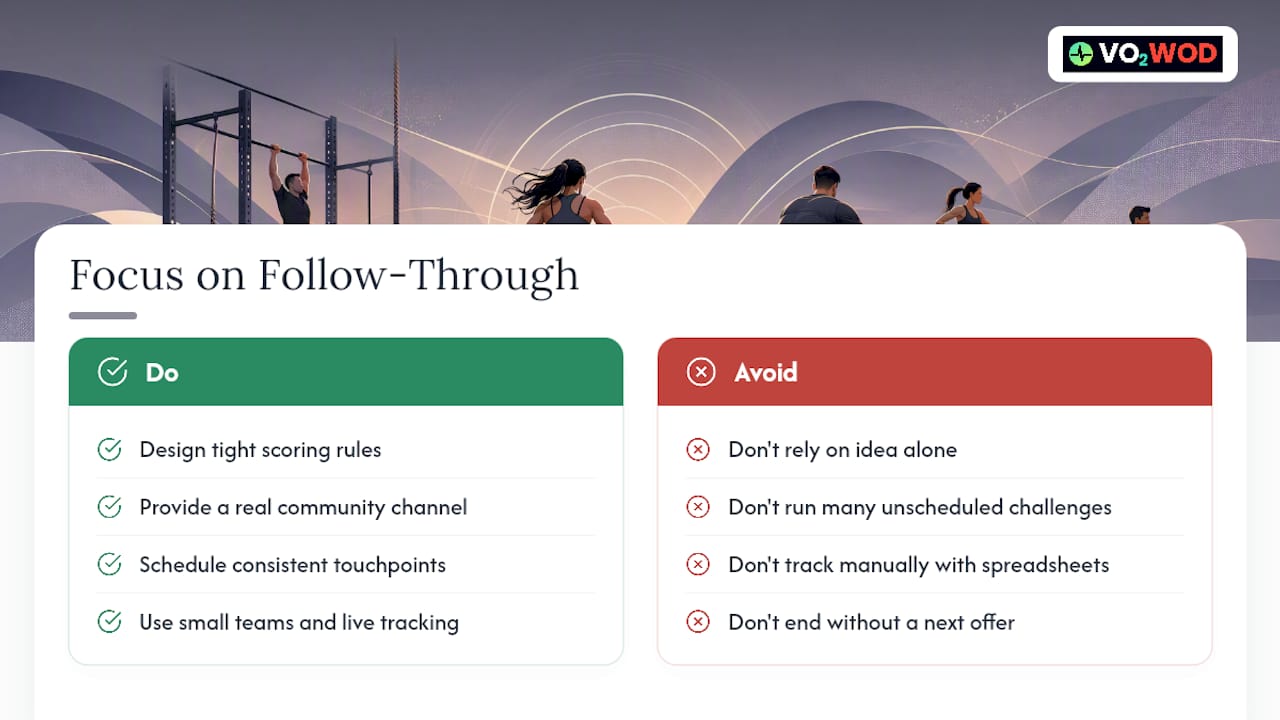
The conventional advice tells you to run more challenges. The better advice is to run fewer, staggered across the year, and automate the parts that burn out your staff. Completion rates hinge less on the format and more on whether someone besides the participant is paying attention to their progress. That's the whole argument for small teams over solo formats, and for live tracking over manual spreadsheets.
If you take one thing from this: build the conversion path before you build the leaderboard. A challenge that ends without a clear next offer is just a month of free entertainment for your members. A challenge that ends with a consult booked is a retention engine.
— Marcus
Sources
Before you launch, pull together three assets: a one-page rules template, a simple scoring sheet, and a 28-day communication calendar mapping out those 8 to 10 touchpoints.
- 30 Day Fitness Challenge Blueprint for Gyms
- How to Run Fitness Challenge Programs That Boost Revenue and Retention | StudioStackTools
- Automate Fitness Challenges for 2x Engagement Guide | US Tech Automations
- Organizing Fitness Challenges With Fun Ways To Keep Members Motivated | Snap Fitness