

Member segmentation groups members by shared behaviors, needs, and lifecycle stage so you can send communications that actually get opened, clicked, and acted on. Do it well and you can expect a real lift in engagement: effective segmentation raises email open rates by 20 to 30 percent because messages match what a specific group of people actually cares about right now. This guide skips the theory and gets you to testable segments fast.
- Segmentation is not just demographics. Behavior and lifecycle stage predict engagement better than age or job title.
- Every segment in this guide is built to trigger a specific action, not just a mailing list.
- You'll get starter segments, a build workflow, and the metrics to track once they're live.
Quick stat: Personalized, relevant content tied to real segments drives that 20 to 30 percent open rate increase most organizations see once they move past generic blasts.
Key Takeaways
Member segmentation works when segment rules are built on behavior and lifecycle stage, kept current through active lists, and reviewed on a fixed cadence.
| Point | Details |
|---|---|
| Lead with behavior, not demographics | Behavioral and psychographic signals predict engagement better than job title or age. |
| Expect a real open-rate lift | Relevant, segmented messaging can raise open rates by 20 to 30 percent over generic sends. |
| Use active lists, not static exports | Dynamic segments update automatically as behavior changes, avoiding stale targeting. |
| Start small and test | Three to five starter segments with clear KPIs beat launching a full taxonomy at once. |
| Build in compliance from day one | Capture explicit opt-in for behavioral and wearable data under GDPR and CCPA before it drives a segment. |
| Gym-specific behavior data needs the right platform | Vo2wod feeds live heart rate and workout-intensity signals directly into member segments, cutting the manual work of stitching data together. |
Table of Contents
- Why Member Segmentation Matters for Engagement and Retention
- What Are the Main Types of Member Segmentation?
- How Do You Build Actionable Member Segments?
- Which Starter Segments Should You Test First?
- What Infrastructure Do You Need to Scale Segmentation?
- How Do You Measure and Optimize Member Segments?
- Applying Segmentation Inside a Functional Fitness Gym
- Privacy and Compliance in Member Segmentation
- Common Segmentation Mistakes and How to Avoid Them
- How Segmentation Powers Personalization
- What Tools Support Member Segmentation?
- Sources
Why Member Segmentation Matters for Engagement and Retention
Untargeted email is a tax on your list. Every irrelevant message you send trains members to ignore the next one, and open rates drift downward over time. Segmentation reverses that. It's the difference between "here's our newsletter" and "here's the thing you specifically need to see before your renewal lapses."
The numbers back this up. Organizations that segment effectively see that same 20 to 30 percent lift in open rates, and the effect compounds: higher opens lead to higher click-through, which leads to more renewals and event sign-ups, because the content people see actually applies to them.
There's an operational payoff too, one that rarely makes the pitch deck. Fewer irrelevant sends means less list fatigue and fewer unsubscribes. Your marketing team spends less time writing one-size-fits-all copy and more time refining messages for groups that respond. And your data team stops fielding the same question every quarter: "why did engagement drop again?"
Segmentation done right also reallocates resources toward the members most likely to act:
- Higher retention. Members who get relevant renewal reminders and content stay longer.
- Better conversion. Targeted event or upgrade offers convert at higher rates than blanket promotions.
- Lower list fatigue. Fewer irrelevant messages mean fewer opt-outs and spam complaints.
- Smarter resource allocation. Staff time goes toward the segments most likely to respond, not toward blasting everyone equally.
What Are the Main Types of Member Segmentation?
Most organizations default to demographic segmentation because it's the easiest data to pull: age, job title, location, membership tier. It's a starting point, not a strategy. The four primary segmentation types are demographic, geographic, psychographic, and behavioral, and behavioral and psychographic signals are typically the ones that actually predict engagement.
Here's what each looks like in practice:
- Demographic segmentation groups by age, job title, income, or membership tier. Example: sending different renewal pricing to student members versus full professional members.
- Geographic segmentation groups by location, region, or time zone. Example: promoting a regional chapter event only to members within driving distance.
- Psychographic segmentation groups by values, interests, or motivations. Example: separating members who joined for networking from those who joined for continuing education credits.
- Behavioral segmentation groups by actions: attendance history, email engagement, purchase patterns. Example: flagging members who opened the last five emails but haven't logged into the member portal in 90 days.
Demographic-only segmentation has a real ceiling. Knowing someone's job title tells you almost nothing about whether they'll show up to your next event. As one critique of demographics-first segmentation puts it, convenience labels like postcode or title rarely explain why members actually engage or churn.
The strongest segments combine axes. "Behavior times tenure" is a good default: a member active for two years who suddenly stops opening emails behaves very differently than a brand-new member doing the same thing. One needs a win-back campaign; the other might just need a better welcome sequence.
How Do You Build Actionable Member Segments?
Building a segment that actually changes what you send, and to whom, takes more than a spreadsheet filter. Here's the workflow that holds up under real use:
- Inventory your data sources. Pull from your AMS or CRM, event attendance records, payment history, community platform activity, learning management data, and email engagement metrics. Most organizations already have this data; it's just scattered across five systems that don't talk to each other.
- Prioritize signals by predictive value. Rank sources by how well they predict the behavior you care about. Event attendance and email engagement usually outperform static profile fields.
- Write concrete segment rules. Instead of "engaged members," write "attended two or more events in the last 90 days AND opened the last three emails." Instead of "at risk," write "renewal due within 60 days AND has an overdue invoice AND zero logins in 30 days."
- Choose active lists over static lists. A static list is a snapshot; a member who joins the criteria next week never gets added, and one who leaves the criteria still gets the message. An active list recalculates automatically, so targeting stays current without manual rebuilds.
- Run the governance checklist before launch. Confirm identity resolution across systems (is "J. Smith" in your AMS the same person as "Jane Smith" in your event platform?), deduplicate records, assign an owner for segment upkeep, and verify privacy opt-in status for every channel you plan to use.
Pro Tip: Start with just two rule conditions per segment. A rule with five conditions looks precise on paper but usually returns a list too small to test meaningfully, and it breaks the first time one data source changes format.
Active lists matter more than they sound. A static export from three months ago is quietly wrong today: renewal dates have passed, new members have joined, and engagement scores have shifted. Unifying signals from events, payments, community platforms, and learning systems is what makes movement-based, always-current segmentation possible instead of a quarterly guessing game.
Which Starter Segments Should You Test First?
You don't need twenty segments on day one. Practical segmentation efforts that start with three to five segments and expand once the infrastructure holds up tend to outperform organizations that try to launch a full taxonomy at once. Try these first:
- New-onboard members (first 30 days): send a welcome series tied to first actions taken, not a generic "welcome to the community" blast. KPI: activation rate (first login, first event registration).
- Renewal cohorts (90/60/30 days out): escalate urgency and value framing as the renewal date approaches. KPI: renewal conversion rate by window.
- High-engagement advocates: members who open everything and attend regularly. Invite them into referral programs or advisory roles. KPI: referral rate.
- At-risk or lapsed members: low engagement plus an overdue invoice or missed renewal. Trigger a win-back offer or a personal outreach call. KPI: reactivation rate.
- Competency or skill tiers: based on certifications, course completions, or self-reported experience level. Route content by tier. KPI: content click-through by tier.
Give each test at least one full engagement cycle, typically 30 to 60 days, before you judge results, and don't launch a new segment on a list smaller than a few hundred members. Below that, normal variance will look like a trend.
What Infrastructure Do You Need to Scale Segmentation?
Segments only stay useful if the data behind them stays current. That starts with a unified member profile, one system acting as the source of truth for identity, so a change in one place doesn't create three conflicting versions of the same member elsewhere.
The most common failure mode is data silos. Segment activation typically breaks down when member data is scattered across disconnected systems, forcing teams to rely on manual exports that go stale within days. Fixing this means real integrations, not scheduled CSV dumps, between your AMS, email platform, and event or community tools.
Once data flows automatically, you can build real automation:
- Triggers that add or remove members from a segment the moment their behavior changes.
- Suppressions that stop overlapping campaigns from hitting the same person twice in one week.
- Next-best-action routing that decides, per member, whether the right next touch is an email, a call, or an in-app message.
Assign someone ownership of segment health, not just campaign execution, and review segment performance on a recurring cadence rather than only when something breaks.
How Do You Measure and Optimize Member Segments?
Segmentation isn't a one-time build. It's a loop: launch, measure, refine, repeat.
- Track the core KPIs. Open rate, click-through rate, conversion or renewal rate, retention/churn, and engagement depth (logins, event attendance, community activity) tell you whether a segment is actually working.
- Run real experiments. Use holdout groups so you can prove the segment caused the lift, not just correlated with it. Roll out changes incrementally, and watch for overlapping lists, if two segments target the same member with conflicting messages in the same week, your data will lie to you.
- Set a refresh cadence. Review campaign performance monthly and revisit segment definitions and rule logic quarterly, since member behavior and your data sources both shift over time.
The 20 to 30 percent open rate lift tied to good segmentation isn't a one-time bump. It erodes if segment rules go stale, which is exactly why the quarterly review matters as much as the initial build.
Applying Segmentation Inside a Functional Fitness Gym
Gyms generate behavioral data most industries would envy: attendance frequency, workout intensity, wearable heart rate, and class reservation patterns. A platform like VO2WOD captures these signals in real time through live monitoring and automatic workout scoring, giving gym owners something to segment on beyond just membership tier.
- High-effort regulars (consistent attendance plus strong intensity scores): invite them to a paid performance challenge.
- Reservation-only members who rarely check in: trigger a personal outreach before they lapse.
- Wearable-connected members with declining heart rate effort: flag for a coach check-in.
Pro Tip: Start with one wearable-based segment and confirm opt-in consent before building the campaign around it. One clean test beats five half-built ones.
Privacy and Compliance in Member Segmentation
Segmentation runs on personal data, and that means privacy law applies the moment you start tracking behavior, not just when you send email. If your membership includes European Union residents, GDPR requires a lawful basis for processing that data, typically consent or legitimate interest, and gives members the right to access, correct, or delete their records. Behavioral tracking used for segmentation counts as profiling under GDPR, which means you need clear disclosure about what you're tracking and why.
In the United States, the California Consumer Privacy Act (CCPA) and its expansion under the California Privacy Rights Act give California residents the right to know what data you collect and to opt out of its sale or sharing. Even organizations outside California often apply CCPA-level practices across their whole list, since maintaining two different privacy standards for different members adds operational complexity most teams don't want.
Build compliance into the segmentation workflow itself rather than treating it as a final check:
- Capture explicit opt-in for any wearable, biometric, or sensitive behavioral data before it feeds a segment.
- Keep a record of consent status per channel, not just per member, since someone may opt into email but not SMS.
- Set a data retention policy so lapsed members' behavioral data doesn't sit in your system indefinitely.
- Give members a real, accessible way to see and correct what data is driving their segment assignment.
None of this should feel like a tax on your marketing plan. Organizations that bake consent into their data pipeline from the start avoid the scramble that comes with a late compliance review.
Common Segmentation Mistakes and How to Avoid Them
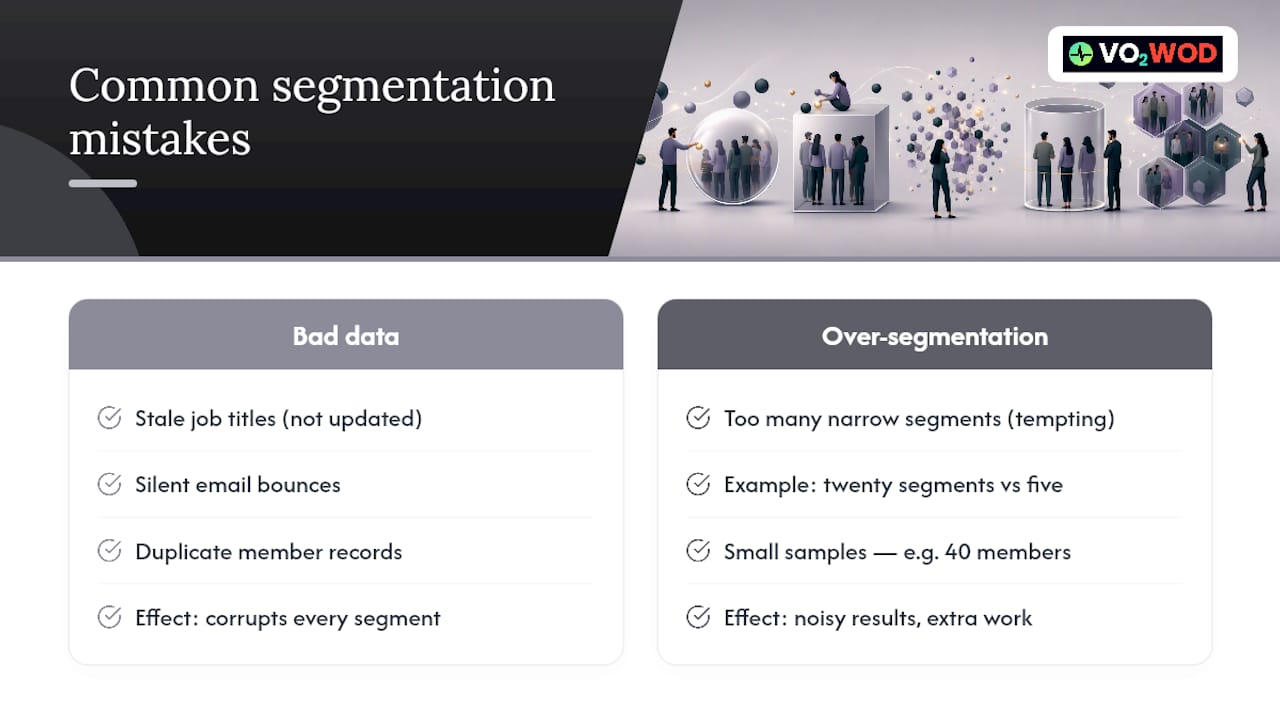
Two problems sink most segmentation programs: bad data and too many segments.
Data quality issues usually start small. A member's job title field hasn't been updated in three years, an email bounces silently, or the same person exists as two records because they registered for an event with a different email address. None of these look urgent individually. Together, they quietly corrupt every segment built on top of that data. Before you build segment rules, run an identity resolution and deduplication pass, and set a recurring cadence to catch drift before it compounds.
Over-segmentation is the opposite failure, and it's more tempting because it looks like sophistication. Twenty narrow segments feel more precise than five broad ones, but each split shrinks your sample size, and a segment of 40 members produces results too noisy to trust or act on. It also multiplies your workload: twenty segments mean twenty messages to write, twenty performance reports to review, and twenty places for a rule to go stale.
The fix for both is the same discipline. Start with segments backed by enough members to generate a real signal, typically a few hundred at minimum, and add a new segment only when an existing one has proven itself and a genuinely distinct behavior justifies splitting it further. Segmentation that surfaces real motivations and behaviors, rather than convenience labels, tends to need fewer, better segments, not more of them.
How Segmentation Powers Personalization
Segmentation is the input; personalization is what members actually see. The gap between the two is where most programs lose their edge.
New members who complete a joining questionnaire or initial competency assessment can be routed straight into a content stream built for their stated goals, rather than the same generic onboarding sequence everyone gets. Using assessments to assign initial segments lets you personalize from day one instead of waiting for behavior data to accumulate.

Once behavior data exists, personalization gets sharper. A member flagged as a high-engagement advocate might see an invitation to a leadership program where a lapsed member in the same demographic sees a simple "we miss you" offer with a low-friction reactivation path. Renewal emails can shift tone and urgency depending on which 90/60/30-day window a member sits in, rather than sending the identical reminder to everyone regardless of timeline.
Content streams work the same way. Instead of one newsletter trying to serve every interest, cycle distinct content tracks, technical deep dives for one segment, networking event highlights for another, so each group gets material that matches why they actually joined. That single shift, tested against a generic newsletter, is often the fastest way to see the open-rate lift segmentation promises translate into real click behavior.
What Tools Support Member Segmentation?
The right tool depends on how much of your member data already lives in one place. Entry-level platforms handle basic list filtering, tagging members by field values and building simple static lists for email sends. That works for small lists with limited behavioral tracking.
Mid-tier association management systems and CRMs go further, combining membership records, event history, and payment data into one profile, which lets you build the active, rule-based lists this guide recommends. The key question to ask any platform is whether it supports dynamic segments that update automatically as behavior changes, or only static exports that go stale the moment you pull them.
For gyms specifically, the calculus is different because the most predictive behavioral signal, attendance and effort inside a class, often lives outside a general-purpose CRM entirely. That's the gap platforms built specifically for functional fitness aim to close: pulling live workout data directly into the same system that manages memberships and communications, so a segment like "high-effort regulars" doesn't require stitching together three separate exports by hand. Look for wearable integration support (Garmin, Apple, Fitbit, Samsung) if heart rate and intensity data matter to your segmentation strategy, since that signal set doesn't exist in most general membership software.
The one mistake that wastes a good segmentation strategy
The biggest mistake I see is convenience segmentation: grouping by whatever field is easiest to pull, then calling it done. Fix it by picking one behavior signal and one lifecycle trigger, combining them, and testing that single segment before building anything else.
— Marcus
How Vo2wod Gets Behavior-First Segmentation Running Fast
Most gym software gives you membership records and little else, which means every behavioral segment starts with someone manually cross-referencing attendance spreadsheets against a class schedule. Vo2wod is built to close that gap for functional fitness gyms specifically: live heart rate tracking and automatic workout scoring feed straight into the same system that manages your memberships, so "high-effort regulars" or "declining-intensity members" become segments you can act on immediately, not a data project.

Switching platforms is usually the excuse gyms use to avoid this entirely. Vo2wod removes that friction with free data migration, one month of complimentary service, and a dedicated support team walking you through the transition. If you're currently choosing between platforms, see how Vo2wod stacks up against the alternatives gym owners typically consider, or go straight to the Vo2wod product overview to start a trial and see your first behavior-based segment built from real class data within weeks, not quarters.