

Define "family" as a household or a set of designated members you approve at signup, cap the discount so it never eats your margin, and keep personal training and premium services billed separately from the family add-on rate. This is the fastest way to convert single memberships into stickier, higher-value household accounts.
Multi-person household memberships run 58% lower annual churn than individual memberships, which is the entire business case for building this policy correctly instead of bolting on an informal "family discount" your front desk improvises.
Your one action today: enable household accounts and engagement flags in your management platform, such as VO2WOD, so every member of a family plan gets a named profile, individual check-in, and a shared billing record.
- Set the family scope: household or up to N designated members
- Price per person with a floor, not a flat blanket discount
- Exclude PT, premium workshops, and specialty classes from the family rate
- Turn on engagement tracking at the individual member level, not just the account level
Key Takeaways
| Point | Details |
|---|---|
| Price with a floor | Keep effective per-person rates at or above 65% of the individual rate to protect margin. |
| Define family broadly but clearly | Use "household or designated members" language and light verification like an address declaration. |
| Separate premium services | Keep personal training and specialty workshops billed outside the family add-on rate. |
| Track engagement per member | Multi-person households show 58% lower annual churn, but only if you monitor individual attendance. |
| Configure software before rollout | VO2WOD supports household accounts, pooled credits, and engagement flags to enforce the policy consistently. |
Table of Contents
- Family Memberships Policy: Choosing How to Price the Plan
- Who Qualifies as Family Under Your Membership Policy
- Setting Up Billing Rules for Multi-Person Accounts
- Configuring Check-In and Booking for Household Accounts
- Deciding What to Include and What to Upsell
- Enforcing the Policy Without Creating Staff Headaches
- Rolling Out the Policy in Your Gym Management Software
- What the Research Actually Supports (and What Gets Overrated)
- Try Family Membership Policies Built for Household Tracking
- Frequently Asked Questions
- Sources
Family Memberships Policy: Choosing How to Price the Plan
Most gyms default to a flat family rate because it is easy to explain. It is usually the wrong call. Per-person incremental pricing wins whenever household size varies, because it protects revenue per body walking through the door instead of capping it at an arbitrary number.
Flat family rates make sense only when your average household size is large and consistent. If most of your family sign-ups are three or four people, a flat rate simplifies billing without leaving real money on the table. Below that, incremental pricing captures more revenue per household.
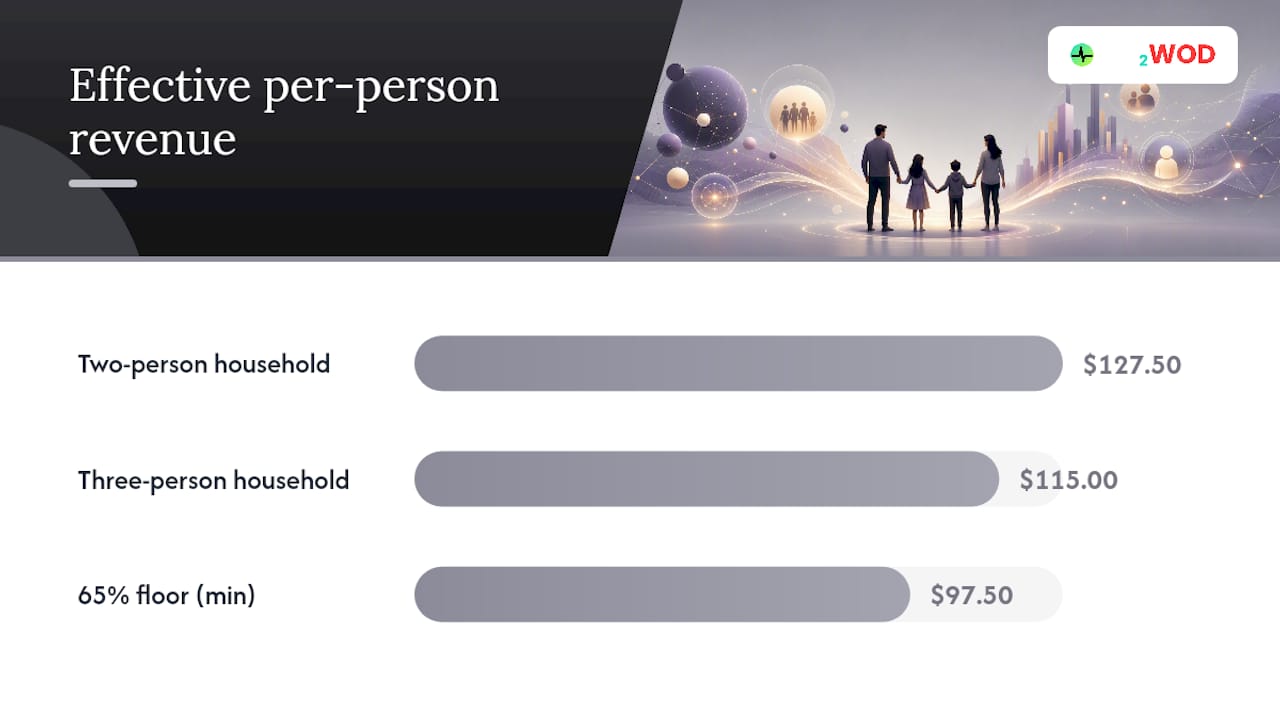
The floor matters more than the model. Effective per-person pricing should not drop below roughly 65% of your standard individual rate. Go lower and you train prospects to expect steep discounts, which drags down your average revenue per member across the whole gym, not just family accounts.
Here is how the math should work in practice:
- Two-person household: primary member pays full rate ($150/month), second member pays 70% ($105/month). Effective per-person rate: $127.50, comfortably above the floor.
- Three-person household: primary pays full rate, members two and three pay 65% each. On a $150 base, that's $150 + $97.50 + $97.50 = $345 total, or $115 effective per person.
- Contract length effect: annual contracts can justify pushing add-on rates a few points lower, since the longer commitment offsets the discount.
Run these numbers against your current individual rate before you launch anything. A floor that looks generous on paper can quietly erode your average revenue per member within two or three billing cycles.
Who Qualifies as Family Under Your Membership Policy
Vague eligibility rules are where family membership policies fall apart at the front desk. Write it down, post it, and train staff to apply it the same way every time.
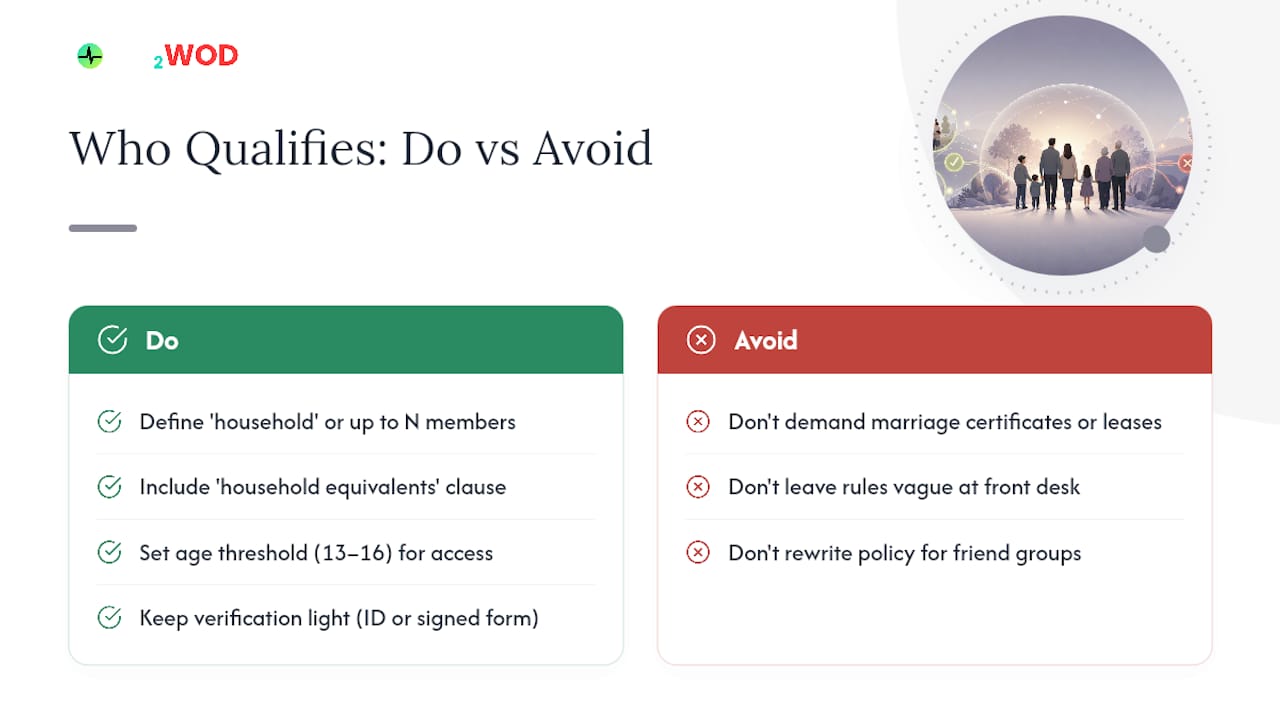
A workable policy template: "Household or up to [N] designated members living at the same address, or approved as household equivalents at signup." That second clause matters. It lets you include unmarried partners, adult roommates who function as a household, or blended families without forcing every applicant to prove a legal relationship.
Set an age threshold for independent access, typically 13 to 16 depending on your equipment and class formats, below which a member needs adult supervision on the floor. Above that age, they get their own check-in credential and full access within the plan's limits.
Verification should stay light. A shared address on a driver's license or a simple signed declaration is enough for most gyms. Demanding lease agreements or marriage certificates creates friction that pushes prospects toward a competitor with a simpler sign-up process.
Pro Tip: Handle friend-group requests case by case rather than rewriting your policy for every edge case. Approve them as "designated members" at your discretion, and note the exception in the account record so front desk staff aren't guessing later.
Setting Up Billing Rules for Multi-Person Accounts
The primary payer owns the account: their card is on file, their signature is on the contract, and they are the one authorized to add, remove, or freeze other members. Build a clear rule for what happens if the primary cancels: either a designated backup member assumes the primary role, or the account converts to individual billing for whoever remains.
Map your family add-ons directly onto your existing membership tiers instead of creating a parallel pricing structure. If a member upgrades or downgrades mid-cycle, prorate the difference on the next billing date rather than issuing a refund. It's cleaner for your books and easier for staff to explain.
Pooled credits (for guest passes or drop-in classes) need a hard cap per billing cycle, shared across the household, not per individual member. That keeps a family of four from effectively getting four times the guest allowance of a single member paying a comparable rate.
A few billing rules worth locking in before launch:
- Cap pooled guest passes at 2 to 4 per household per month
- Require 30 days' written notice for any membership transfer
- Refund disputed charges only when a documented system or billing error occurred
- Never refund for a member simply forgetting to freeze or cancel on time
- Confirm primary payer and backup contact at signup
- Set proration rules for mid-cycle tier changes
- Cap pooled credits per household, not per member
Configuring Check-In and Booking for Household Accounts
Every family member needs their own account, whether that's a QR code, a fob, or an app login. Sharing one credential across a household defeats the entire point of tracking engagement, and it's the single biggest driver of billing disputes down the line.
Tie each account's permissions to the plan tier. A teenager on a supervised sub-account might only book youth classes; an adult household member gets full class access. Booking credits can pool at the household level for flexibility, but attendance and workout data should stay per member, both for your reporting and for the member's own sense of progress.
Wearable syncing (Garmin, Apple, Fitbit, Samsung) should also run per individual, not per household. Merged data makes engagement tracking meaningless and undercuts the personalized feedback that keeps members coming back.
- Issue a unique check-in credential to every member, regardless of age
- Pool booking credits at the household level, keep performance data individual
- Sync wearables per person for accurate workout scoring
Pro Tip: Give front desk staff a one-line script for disputes: "This account is shared for billing, but each person checks in separately so we can track your individual progress." It defuses most confusion in one sentence.
Deciding What to Include and What to Upsell
A family plan earns its keep when it feels generous on the things that cost you nothing and firm on the things that actually protect revenue. Pool group classes, shared guest passes, and open-gym access. Keep those inside the family rate.
Personal training, specialty workshops, and one-on-one coaching stay outside the plan entirely. Keeping PT and premium services out of the family add-on rate protects one of your highest-margin revenue lines from getting quietly discounted alongside everything else.
The upsell works best when it feels like an obvious yes rather than a pitch: a $25 introductory PT session for a newly added spouse, a discounted family-class bundle for households that train together, or a small anniversary reward at the one-year mark. None of these should feel like negotiation. They should feel inevitable.
- Include: group classes, open gym, pooled guest passes
- Exclude: personal training, specialty workshops, premium coaching
- Upsell: intro PT sessions, family-class bundles, anniversary perks
- Low-cost retention perk: designate a weekly "family hour" to build a habit loop
Enforcing the Policy Without Creating Staff Headaches
Every family plan needs contract language covering cancellation and transfer before a single member signs. Specify whether membership slots are transferable to a new household member if one leaves, and whether cancellation by the primary payer terminates the entire account or triggers a conversion to individual billing.
Build a temporary freeze option for injury, travel, or financial hardship, capped at a set number of days per year, so staff aren't approving ad hoc exceptions on the fly.
Watch for fraud indicators: mismatched payment methods across "household" members, repeated swaps of who counts as a designated member mid-cycle, or an address that changes every few months. None of these prove bad intent alone, but two or three together warrant a manager conversation.
- Document the cancellation and transfer terms in the signed contract
- Offer a capped freeze option instead of forcing cancellation
- Flag mismatched payment methods or frequent member swaps for review
- Route disputed cases to a manager with a written record of the decision
Pro Tip: Keep a simple exception log, even a shared spreadsheet, of every policy override your team approves. It protects you if a similar case comes up six months later and a different staff member is on shift.
Rolling Out the Policy in Your Gym Management Software
Writing the policy is the easy part. Making it hold up at the front desk depends on whether your software can actually enforce it. VO2WOD supports household accounts, individual member check-ins, pooled credits, recurring billing, and wearable integration, which covers most of what this policy needs without custom workarounds.
Before rolling anything out gym-wide, test your pricing floor, proration rules, and pooled credit caps in a trial instance. VO2WOD's transition process includes free data migration and a dedicated support team, so you can pilot a new family policy without disrupting billing for your existing members.
Track household-level engagement and flag when any member's attendance drops. That single habit turns a churn problem into a retention save, because you catch the disengaged spouse or teenager weeks before the cancellation request lands on your desk.
- Configure household accounts and per-member check-in credentials
- Set pooled credit caps and proration rules in a trial environment first
- Enable engagement flags to catch attendance drop-offs early
- Compare your current platform's household features against alternatives before committing to a rebuild
What the Research Actually Supports (and What Gets Overrated)
Most of the advice floating around gym forums treats family memberships as a discounting problem: how much do you knock off the second membership? That framing is backwards. The real lever is engagement, not price. Family plan members refer at roughly 1.7 times the rate of individual members, which tells you the policy's biggest payoff is acquisition, not the modest margin you give up per household.
Where conventional advice falls short is enforcement. Gyms write a decent pricing structure, then let front desk staff improvise everything else: who counts as family, how transfers work, what happens when the primary payer cancels. That inconsistency is what actually erodes trust and margin, not the discount itself.
If you do one thing first, make it the engagement flag, not the pricing spreadsheet. A family plan with a mediocre discount and sharp attendance tracking will outperform a perfectly priced plan nobody is watching. Price matters. Enforcement and visibility matter more.
Try Family Membership Policies Built for Household Tracking
Most gym platforms treat a family membership like a billing footnote: one account, one login, and no real way to see whether the spouse or the teenager is actually showing up. Vo2wod builds household accounts as a first-class feature, with individual check-ins, per-member performance tracking, and engagement flags that catch a drop-off before it becomes a cancellation.

That matters most for the exact policy this article walks through: pooled credits at the household level, individual data at the member level, and enforcement your front desk can actually run without guessing. Vo2wod also includes free data migration and a one-month complimentary trial, so you can test your pricing floor and proration rules on real accounts before committing your whole membership base to a new structure.
If you're ready to see how household accounts, wearable integration, and automatic workout scoring work together, compare Vo2wod against your current platform and start your trial migration this week.
Frequently Asked Questions
What should a family memberships policy include at minimum? A workable policy needs four elements: a clear definition of who qualifies as family, a pricing structure with a stated floor, billing rules covering the primary payer and proration, and an enforcement process for cancellations, transfers, and disputes.
Should gyms charge a flat family rate or price per person? Per-person incremental pricing usually outperforms a flat rate because it scales with household size. Flat rates work best only when your average family sign-up consistently includes three or more members.
How low can a family membership discount go before it hurts revenue? Dropping below that trains the market to expect steep discounts across your whole membership base.
Do personal training sessions count toward family membership pricing? No. Personal training, specialty workshops, and premium coaching should stay priced separately from the family add-on rate to protect one of a gym's highest-margin revenue lines.
How do family memberships affect member retention? Multi-person household memberships show meaningfully lower annual churn than individual memberships, largely because social accountability and shared billing raise the friction of canceling.
Sources
- Family Plans & Group Memberships: Pricing and Retention Strategies
- How to Build a "Family Plan" Membership at Your Gym That Reduces Churn and Increases Revenue