

Run a dual-sided guest-pass referral that any member can share in under 60 seconds, automate the attribution so nothing falls through the cracks, and pay the reward only after a friend's first paid month clears. Time the ask to onboarding or a post-class win, not a random email blast. Everything else in gym referral marketing is optimization around that core loop.
TL;DR:
- Automated referral programs generate over three times more referrals at about $42 each, compared to $156 for paid digital advertising.
- Timing the referral ask immediately after a workout or during early membership days significantly increases conversion rates.
- Dual-sided incentives, a single easy referral path, and rewards issued after the first paid month improve program effectiveness.
- Using one clear referral mechanism and automating reward delivery prevent attribution issues and fraud.
- Tracking referral-to-member conversion rates and retention lifts justifies shifting marketing budgets from paid ads to referral strategies.
Table of Contents
- Why Referral Programs Beat Paid Ads For Gym Growth
- What To Design Before You Pick An Incentive
- 25+ Gym Referral Program Ideas By Format And Channel
- Choosing The Right Incentive For Your Price Point
- When To Actually Ask For The Referral
- Setting Up Tracking And Automation That Doesn't Break
- Building A Member Ambassador Program
- Measuring Whether Your Referral Program Is Actually Working
- Where Referral Programs Go Wrong
- A 90-Day Roadmap For Getting This Running
- Automating The Referral Mechanics With VO2WOD
- Sources
Why Referral Programs Beat Paid Ads For Gym Growth
Automated referral programs generate roughly 3.1 times more referrals than manual asks, at about $42 per referred member compared with $156 for paid digital ads. That gap alone should reorder most gyms' marketing budgets.
The retention math backs it up. A referred member joins already tied to someone inside the building, so the social pressure to show up is built in from day one. Fitness research on recommendation behavior finds that members who exercise with a friend retain at higher rates, and referred members carry higher lifetime value than cold leads from a Facebook ad.
The numbers: Referral acquisition costs roughly $42 per member versus $156 for paid digital ads, a 3.1x volume advantage when the process is automated rather than left to word of mouth.
Timing explains the rest. A referral ask that lands right after a hard workout, when a member is still riding the endorphin high, converts far better than the same message sitting in an inbox for three days.
What To Design Before You Pick An Incentive
Most referral programs fail before the reward even matters, because the mechanics underneath it were never built properly. Work through this checklist first.
- Decide who gets rewarded. Dual-sided incentives, where both the referrer and the new member get something, consistently outperform single-sided rewards and beat cash or merchandise in industry tests.
- Pick one frictionless path. A unique short URL or a digital guest pass, not five different ways to refer someone.
- Set fulfillment rules in advance. Rewards get issued after the referred member's first paid month clears, never at sign-up.
- Script the ask for staff. Front desk and coaches need a specific line to say, built into onboarding, not a vague "tell your friends" poster.
- Build a simple dashboard. Track who referred whom, when the reward triggered, and whether the new member stuck around past month three.
Pro Tip: Write the staff referral script into your onboarding checklist as a required step, not a suggestion. Programs that rely on staff remembering to ask almost always underperform automated prompts.
25+ Gym Referral Program Ideas By Format And Channel
Not every idea fits every gym. A CrossFit box with 150 members needs different mechanics than a 24-hour full-service club with 2,000. Here's a working menu organized by what the offer actually is.
Guest pass templates
- Single free class pass. The lowest-friction option. A friend tries one class, no commitment, easy yes.
- Free week trial. Gives a prospect enough time to feel the community, not just sweat once and disappear.
- Bring-a-friend workout day. One scheduled day per month where members can bring a guest at no cost, no code needed.
- Digital QR guest pass. A printable or app-based QR code members text or share on social media directly.
Account credit and stacking rewards
- Flat account credit per referral. Simple, easy to explain, easy to automate through your billing system.
- Stacked thresholds. Refer 1 friend, get a small credit. Refer 3, get gym merch. Refer 5, get a free quarter of membership.
- Percentage-off stacking. Each successful referral knocks a percentage off the next month, capping at a free month.
- Family plan discount trigger. Referring a family member unlocks a household rate automatically in the system.
Experience-based rewards
- Free personal training session. This one does double duty. It rewards the referrer and creates an upsell opportunity into recurring PT.
- VIP class access. Early or exclusive booking windows for specialty classes as a referral perk.
- Reserved parking or locker upgrade. Low-cost, high-visibility rewards that other members notice and ask about.
- Founder's circle status. A recognition tier with small perks for members who've referred multiple people.
Merch and partner cross-promotions
- Branded gear drops. Limited-run shirts or bags only available through referral milestones.
- Local business partnerships. Team up with a nearby smoothie shop or physical therapy clinic for bundled referral perks.
- Wearable tech giveaway. Tie a bigger referral milestone to a fitness tracker, which also nudges members toward the kind of heart-rate tracking your gym software already supports.
- Recovery service bundle. Partner with a massage or cryotherapy provider for referral-tier rewards.
Seasonal sprints and gamification
- New Year referral sprint. January's natural surge in interest makes a 30-day referral push in this window especially effective.
- Summer shred challenge. Pair a fitness challenge with a referral leaderboard for extra motivation.
- Anniversary month push. Reward referrals during your gym's founding month with double credit.
- Referral leaderboard with prizes. Publicly track top referrers on a board or app feed, updated weekly.
- Team-based referral competitions. Split members into small teams competing for a group prize based on total referrals.
Low-tech and high-tech mechanics
- Front-desk referral cards. A physical card with a code, handed out and redeemed at check-in.
- Punch-card style tracking. A simple paper or laminated card for gyms without full software integration.
- SMS share links. A text message with a personalized link members forward directly to friends.
- In-app one-tap sharing. Built into gym management software, letting members share a referral link from their phone in seconds.
- Automated milestone triggers. The system fires off a referral prompt automatically after a PR, a 90-day mark, or a class streak.
The common thread across all of these: the ones that actually get used are the ones that take less than a minute to act on. A punch card works fine for a 100-member studio. A 2,000-member club needs the SMS or in-app version, because staff simply cannot track referral cards at that volume.
Choosing The Right Incentive For Your Price Point
The reward has to make financial sense relative to what a member pays monthly, or it either erodes margin or feels insultingly small.
- Under $100/month membership: account credit or a stacked merch reward tends to work better than a free month, which can feel disproportionate to the price point.
- $100 to $200/month: a free month is the sweet spot. It's a real reward without gutting revenue.
- Above $200/month (boutique, semi-private, or full-service clubs): free personal training sessions or a quarter-off tier often outperform pure cash credit, because it introduces the referrer to a paid service they might convert into.
Dual-sided combinations outperformed cash rewards and merchandise in industry incentive testing in industry incentive testing, which is a strong argument for skipping the single-sided cash reward altogether. Prosocial framing (the referrer's reward is framed as helping a friend, not just benefiting themselves) also lowers the psychological cost for the person being referred, making the friend more likely to actually act on the invite.
Stacking works well across price points: refer 3 people and unlock merch, refer 5 and unlock a free quarter. It gives members a reason to keep referring instead of stopping after one successful conversion.
When To Actually Ask For The Referral
Timing determines conversion more than the reward itself does in most cases.
- Right after class, while endorphins are still high. A post-workout SMS prompts convert better than delayed email prompts sent the next day.
- Days 7 to 14 of a new membership, when early enthusiasm is at its peak and the new member is still talking about the gym to friends.
- Days 30 to 60, when referral readiness climbs as the member becomes genuinely integrated into the community, and readiness peaks again past the 90-day mark.
- Milestone moments: a first personal record, a 90-day anniversary, or a 10-class attendance streak all outperform generic, untimed prompts.
A personalized prompt that references the member's actual attendance, not a generic "refer a friend" blast, roughly doubles response rates compared to a form-letter version of the same ask.
Setting Up Tracking And Automation That Doesn't Break
Referral programs die from attribution problems more often than from bad incentives. Here's how to build the mechanics so credit never gets lost.
- Pick one referral mechanism and make it the only one. A single unique URL or guest pass code. Running a QR code, a paper card, and a promo code simultaneously guarantees you'll lose track of who referred whom.
- Automate reward issuance to fire after the first paid month clears, not at signup. This is both a fraud safeguard and a cash-flow protection.
- Build a three-touch sequence: a congratulatory message when a referral converts, the shareable link itself, and a reminder nudge about a week later if it hasn't been used.
- Feed referral events into your member lifetime-value dashboard. Referred members should be tagged distinctly from organic sign-ups so you can compare their retention curve directly.
- Run A/B tests on reward size and message timing rather than guessing. Test one variable at a time: a $25 credit versus a $50 credit, or a same-day prompt versus a 48-hour delayed one.
Pro Tip: Automated account credit notifications delivered within 48 hours of a verified conversion perform far better than manually processed credits that take a week. Speed of visible reward matters almost as much as the reward's size.
Best-practice checklists for referral automation consistently point to three-touch sequences and single-path attribution as the difference between a referral program that scales and one that quietly stalls after month two.
Building A Member Ambassador Program
A small ambassador cohort turns your most engaged members into a standing referral engine instead of a one-off ask.
- Selection criteria: attendance frequency, tenure past 90 days, and organic social mentions or tags of the gym.
- Cohort size: A small ambassador cohort typically includes several members scaled to the total membership size, with explicit benefits and expectations; scale proportionally for larger clubs.
- Benefit tiers: a membership discount, unlimited guest passes for friends, and public recognition (a wall feature, a social shoutout) in exchange for a set number of monthly referral activities.
- Renewal structure: review ambassador status quarterly and rotate out members who stop meeting the activity bar, so the title stays meaningful.
Measuring Whether Your Referral Program Is Actually Working
Track referral-to-member conversion rate: successful paid conversions divided by total referral links or passes sent out.
Compare cost-per-acquisition directly against paid channels. If referral CPA is running near $42 against $156 for paid ads, as Stanford's research on referral economics found, that gap alone justifies shifting budget.
Worth tracking: Referred members tend to show higher retention and lifetime value compared to members acquired through paid channels, and NPS scores are a practical leading indicator of which members are likely to refer next.
Report monthly at minimum. Test one incentive variable per quarter rather than changing everything at once, so you can actually tell what moved the needle.
Where Referral Programs Go Wrong
Most failed referral programs share the same handful of mistakes.
- Issuing rewards immediately at signup invites gaming, with members creating fake accounts to trigger credits. Wait for the first paid month to clear before issuing anything.
- Running multiple referral paths at once breaks attribution entirely. Pick one dominant mechanism and retire the rest.
- Overcomplicating the mechanics kills uptake. If sharing takes more than a minute or requires explaining three steps, most members won't bother.
- Inconsistent staff follow-through is the quiet killer. Fix it with a written script, regular roleplay during team meetings, and a simple "ask frequency" metric tracked per staff member.
A 90-Day Roadmap For Getting This Running
Here's the sequence worth actually following if you're starting from nothing.
Weeks 0 through 2: set up a single guest-pass offer with a unique share link, write the staff ask script, and drop it into your onboarding flow. Don't touch incentive size yet. Just get the mechanism live and used consistently.
Weeks 2 through 8: automate your milestone triggers, meaning the system should fire a referral prompt after a first PR or a 30-day mark without anyone remembering to send it manually. Start A/B testing incentive size here, one variable at a time.
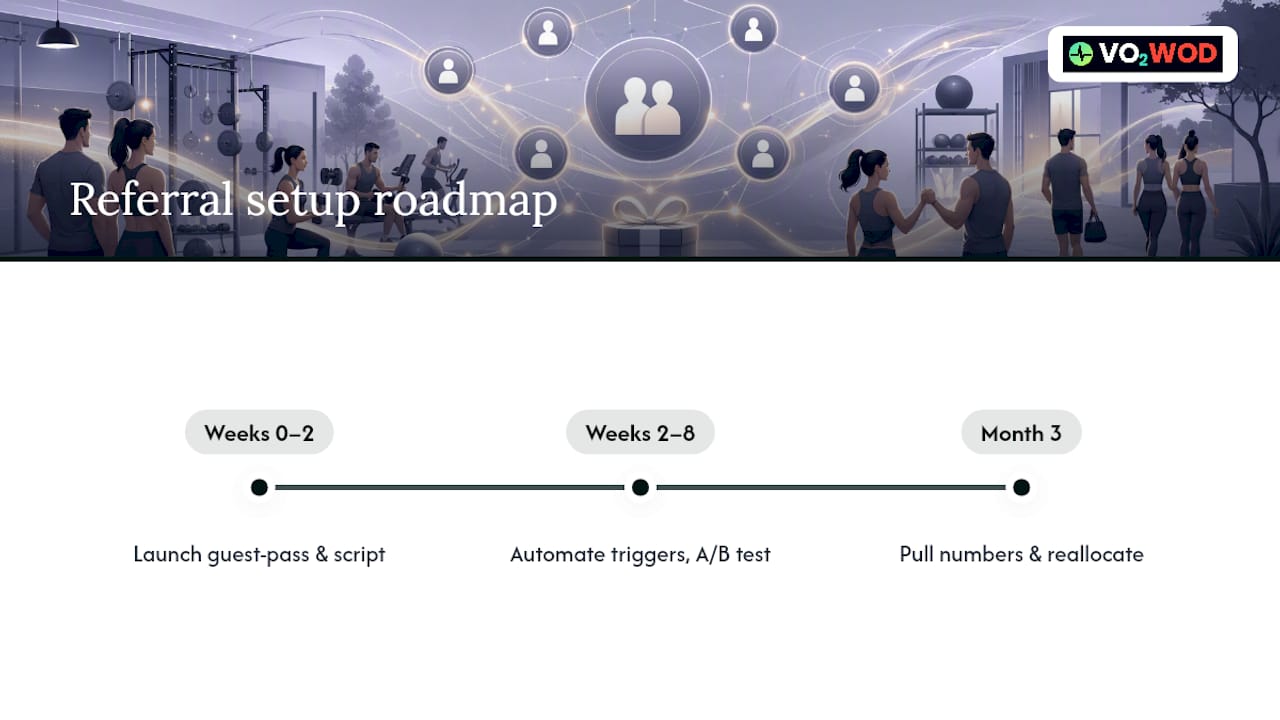
Month 3: pull your numbers. Look at referral-to-member conversion, retention lift among referred members versus organic sign-ups, and cost-per-acquisition against whatever you're spending on ads. Kill whatever underperforms and put the saved budget behind whichever campaign actually converted.
The gyms that get this right treat referrals as a system to build once and automate, not a campaign to relaunch every few months hoping for different results.
— Marcus
Automating The Referral Mechanics With VO2WOD
Everything in this playbook, the guest passes, the milestone triggers, the staff scripts, still depends on someone manually tracking who referred whom and remembering to issue the reward on time. That's the part that breaks most programs. VO2WOD handles the mechanics directly inside the same platform gyms already use for check-ins and billing: CRM tagging flags referred members automatically, in-app messaging fires the congratulatory and reminder touches on schedule, and milestone triggers can launch a referral prompt the moment a member hits a 30-day mark or a personal record.
Because free data migration and a complimentary trial month come standard, testing this out doesn't mean ripping out your current setup first. Gyms weighing a switch from another platform can also see how the referral and engagement tools stack up on the software comparison page. The practical next step: start a trial, configure one automated referral trigger, and measure the conversion lift against whatever you're running now.
Sources
- Personal touch quantified (Stanford Graduate School of Business)
- Personal touch quantified (Stanford Graduate School of Business)
- Machine learning insights into recommendation intention (Journal of Big Data, 2026)
- Gym referral programs that work (Rework resources)