

You reduce class no-shows by making booking commitments feel real: confirm every reservation, send timed reminders, fill cancelled spots automatically from a waitlist, and back it all with a short, fair cancellation policy. Then track no-shows by class and by member so you fix patterns instead of guessing. Below is the plan, in the order we would roll it out in a functional fitness gym.
TL;DR
- A no-show is a booked member who neither attends nor cancels in time. The spot cannot be resold, so it is lost revenue and a weaker room.
- Reminders do most of the work. Vendor reports describe automated sequences cutting gym no-show rates from 20-25% to 8-12%.
- Pair reminders with a waitlist that promotes members automatically, so a late cancellation does not become an empty spot.
- Keep rules simple and visible: a cancellation window, a grace allowance and a consequence you apply the same way every time.
- Review no-shows monthly by class time, day and member. Adjust one thing at a time.
Table of Contents
- What counts as a no-show, and what it costs
- Why members miss classes they booked
- Make booking and canceling effortless
- Build a reminder sequence that works
- Use a waitlist so a late cancel is not a lost spot
- Set cancellation rules members will accept
- Find patterns and measure what works
- Give members a reason to show up
- Our perspective
- See it in your own gym
- FAQ
- Sources
What counts as a no-show, and what it costs
Define it in writing before you measure it. A no-show is a member who holds a reservation and does not check in. A late cancel is a member who cancels inside your cancellation window, too late for the spot to be resold. Both leave the same hole in the room, so track them separately but fix them together.
The scale is easy to underestimate. One scheduling-industry summary puts the average no-show rate for group fitness classes in the U.S. at 15%, citing Mindbody's 2026 data. That is a vendor-compiled figure, so treat it as a rough benchmark and compare it with your own numbers.
The cost compounds with capacity. A case study on fitness waitlist automation reports that the average boutique studio runs at 71% class capacity, citing IHRSA's 2025 studio economics report. The same page estimates that for a studio running 60 classes a week with 20 spots each, empty spots represent roughly $398,000 to $633,000 in unrealized annual revenue at $22 to $35 per spot. Your math will differ, but the exercise is worth doing: multiply your weekly empty spots by what a spot is worth to you.

There is also a cost you do not see on the invoice. A half-empty room at 6 a.m. feels flat. Members who showed up for the energy of a full class get less of it, and that is how a no-show problem slowly becomes a retention problem. If you want the capacity side of the equation, our guide to break-even class capacity planning walks through how many spots you need filled for a class to pay for itself.
Why members miss classes they booked
Most no-shows are not defiance. They are friction and forgetfulness.
- They forgot. Research on limited attention suggests that people simply lose track of plans. An academic study found that email reminders increased gym visits by 13%, and the authors point to limited attention as an explanation.
- Booking cost nothing. If a reservation is free to make and free to ignore, it is a soft intention, not a commitment.
- Plans changed and canceling felt awkward. If canceling takes five taps and a login, some members just skip it.
- The class did not match their week. A pattern of no-shows on one slot often means the time or the format is wrong, not the member.
- They are drifting. A member who stops showing up without canceling is often one step from leaving. Treat no-shows as an early signal.
Each cause has a different fix, which is why a single "strict policy" rarely solves the problem on its own.
Make booking and canceling effortless
The first lever is the one owners skip: make canceling easier. A member who can release a spot in two taps from a phone will do it. A member who has to email the front desk will not, and the spot goes empty.
Aim for these basics:
- One place to book, change and cancel. Members should not need to remember which tool they used.
- Instant confirmation. Every booking triggers a message with the class name, time, coach and the cancellation deadline.
- Calendar add. A reservation that lives in the member's own calendar is harder to forget. Our breakdown of three gym calendar sync approaches shows how to set this up without creating double bookings.
- Class names that tell members what they are signing up for. Vague class titles produce vague commitment. See these class naming templates for functional gyms for options that make members want to book.
- A clear path for drop-ins. Visitors who book once and never appear are a common no-show source, so give them a structured process for drop-in booking, waivers and follow-up.
Low-friction check-in matters too. When arriving takes a QR scan or a wristband tap, you get accurate attendance data without front-desk typing, and accurate data is what lets you separate real no-shows from members who simply were not marked present.
Build a reminder sequence that works
Reminders are the highest-return change for most gyms. Several vendor sources report large effects, and while those numbers come from companies selling automation, the direction matches the academic finding above.
- One automation guide says automated reminder sequences typically drop gym no-show rates from 20-25% to 8-12%.
- Another vendor reports that confirmation sequences tailored to a client's history can reduce no-shows by 18-25%.
- A booking-statistics roundup attributes to Mindbody that studios using automated check-in reminders see a 29% higher retention rate.
Treat these as directional, not guaranteed. Your results depend on your members, your classes and your execution.
A simple multi-touch schedule
A practical plan is a multi-touch sequence, not a single text. Here is a starting point:
| Touch | Timing | Purpose |
|---|---|---|
| Booking confirmation | Immediately | Lock in the details, show the cancellation deadline |
| Day-before reminder | Evening before | Prompt a plan: bag, ride, childcare |
| Same-day reminder | 2 to 4 hours before | Last chance to cancel and free the spot |
| Post-miss note | Within a few hours after a no-show | Friendly check-in, not a scolding |
The same-day message does the heavy lifting, because it arrives while the member can still act. Include a one-tap cancel link so the honest answer "I can't make it" is easier than silence. If you want more ideas on structuring the cadence, these reminder sequences to reduce no-shows show how other attendance-driven organizations handle it.
Do not set it and forget it
One caution from the research: no-show behavior differs by class type, so a yoga-style class and a high-intensity class may respond to different message timing and channels. The Axionis guide recommends monthly calibration of message timing and channel preference. In practice, that means testing text versus email for your morning crowd, and checking whether a two-hour reminder beats a four-hour one.
Use a waitlist so a late cancel is not a lost spot
Reminders reduce no-shows. Waitlists reduce the damage of the ones that remain.
An automated waitlist watches enrollment and promotes waitlisted members into open seats when a cancellation or no-show occurs. One roundup attributes to Glofox the claim that waitlist systems that fill spots automatically can increase total class bookings by 38%. Even if your lift is a fraction of that, the logic holds: a spot released at 4 p.m. for a 6 p.m. class can still be filled if someone is notified instantly.
Tips for running a waitlist well:
- Promote automatically, with a short window for the new member to confirm.
- Keep the cutoff realistic. Promoting someone 20 minutes before class rarely works, so set a time after which the waitlist stops auto-promoting and a coach decides.
- Show waitlist position. Members who see they are third in line are more likely to cancel early when they know the spot has value.
- Let the waitlist inform scheduling. A class with a permanent waitlist is a signal to add capacity or another time slot.
Set cancellation rules members will accept
Policies work when they are clear, proportionate and consistently applied. They backfire when they feel like a trap.
A workable structure:
- A cancellation window that matches how fast you can resell a spot. For many functional gyms, a few hours before class is enough, particularly with a waitlist.
- A grace allowance. Life happens. Waive the first late cancel or no-show, or allow a small number per month.
- A proportionate consequence. Options include a modest late-cancel fee, a lost class credit, or a temporary booking restriction for repeat no-showers. Pick one, not all three.
- Written, visible, and agreed to at signup. Members should see the rule when they book, not when they are penalized.
- Room for exceptions. Illness and emergencies deserve a coach's discretion.
Tone matters as much as the rule. A message that says "we held this spot for you and a teammate was on the waitlist" lands better than "you have been charged." Linking the rule to the community effect, rather than to your revenue, keeps trust intact. If you want a starting document, our class reservation policy template gives you language to adapt.
Be cautious with fees in a membership business. Your goal is attendance, not penalty income. Many owners find that clear reminders and an easy cancel path remove the need for fees on most members, leaving penalties for the small group that repeatedly ignores the rule.
Find patterns and measure what works
You cannot manage what you do not count. Set up a monthly review with a handful of numbers:
- No-show rate: no-shows divided by total reservations, per class and overall.
- Late-cancel rate: tracked separately, because it shows whether your window is right.
- Fill rate after waitlist: how many cancelled spots got resold.
- Repeat offenders: members with three or more no-shows in a month.
- Time and day patterns: are Friday evenings or 5 a.m. classes consistently worse?
Look for clusters. If one slot has a high no-show rate, the answer may be to move it, rename it or merge it, not to tighten the policy. If the same members keep missing, reach out personally. A short message from a coach asking whether the schedule still works is often the cheapest retention move you can make, and it connects directly to the larger problem of hidden cancellations and churn.
Change one variable at a time: reminder timing, then cancellation window, then waitlist cutoff. Give each change a few weeks and compare against your baseline so you know which one moved the number.
Give members a reason to show up
The best no-show prevention is a class worth attending. Community and visible progress both pull members through the door. Members who feel known by coaches and teammates are harder to lose, and our guide on building a gym community members stay for covers the habits that make that happen.
Data helps too. When members see their effort in a class, with live heart rate and an automatic score, a skipped session means a gap in their own history. Our write-up on group heart rate training explains how to roll that out, and the effort uplift it describes is one reason we build performance feedback into the booking experience rather than treating it as a separate tool.
Our perspective
Most owners come to us thinking they have a discipline problem with their members. Usually they have a systems problem: bookings in one tool, messages in another, attendance on a whiteboard, results nowhere.
We built VO2WOD for functional fitness gyms because the pieces that stop no-shows belong together. Scheduling and reservations, QR or wristband check-in, in-app messaging and milestones, and billing all share one member record. When a reminder, a waitlist and a performance history live in the same place, you can see who is drifting before they cancel.
Our view is that members show up for two things: people and progress. Live heart rate in class and automatic workout scoring make progress visible without your coaches typing anything in, and that gives a member a personal reason to keep a booking. We think that does more for attendance than any penalty ever will.
If you are switching from another system, we handle the data migration and onboarding so your reminder and waitlist setup does not wait on a spreadsheet project.
Marcus
See it in your own gym
VO2WOD brings reservations, check-in, member messaging, billing and live in-class performance tracking into one platform built for functional fitness gyms. We offer free data migration, a month of complimentary service and a dedicated team to get you set up.
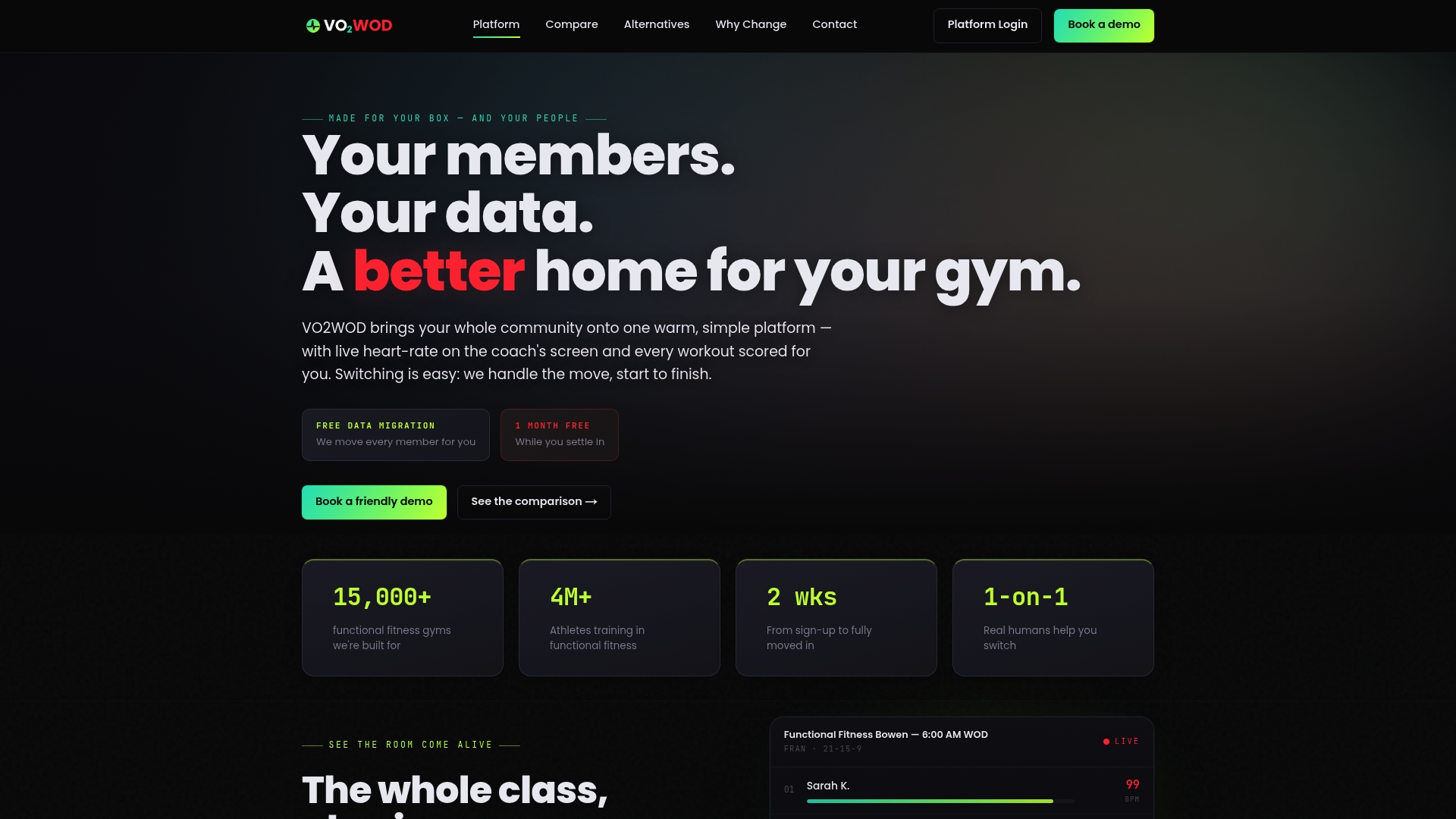
You can explore VO2WOD, look at the Vo2hub group-fitness hardware, or see how we compare with other gym software.
FAQ
What is a normal no-show rate for group fitness classes?
One industry roundup cites an average of 15% for U.S. group fitness classes, attributed to Mindbody. Your rate may be higher or lower depending on class type, time of day and how you remind members. Measure your own baseline for a month before setting a target.
Should I charge a fee for no-shows?
Only if reminders and an easy cancel path are not enough. If you do, announce it clearly at booking, allow a grace allowance and apply it consistently. Many gyms start with a lost class credit or a temporary booking limit before moving to a fee.
How far ahead should I send a class reminder?
A good default is one reminder the evening before and another two to four hours before class, each with a one-tap cancel option. Test timing by class type, since early classes and lunchtime classes behave differently.
Do waitlists really help with no-shows?
They do not stop members from missing class, but they refill spots released by late cancellations. Automatic promotion works best when it has a clear confirmation window and a cutoff time before class.
Sources
- Fitness Waitlist Automation case study
- Fitness Booking Statistics for Gyms and Studios
- Fitness Business Automation Guide
- AI Scheduling For Fitness Studios
- Experimental and non-experimental evidence on limited attention