
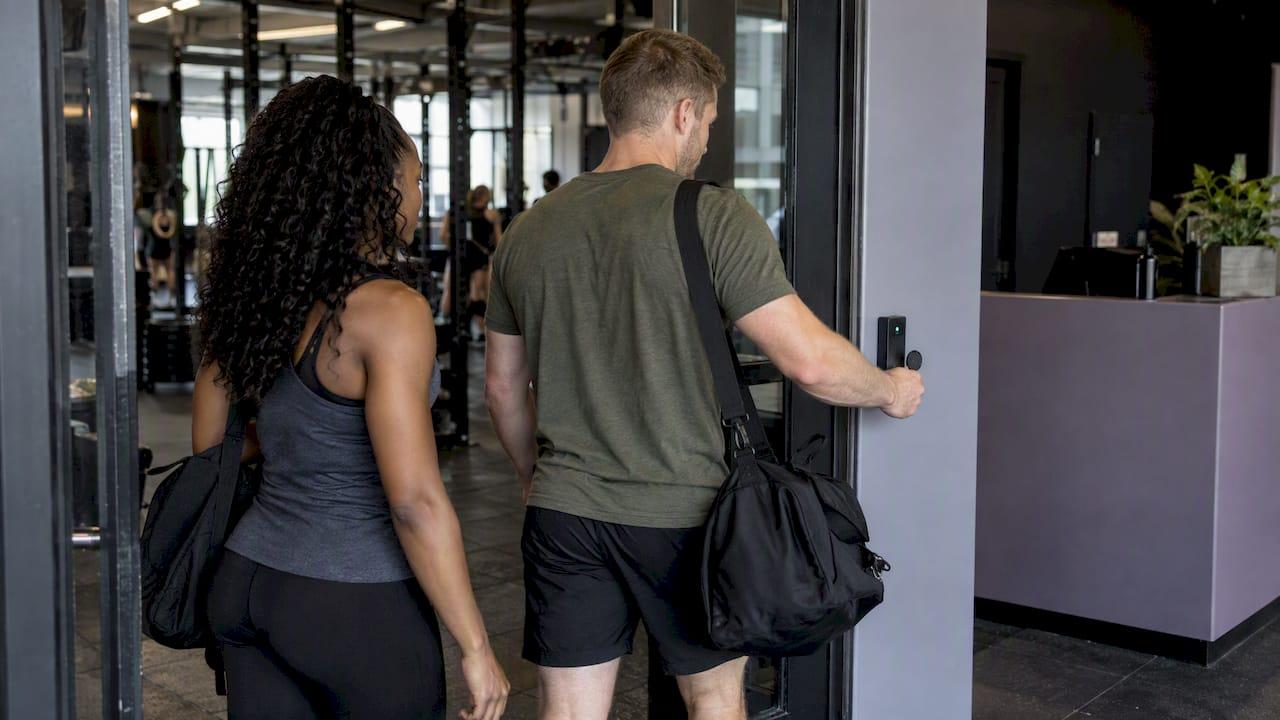
A buddy check-in happens when one person scans in, taps a card, or gets marked present for someone else. You stop it with three layers: a credential that belongs to one person, a check-in step that makes the person visible, and a written policy with a consequence you actually enforce. Technology helps, but the policy and the daily habits of your front desk and coaches do most of the work.
This guide covers why members do it, how to spot it, which controls work in a functional fitness gym, what to do when you catch someone, and how to handle photos and biometrics without creating a privacy problem.
TL;DR
- Treat every credential (card, tag, QR code, wristband, app login) as personal and non-transferable, and put that in writing in your membership terms.
- Detect sharing by comparing independent records: who scanned in, who is physically in the room, and who shows performance data in class.
- Make the right behavior the easy behavior: fast check-in, a visible coach greeting, and a guest process that takes under a minute.
- Decide your consequence before the first incident, apply it the same way every time, and keep notes.
- If you add photos or biometric checks, give notice, get consent where required, and set a deletion schedule first.
Table of Contents
- What a buddy check-in is and why it happens
- What it costs you beyond one free workout
- How to spot buddy check-ins
- Controls that actually prevent it
- What we have learned about this at VO2WOD
- What to do when you catch someone
- Photos, biometrics, and privacy: do this before you collect anything
- A simple rollout plan for the next 30 days
- Where VO2WOD fits
- FAQ
- Sources
What a buddy check-in is and why it happens
The term comes from "buddy punching" in workplaces, where one employee clocks in for another. In a gym the same move takes a few forms:
- A member lends a key tag, barcode, or login to a friend, partner, or relative.
- A member books or reserves a class spot for someone who never arrives, or the reverse: someone shows up under another person's reservation.
- A coach or front-desk person taps "present" on a roster for a person who is not there.
- Two people enter on a single scan, which gym owners usually call tailgating.
Members rarely think of it as fraud. It usually starts as a favor: a friend who wants to try a class, a spouse who forgot a card, a member on a lower-tier plan sharing with someone who would otherwise pay. At a functional fitness gym, where a class has a capped size and a coach programs for the people on the whiteboard, the cost is real. An unrecorded athlete is an athlete the coach did not scale for, did not screen for injuries, and did not count against capacity.
It also corrupts your data. Attendance drives your retention reports, your coach scheduling, and your decisions about class times. Large chains treat this seriously: New York Sports Clubs states that check-ins distinguish members from nonmembers, verify paid access privileges, and help it monitor usage and staff accordingly. If your check-in record is polluted, every one of those uses gets weaker.
What it costs you beyond one free workout
There is no reliable public figure for how much buddy check-ins cost a typical boutique gym, and we would not invent one. The costs show up in four places you can measure yourself:
- Lost revenue. A person using your space regularly without paying is the obvious one. A single occasional guest is a marketing opportunity; a regular who never converts is a leak.
- Capacity and experience. Unrecorded athletes crowd barbells, rigs, and rowers that paying members reserved.
- Liability. If someone is hurt and your records say they were never in the building, you have a waiver and insurance conversation you do not want. Policies at major clubs reflect this: Equinox requires guests to be accompanied by a member, check in at the front desk, show photo identification, and sign a Guest Waiver.
- Bad decisions. Attendance that overstates or understates who really trains skews your read on churn risk. A member who looks active on paper may be disengaged, and the reverse.
How to spot buddy check-ins
No single signal proves anything. The strongest approach is to compare records that are collected independently, so one trick cannot fool all of them.
Watch the room, not just the scan log
The simplest check is a coach who knows names. In a class of 12 to 20, your coach can tell within a minute whether the people on the roster are the people in the room. Ask coaches to greet each athlete by name at the start of class and to flag any face they do not recognize. Do this as a welcome, not an interrogation: "Hey, I don't think we've met, are you joining us today?" It handles legitimate drop-ins and exposes borrowed credentials at the same time.

Look for patterns in the access log
Access-control vendors describe two common signs of credential sharing: two people entering after a single credential scan, and implausible access-log patterns such as unusually frequent or inconsistent use. In practice, that means reviewing a short weekly report for:
- the same credential scanning in at two locations or two overlapping classes,
- scans at hours that do not match a member's usual pattern, such as a 6 a.m. regular suddenly appearing at 9 p.m. daily,
- a member with very high visit counts and no performance entries, no personal records, and no messages.
Compare scans against bodies and performance data
One security approach is to count people entering on camera and compare that number with access-control events, alerting staff when the two differ. You do not need cameras to apply the principle. Any second source that does not depend on the scan will do: a coach's headcount, a class roster, or in-class performance data.
This is where we see the most practical edge for functional fitness. If each athlete wears a heart rate tracker linked to their own profile, a name on the board with no live data during the workout is easy to see. The same goes for a workout score that was entered by hand for someone who was not there. Automatic scoring and live biometrics do not exist to catch cheats, but they give you a second, independent record that makes sharing pointless.
Controls that actually prevent it
1. Make the credential personal and say so in writing
Start with your terms. Plain, specific language works better than a vague "no sharing" line. Examples from organizations that publish theirs:
- New York Sports Clubs says membership is individual, key tags and barcodes may not be loaned, and all entrants must be members or recorded guests.
- The University of North Dakota Wellness Center says access cards are non-transferable and exclusively for the named person, and that staff may ask members and guests to identify themselves.
- A U.S. Army 24/7 access agreement prohibits sharing a registered access card or otherwise granting access to unauthorized people, and requires patrons to make sure the door closes securely behind them.
The last point matters for any gym with unstaffed or open-gym hours. Tailgating is a habit, so address it directly in your open-gym rules.
You can borrow the structure of these policies, adapted to your terms and reviewed by your attorney. Examples of how other fitness-minded programs frame personal responsibility, such as women's workout programs built around individual plans, show how much easier it is when each person owns their own tracking and participation.
2. Pick a credential that is hard to lend
Credentials sit on a ladder from easy to share to hard to share:
| Credential | Easy to lend? | Notes |
|---|---|---|
| Printed barcode or key tag | Very | Can be photographed or handed over in seconds |
| Static QR code in a screenshot | Very | Screenshots can be forwarded |
| App login with QR on a personal phone | Moderate | Requires handing over a phone or login |
| Wristband tied to one athlete | Harder | Visible, and tied to that athlete's data |
| Photo on the profile shown at check-in | Hard | A coach or desk can match face to profile |
| Biometric check (face, fingerprint) | Hardest | Carries legal and privacy duties, see below |
You do not have to jump to the bottom row. For most functional fitness gyms, a personal wristband or app QR plus a profile photo that shows on the check-in screen is enough. New York Sports Clubs combines a key tag or app scan with a photograph taken to protect membership integrity and security, which is the same idea.
Our contactless check-in guide for functional fitness gyms walks through QR and wristband flows that keep the line moving.
3. Build a guest process that is easier than cheating
Most buddy check-ins are guests who did not want paperwork. Remove the reason. A good guest flow has four parts:
- the host member books or invites the guest in advance,
- the guest signs a waiver on a phone or tablet at arrival,
- staff or the coach confirms identity, and
- the guest is recorded as a guest, not as the member.
Large clubs do the same. 24 Hour Fitness, for example, requires guests to register and sign a liability waiver, and its buddy access requires registration, a waiver, check-in with the host, and the host's presence. You can offer a free first class or a bring-a-friend week as a deliberate, tracked program, so friends have a legitimate door in.
4. Tie reservations to check-in
If your system lets members reserve spots, require check-in against the reservation. A reservation with no check-in is a no-show you can act on. A check-in with no reservation is a flag. Reconciling the two daily takes minutes and catches most of the quiet cases.
5. Keep the check-in step quick
Strict controls that slow the door will cost you the very members you want to keep. Attendance data is useful because it is complete: New York Sports Clubs notes that its check-in data supports security, verifies paid access, monitors attendance, helps staff for peaks, and lets members get usage reports. Members accept a small step when they see a benefit like that. Aim for a check-in that takes a few seconds: a tap or scan on the way in, with a coach greeting as the second layer.
What we have learned about this at VO2WOD
The following is our point of view, based on how we build for functional fitness gyms.
We do not think buddy check-ins are mainly a security problem. They are a signal that the gym has no easy, honest way for a friend to try a class, or that the data from class does not matter to the member. When members care about their own history, their personal records, their heart rate zones, their score on the board, they have a reason to be recorded accurately. Nobody wants a friend's name on their workout.
That is why we combine check-in by QR or wristband, live in-class heart rate tracking, and automatic workout scoring in one platform. Each layer is a separate record of the same person in the same class. A wristband that belongs to one athlete and feeds that athlete's own live data means a borrowed identity quickly stops adding up, and your coaches see it without policing anyone.
Our advice for owners: fix the guest process first, write a one-page policy second, and add technology third. Gyms that do it in the other order tend to buy a tool and then argue with members about it.
— Marcus
What to do when you catch someone
Decide the response before you need it. Public policies show the range:
- New York Sports Clubs says allowing someone else to use a key tag or barcode results in immediate membership termination.
- The University of North Dakota says misuse of valid IDs or improper entry may lead to card confiscation, immediate removal, suspension, and further university discipline.
A large chain can afford a hard line. A boutique gym built on community usually wants a ladder:
- First instance: a private, friendly conversation. Remind the member of the policy and offer the guest pass or a trial for the friend.
- Second instance: a written warning, and the friend is invited to sign up or stop attending.
- Third instance or deliberate resale of access: suspension or termination under your terms, with the reason documented.
A few practical rules keep this fair:
- Talk to the member, not the whole class, and never in front of others.
- Write down dates, what you saw, and what you said. If a dispute comes later, notes protect you.
- Apply the same rule to the loud regular and the quiet newcomer.
- Have your attorney check your terms and cancellation language, since contract rules vary by state.
If a staff member or coach is marking people present who are not there, treat it as an employment matter and handle it through your HR process.
Photos, biometrics, and privacy: do this before you collect anything
Photos and biometric identifiers solve sharing, and they create new obligations. Think of them as a tool to add only when the lighter controls fail.
What the U.S. guidance says in plain terms:
- The FTC recommends that facial-recognition services be designed with privacy in mind, use reasonable security, define retention and deletion practices, give clear notice, and offer meaningful choice where appropriate.
- The FTC's biometric policy statement warns that biometric systems raise privacy, security, bias, and discrimination concerns, and that businesses may violate Section 5 through unreasonable protection failures, concealed surveillance, inaccurate technology, or harmful uses.
- NIST's identity-proofing guidance calls for a privacy-risk assessment covering identity data, biometrics, images, video, retention, third-party processing, and secondary uses. It also says organizations using biometrics should publish information about collection, storage, protection, and deletion, obtain and document explicit informed consent, and set a default retention period with a deletion process.
Some states have their own biometric laws, with Illinois the best known, so check the rules where your members live before you scan a face or fingerprint. Our biometric consent toolkit for gyms covers what consent should include, and our data privacy controls for gym owners lists steps you can take this week.
A lighter model also exists. 24 Hour Fitness says it may review formal ID to confirm identity at check-in and uses the information for entry identification and attendance tracking without storing a copy of the ID. It also says it collects information about members, buddies, and guests for access and guest-use tracking, and advises members to tell others when they give their information. Checking without keeping is a reasonable default for a small gym.
A short privacy checklist for any verification step:
- Collect the least you need. A profile photo may be enough without any face matching.
- Tell members what you collect, why, and for how long, in the sign-up flow and your policy.
- Do not use check-in photos for anything else, such as marketing.
- Set a deletion rule for lapsed members.
- Ask your vendor where data is stored and who can access it.
Heart rate data is its own category of member information. If you are unsure whether health-privacy rules apply to you, our HIPAA guide for gyms explains when they do and what to do instead.
A simple rollout plan for the next 30 days
Week 1: Write it down. Add a short clause to your terms: credentials are personal, guests must register, and here is what happens if the rule is broken. Post it at the front desk and in your member app or email.
Week 2: Fix the guest door. Create a digital waiver, a guest booking option, and one clearly labeled bring-a-friend offer. Keep it free or low-cost. If you are rethinking offers, our gym membership pricing playbook can help you decide what a guest or drop-in should cost.
Week 3: Train coaches. Teach the greeting by name, the quick "are you new?" question, and who to tell if something looks off. Give them a script so they are comfortable.
Week 4: Review the data. Run a weekly report of reservations versus check-ins, multiple scans per credential, and members with visits but no performance data. Act on patterns, not single events.
After a month, you should see fewer unexplained entries, more registered guests, and cleaner attendance numbers.

Where VO2WOD fits
If you want these controls in one system, VO2WOD is management software built specifically for functional fitness gyms. It includes check-in by QR or wristband, class scheduling and reservations, live in-class heart rate monitoring, automatic workout scoring, and membership billing, so your attendance record, your reservations, and your performance data sit together instead of in separate tools. Wearable integration covers Garmin, Apple, Fitbit, and Samsung devices.
Switching is not meant to be painful: we offer free data migration, a month of complimentary service, and a dedicated support team to move you over. See what VO2WOD offers functional fitness gyms, or look at why gyms switch to VO2WOD and our Vo2hub group-fitness hardware.
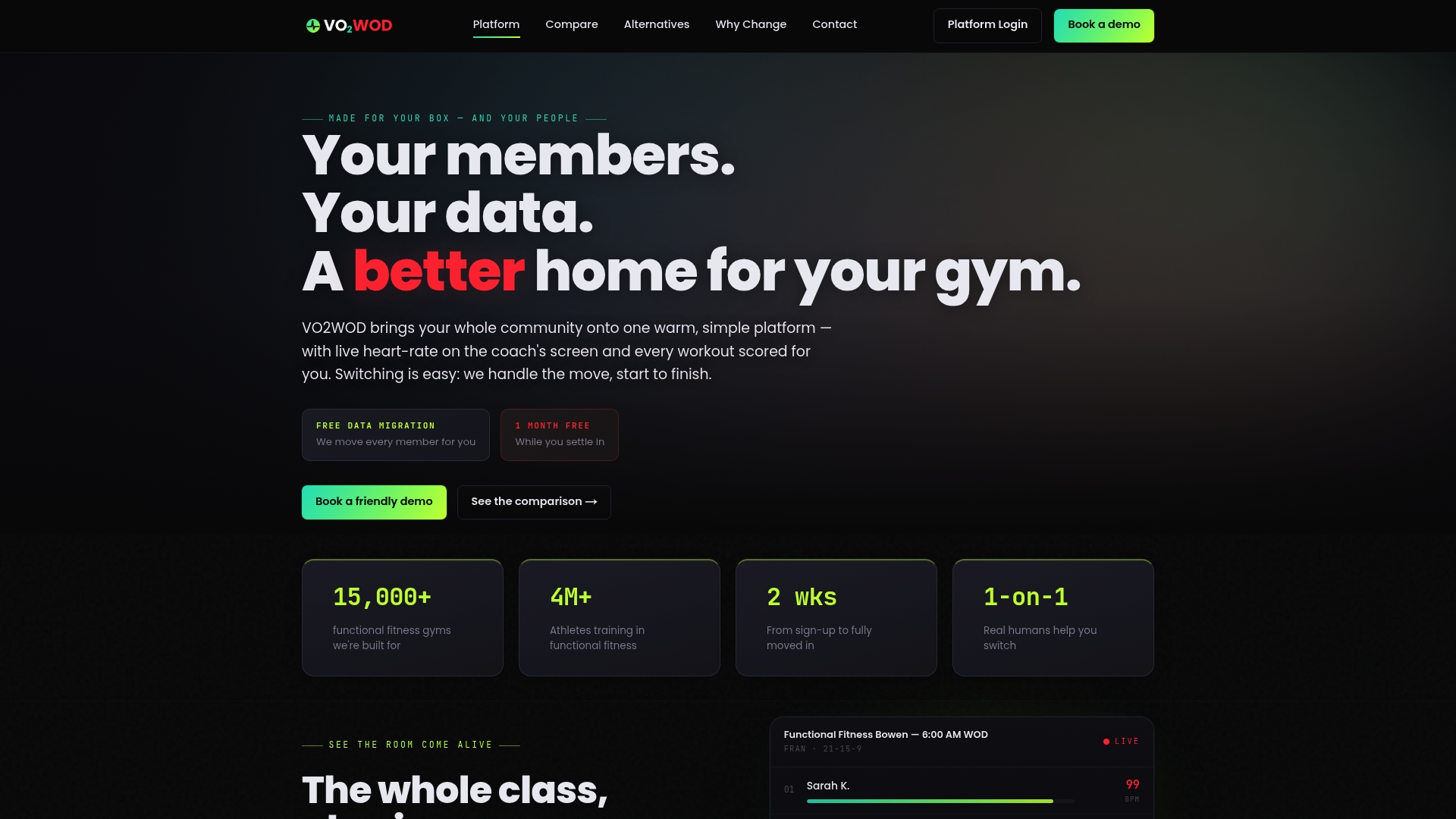
If your gym runs on a mix of spreadsheets, a door system, and a scheduling app, it is hard to cross-check anything. One platform makes the independent records we described above a by-product of normal operations.
FAQ
What is a buddy check-in at a gym?
It is when someone checks in using another person's membership, card, tag, QR code, or reservation. It also covers a coach or staff member marking someone present who is not there. The result is inaccurate attendance and, often, unpaid use of your facility.
Is buddy check-in the same as buddy punching?
The idea is the same. "Buddy punching" is the workplace term for clocking in for a coworker, and gym owners borrow it for members checking in for friends. The difference is the consequence: at a gym, it affects revenue, capacity, and liability, and employee timesheets only when staff are involved.
Do I need facial recognition to stop it?
No. A personal wristband or app QR, a profile photo shown at check-in, a coach who greets members by name, and a clear guest process stop most cases. Facial recognition and other biometrics add legal and privacy duties, so consider them only after lighter controls fall short.
Should I ban a member who checks in a friend?
That depends on your terms and your community. Some large clubs terminate membership right away. Many boutique gyms start with a private conversation, then a written warning, and keep termination for repeat or commercial misuse. Whatever you choose, put it in writing and apply it evenly.
Sources
- Our Policies, New York Sports Clubs
- Our Policies, Lucille by NYSC
- UND Wellness Center Participant Policy Manual
- 24/7 Access Agreement, JBLM
- Equinox Member Policies, April 2023
- Member Policies, 24 Hour Fitness
- Inclub Privacy Policy, 24 Hour Fitness
- FTC best practices for facial recognition
- FTC Policy Statement on Biometric Information
- NIST Special Publication 800-63A
- How To Stop Gym Membership Sharing With Access Control
- Automatic Tailgating Detection for Gyms
- Women's workout programs