

Valid consent for biometric data requires informed, specific, and freely given authorization obtained before any scan, faceprint, or fingerprint is captured, and most laws expect that authorization in writing or an equivalent recorded form. The Biometric Information Privacy Act (BIPA), the Federal Trade Commission (FTC), and the National Institute of Standards and Technology (NIST) each shape what "valid" means in practice. Requirements shift by state, and getting it wrong carries real litigation and enforcement exposure.
TL;DR:
- Consent for biometric data must be informed, specific, freely given, and obtained before any data capture occurs, with clear written or recorded notice.
- Blanket or vague notices, retroactive disclosures, or consent hidden in unrelated documents violate legal requirements and increase litigation risk.
- Illinois BIPA's private right of action drives higher litigation, requiring written notice, release, and strict retention limits, while other states like Washington and Texas have different enforcement bodies and standards.
- In employment or public settings, consent must include genuine alternatives and cannot be implied or conditioned on participation, with additional scrutiny for employer-collected data and public space disclosures.
- Biometric data retention should be purpose-driven and promptly deleted after use or upon withdrawal of consent, with secure storage, detailed logging, and vendor contractual protections to minimize exposure.
Table of Contents
- What Makes Consent For Biometric Data Legally Valid?
- How Do State Biometric Privacy Laws Differ?
- Does Consent Work Differently for Employees and in Public Spaces?
- How Do You Draft a Legally Robust Biometric Consent Form?
- What Are the Retention, Deletion, and Sharing Rules Tied to Consent?
- How Do You Operationalize Consent Day to Day?
- Applying Consent Best Practices in Gyms and Fitness Facilities
- What Happens After Consent Is Withdrawn or a Breach Occurs?
- Key Laws, Regulator Guidance, and Templates
- Author Perspective: Balancing Innovation and Individual Control
- An Adjacent Option: How Gym-Management Software Handles Consent Records
- Sources
What Makes Consent For Biometric Data Legally Valid?
A signature on a waiver is not consent. Neither is a checkbox buried in a 40-page membership agreement, nor a sign at the front door that says cameras are running. Valid consent for biometric data has four components that regulators and courts keep coming back to: it must be informed, specific, freely given, and secured before any capture happens.
"Informed" means the person actually understands what is being collected and why, not that they had the theoretical opportunity to read a disclosure. "Specific" means the notice names the biometric identifier (fingerprint, iris scan, facial geometry, voiceprint) and the exact purpose it will serve, not a catch-all phrase like "for business operations." "Freely given" means no one was pressured, and no service was withheld as leverage. "Before" means before, not after the scanner already logged the data and someone got around to explaining it later.
Businesses should give clear, written notification detailing the specific purpose, the retention period, and the exact use of the data, and that notice has to land before capture, according to compliance guidance on biometric information protections. That single requirement, notice before collection, trips up more companies than any other part of the process. Retailers roll out facial recognition for loss prevention, gyms add fingerprint check-in, and hospitals deploy palm-vein scanning for patient identification, all while treating the consent form as paperwork to clean up after launch.
Here's where it typically breaks down:
- Blanket opt-ins. A single "I agree to the terms of service" checkbox covering fifteen unrelated data uses does not satisfy specificity.
- Vague purpose statements. "To improve your experience" tells a person nothing about what happens to their faceprint.
- Retroactive notice. Collecting first and disclosing later voids the "before capture" requirement outright.
- No retention timeline. Silence on how long data is kept, or when it gets deleted, is itself a defect under most state statutes.
- Consent hidden in unrelated documents. Wrapping biometric consent inside a general liability waiver dilutes specificity and confuses the record.
The FTC has been explicit that surreptitious or deceptive biometric collection can trigger enforcement under its unfairness and deception authority, independent of any state law violation, according to its policy statement on biometric technologies. That means a company can comply with a state statute on paper and still face federal action if its actual practice misleads users about what is happening to their data.
A weak notice looks like this: "By using this app, you consent to our data practices, including biometric identifiers, as described in our Privacy Policy." No purpose, no retention window, no plain-language explanation.
A defensible notice looks like this: "We will capture your fingerprint to verify your identity at check-in. We store this data for as long as your membership is active, plus 30 days, and delete it automatically afterward. We do not sell or share this data with third parties. You may withdraw consent at any time by contacting [email/phone]."
The difference is not tone. It's specificity you can point to later if someone asks what you told the person and when.
Written consent matters for a second reason beyond the legal minimum: recordkeeping. If a regulator or plaintiff's attorney ever asks you to prove someone consented, "we probably mentioned it" is not a defense. A dated, versioned, retrievable consent record is.
How Do State Biometric Privacy Laws Differ?
There is no single American biometric privacy law. Instead, there's a patchwork, and the patchwork is getting denser every legislative session, according to a review of the current regulatory landscape. Illinois set the template that everyone else measures themselves against, and it remains the state that generates the most litigation by a wide margin.
BIPA (Illinois) requires written notice and a written release before collection, sets retention and destruction limits, and restricts disclosure to third parties without additional consent. What sets BIPA apart from almost every other state biometric law is its private right of action: individuals, not just the attorney general, can sue directly, according to the statute's text. That single provision is why BIPA drives so much litigation risk. Companies that would never face a state enforcement action under a Texas or Washington-style statute can still get sued by an individual employee or customer under BIPA, and class-action exposure has produced multimillion-dollar settlements across retail, hospitality, and tech.
Washington's RCW 19.375 requires notice and consent before enrolling a biometric identifier in a database for a commercial purpose, and it imposes its own storage and disclosure duties, per the statute. Unlike BIPA, Washington does not grant individuals a private right of action. Enforcement runs through the state attorney general, which changes the risk calculus considerably: fewer lawsuits, but real exposure if the AG's office decides to act.
Texas's Capture or Use of Biometric Identifier Act (CUBI) follows a similar structure to Washington, requiring notice and consent before capture and limiting sale or disclosure, with enforcement handled by the Texas attorney general rather than private plaintiffs. Texas has used that authority aggressively in recent years against companies collecting biometric data without adequate notice.
Beyond these three, a growing list of states regulate biometric identifiers either through dedicated statutes or as a category within broader consumer privacy laws, and the trend is toward more prescriptive deletion timelines rather than looser ones.
| Jurisdiction | Consent required before capture | Private right of action | Enforcement body |
|---|---|---|---|
| Illinois (BIPA) | Yes, written release | Yes | Individuals + AG |
| Washington (RCW 19.375) | Yes | No | Attorney General |
| Texas (CUBI) | Yes | No | Attorney General |
Practical takeaway for anyone operating across state lines: build your consent process to the strictest applicable standard, which today still means BIPA-level rigor, and reassess every time you add a new biometric feature or expand into a new state. A compliance approach that worked last year for a single-location business may not cover a second location in a different jurisdiction.
Does Consent Work Differently for Employees and in Public Spaces?
Employment settings distort what "freely given" means. An employee asked to consent to fingerprint time-clocking or facial recognition access badges is not in the same position as a customer choosing whether to use a retailer's app. Refusing might mean disciplinary action, a demotion, or in some workplaces, functional termination by attrition. That power imbalance is exactly why several state laws, and FTC guidance more broadly, treat employer-collected biometric consent with heightened scrutiny.
- Offer a genuine alternative. If an employer wants biometric time-clocking, it needs a non-biometric option, a PIN code or badge swipe, that carries no penalty for choosing it.
- Document the choice, not just the enrollment. Record that the employee was offered an alternative and voluntarily selected biometric enrollment, not just that they signed a form.
- Separate biometric consent from employment conditions. Never frame consent as a condition of continued employment in the disclosure language itself, even if that is the practical effect.
- Reassess consent when technology changes. Upgrading from a fingerprint scanner to facial recognition is a new collection event that needs its own notice and consent, not a rollover of the old one.
Public spaces raise a different problem: implied consent. A sign at a stadium entrance reading "facial recognition in use" does not meet the informed, specific, and freely given standard in most jurisdictions, because attendees who object often have no practical way to opt out short of not attending. Best practice is a genuinely accessible opt-out lane or process, posted well before the point of no return, not just a disclosure notice.
Law enforcement access is its own category. When a subpoena, warrant, or other valid legal process compels disclosure of biometric records, companies generally must comply regardless of the original consent scope, but that compulsion should be documented, scoped narrowly to what the legal process actually requires, and logged as an exception in your consent records so the disclosure doesn't get mistaken for a policy violation later.
How Do You Draft a Legally Robust Biometric Consent Form?
A consent form that actually holds up in an audit or a lawsuit needs specific components, not general reassurances. Building one from scratch, or auditing an existing one, comes down to checking for these elements in order.
- Collector identification. Name the exact entity collecting the data, not a parent company or a generic brand name that doesn't match your legal filings.
- Biometric type, named specifically. "Fingerprint," "facial geometry," "iris scan," or "voiceprint," not "biometric information" as a catch-all.
- Explicit purpose statement. State the one or two specific uses (identity verification at check-in, access control) rather than a broad operational justification.
- Retention period, in plain terms. A fixed duration or a clear trigger event ("deleted 30 days after membership ends") rather than "as long as necessary."
- Sharing and disclosure terms. Name any third parties who will receive the data, or state plainly that none will.
- Withdrawal mechanism. A specific, working method (email address, phone number, account setting) for revoking consent.
- Contact point for data requests. Who to reach for questions, corrections, or deletion requests.
A minimal notice for a low-risk use case might read: "[Company] will scan your fingerprint solely to verify your identity when checking in. We retain this data only while your account is active and delete it within 30 days of cancellation. We do not sell or share this data. Contact privacy@[company].com to withdraw consent."
An expanded notice for a higher-risk use, say, facial recognition tied to a marketing analytics platform, needs more: named third-party processors, a description of any automated decision-making involved, and a more detailed retention schedule broken out by data category.
On signatures: electronic consent generally satisfies a "written release" requirement under the Uniform Electronic Transactions Act (UETA) and the federal ESIGN Act, but only if the process links an affirmative action, a checkbox click, a typed name, a tap to accept, to a stored, timestamped record showing clear intent to agree, according to the same compliance guidance cited earlier. A pre-checked box does not show intent. A deliberate click on a clearly labeled button does.
Pro Tip: Store the exact version of the notice a person saw at the moment they consented, not just a link to your current privacy policy. Policies change; the record has to reflect what the person actually agreed to on that date.
For audit and litigation defense, retain: the timestamped consent record, the exact notice version shown, the method of consent (click, signature, verbal with recording), and any subsequent modification or withdrawal events tied to that same person.
What Are the Retention, Deletion, and Sharing Rules Tied to Consent?
Retention periods should be tied to purpose, not convenience. If biometric data exists to verify identity at check-in, there's no legitimate reason to keep it five years after someone cancels a membership. Most state statutes either specify a maximum retention window or require deletion "as soon as the purpose is satisfied," and vague internal policies that don't name a number tend not to survive scrutiny.
- Set a deletion trigger tied to an event: account closure, contract termination, or a fixed calendar date, whichever comes first.
- When someone withdraws consent, delete the underlying biometric data within a reasonable window, generally understood as prompt action rather than an open-ended "eventually."
- Log every deletion event the same way you log every consent event, with a timestamp and confirmation.
- Selling biometric data, or sharing it with a new third party for a purpose not covered in the original notice, requires fresh consent. You cannot retroactively expand scope under an old agreement.
- Contracts with processors and vendors handling biometric data on your behalf need their own data protection clauses specifying permitted uses, security obligations, and deletion requirements that mirror your own.
On security, NIST's identity-proofing and biometric guidance under SP 800-63 is the technical baseline most compliance teams point to when designing storage architecture, encryption standards, and access controls for biometric templates. Regulators generally expect encryption at rest and in transit, strict access limits to raw biometric data, and separation between biometric templates and other identifying information. Stronger programs go further, running periodic penetration testing and maintaining incident response plans specific to biometric data exposure, since a leaked faceprint or fingerprint can't be reset the way a password can.
How Do You Operationalize Consent Day to Day?
Writing a good consent form solves half the problem. The other half is making sure the notice actually appears before capture, every time, for every person, and that you can prove it later.
- Build the notice into the enrollment flow itself, not as a link someone can skip. The screen showing "scan your fingerprint here" and the screen showing the consent notice should be the same screen, or sequential screens the person cannot bypass.
- Version every notice. When you update purpose, retention, or sharing terms, that's a new version, and everyone should re-consent under the new language rather than being grandfathered under the old one.
- Capture metadata with every consent event: timestamp, notice version, device or context (in-app, in-person kiosk, web), and method of affirmative action.
- Trigger renewal when scope changes. Adding a new biometric use case, say, expanding from fingerprint check-in to facial recognition for a loyalty program, requires new consent, not an assumption that the old one covers it.
Pro Tip: Run a privacy impact assessment (PIA) before adding any new biometric feature, not after launch. Reviewing risk, necessity, and less invasive alternatives on paper before deployment is far cheaper than retrofitting compliance after a complaint lands.
Staff training rounds this out. Front-line employees who enroll people in biometric systems need to understand why the script matters, not just that there is one. A staff member who paraphrases the consent notice from memory, skipping the retention detail because it feels unnecessary, has just created a compliance gap that no template can fix.
Applying Consent Best Practices in Gyms and Fitness Facilities
Functional fitness gyms sit right in the middle of this issue because live heart-rate tracking, wearable syncing, and biometric check-in are becoming standard features, not novelties. A gym that adds heart-rate monitoring to its classes is collecting biometric data in real time, and the same rules apply: notice before capture, specific purpose, a working opt-out.
The practical version looks like this: before a member's heart rate ever displays on a leaderboard or gets logged to their profile, they should see a clear notice explaining what's tracked (heart rate during class), why (performance feedback and workout scoring), and how long it's retained. Members who don't want live tracking need a real alternative, manual check-in or a PIN code entry, that doesn't exclude them from the class.
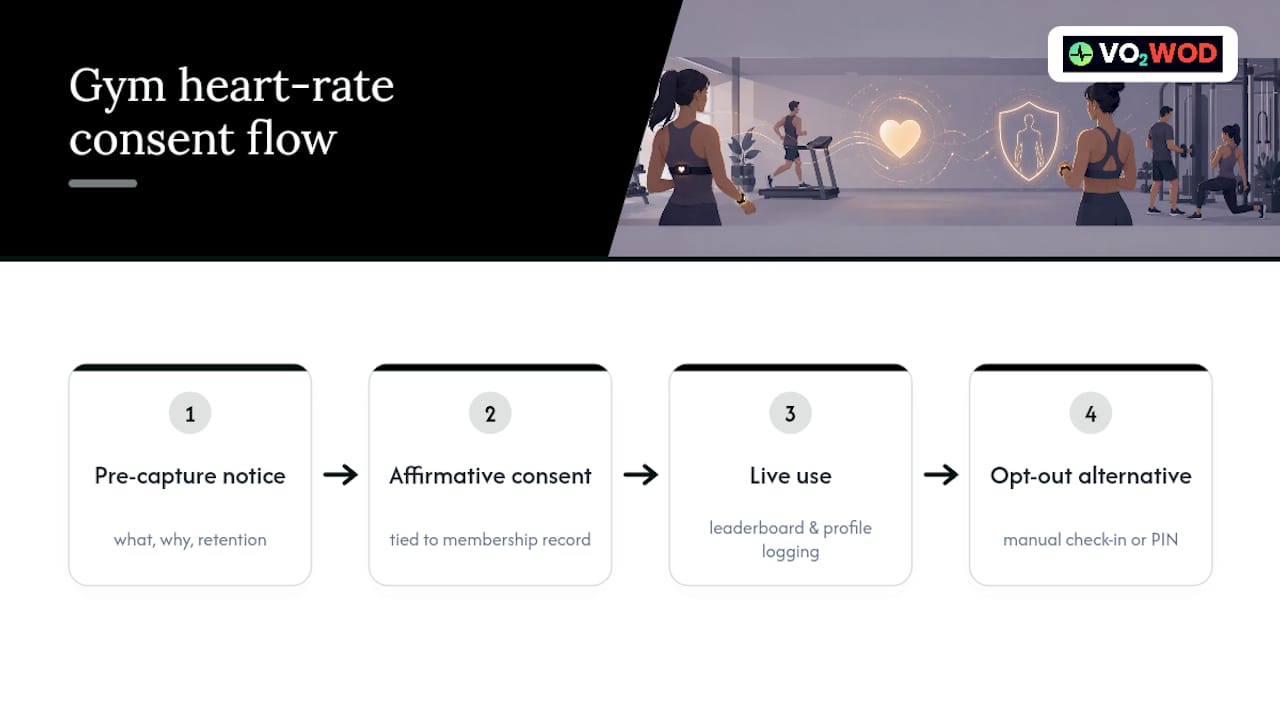
Gym operators who manage this well tend to treat consent as part of the membership record, not a separate filing cabinet. Tying consent status directly to membership data means a front-desk staffer checking someone into class can see, instantly, whether that member has consented to heart-rate tracking and wearable integration, without digging through a paper waiver from eighteen months ago.
This is where a platform like VO2WOD fits into the operational picture. Its wearable integrations with Garmin, Apple, Fitbit, and Samsung devices connect member data to class scoring automatically, and centralizing that data alongside membership records makes it far easier to keep consent status current and tied to the right person, rather than scattered across intake forms and spreadsheets. For gyms migrating from another system, having consent records move over cleanly, rather than getting rebuilt from scratch, matters more than most owners realize until they're mid-migration without them.
What Happens After Consent Is Withdrawn or a Breach Occurs?
Withdrawal is not the end of the paperwork, it's the start of a new obligation. The moment someone withdraws consent, stop processing their biometric data for the purpose they revoked, immediately, not at the next billing cycle or the next data cleanup sprint.
- Halt any active use of the data tied to the withdrawn purpose the same day the request is received.
- Delete the underlying biometric data according to your stated policy, and confirm the deletion in writing to the person who requested it.
- Log the withdrawal event with the same rigor as the original consent: timestamp, method, and confirmation of action taken.
- If the data was shared with a third-party processor, notify that processor of the withdrawal and confirm their own deletion.
Breach response follows a different sequence, but the discipline is the same. Contain the exposure first, cut off the access point or system that leaked the data. Investigate scope: which records, how many people, what type of biometric identifier. Notify regulators and affected individuals where required, since several state biometric laws and general data breach statutes carry specific notification timelines that don't leave room for a slow internal review process. Preserve evidence throughout, logs, access records, and the investigation timeline itself, because that documentation becomes the difference between a company that responded responsibly and one that looks like it tried to bury the problem.
Regulators and courts consistently treat prompt, documented remediation as a mitigating factor. A breach handled transparently, with clear notification and a documented fix, carries materially less enforcement and litigation risk than the same breach discovered later through a complaint or a reporter's inquiry.
Key Laws, Regulator Guidance, and Templates
For readers who want to go straight to the primary sources rather than a summary of them, these are the documents worth bookmarking:
- Illinois BIPA statute text, the full legal language behind written release requirements and the private right of action.
- Washington RCW 19.375, the state's notice-and-consent framework for commercial biometric databases.
- FTC policy statement on biometric technologies, the federal agency's stance on deceptive and surreptitious biometric collection.
- NIST SP 800-63 guidance, the technical standard most compliance teams cite for identity-proofing and biometric system security.
- Compliance guide to biometric information protections, a practical breakdown of written release requirements and electronic signature validity.
Author Perspective: Balancing Innovation and Individual Control
The biggest misconception in this space is that biometric compliance is a legal problem to be solved once and filed away. It isn't. Every new sensor, every new wearable integration, every new "just scan your face for faster checkout" feature resets the clock on what counts as informed consent, because the person agreeing to yesterday's fingerprint scanner never agreed to today's facial recognition rollout.
The businesses that stay out of trouble aren't the ones with the cleverest legal language. They're the ones that treat transparency as a default setting rather than a disclosure obligation to satisfy after the fact. Give people a real choice, document it honestly, and revisit that choice every time the technology changes. That habit costs less than a single BIPA class action and builds more trust than any privacy policy ever will.
— Marcus
An Adjacent Option: How Gym-Management Software Handles Consent Records
Some gym management software gives functional fitness gyms a way to keep consent records tied directly to the membership data they already manage, instead of chasing down paper waivers when a member asks what they agreed to.

If your gym already runs heart-rate tracking during classes or syncs member wearables, you're collecting biometric data whether or not your paperwork has caught up to it. Such software can centralize consent status alongside membership records, class access, and check-in, so front-desk staff can see at a glance who has opted into live tracking and who hasn't, without digging through old intake forms. Wearable integrations with Garmin, Apple, Fitbit, and Samsung may connect to the same member profile that holds their consent history, which can make recordkeeping less of a scramble if the data needs to be produced.
This kind of software is not a substitute for legal advice or a signed consent form, but it can be a practical way to keep those records organized and current. Some gym software providers offer free data migration and a complimentary first month to help gyms see how consent tracking fits into daily operations before committing. Compare the features against other functional fitness platforms or start with a walkthrough of the full system to see whether it fits how your gym already runs classes.