

A workable no-show fee policy sets a cancellation cutoff within about half a day to a full day before class, charges a modest fee that's automated and disclosed before booking, and pairs enforcement with a fair exception path for medical issues and first-time mistakes. The fee exists to change behavior, not to pad revenue. Automation and documented consent do the actual enforcement work.
TL;DR:
- Fees should be proportionate to the value of the missed session, typically $15 to $25 for no-shows, scaled for peak hours and private sessions.
- Automated systems must handle fee collection, policy display, consent capture, waitlist management, and reporting to avoid staff errors and disputes.
- Clear, repetitive communication about the policy via booking screens, reminders, and staff scripts improves adherence and minimizes member frustration.
- Restricting repeat offenders' booking windows or applying graduated enforcement can effectively address patterns without solely relying on fees.
Table of Contents
- What Should a No-Show Fee Policy Actually State?
- What Should You Charge for a Missed Booking?
- How Do You Enforce a No-Show Policy Without Adding Staff Work?
- How Should You Communicate the Policy to Members?
- What Alternatives Work Better Than Fees for Repeat No-Shows?
- How Do You Know If the Policy Is Working?
- An Operator's View on Fees, Fairness, and What Actually Sticks
- Let Your Software Handle the Enforcement, Not Your Front Desk
- Sources
What Should a No-Show Fee Policy Actually State?
A policy that holds up under a member complaint or a chargeback dispute needs specific components, not vague language about "respecting other members' time." Every rule needs a number attached to it and a place where members agreed to it.
Here's what belongs in the written policy:
- Cancellation window: approximately half a day for standard group classes, up to a full day for specialty workshops or small-group training, and a longer window for private sessions where a coach's time is fully blocked.
- Fee structure: a flat dollar fee for drop-in and pack members, or a forfeited class credit for members on class-pack plans, scaled to what a single session actually costs the member.
- Consent capture: a checkbox or digital signature at signup and again at first booking, timestamped and stored, not buried in a PDF nobody reads.
- Exceptions: a documented process for medical emergencies, weather closures, and one penalty-free grace pass per rolling 90 days for first-time mistakes.
- Membership tiering: unlimited members might face a stricter cutoff since they book more freely, while pack holders lose a credit instead of paying cash.
The fee mechanics matter more than most owners assume. A flat $20 charge on a $15 drop-in class reads as punitive, and members notice math that doesn't add up. Tying the fee to the actual session value, and stating that logic in the policy itself, is what makes a no-show fee proportionate and enforceable rather than arbitrary.
What Should You Charge for a Missed Booking?
Fee size is where most new policies go wrong. Charge too little and nobody changes behavior. Charge too much and you get chargebacks, angry reviews, and members who quietly cancel their membership instead of arguing.
Industry benchmarks give a useful anchor. Boutique studios commonly charge a modest late cancellation fee and a somewhat higher no-show fee, often aligned with the single-class price for members on multi-class packs. These fees aim to reflect the value of the reserved seat, not as additional penalties.
Fee benchmark by scenario:
- Late cancel (inside the window, advance notice given): $10 to $15, or a half-credit forfeit.
- True no-show (no notice at all): $15 to $25, or a full credit forfeit.
- Private or small-group session: full session price, since a coach blocked dedicated time.
- Peak-hour class (6 a.m., evening prime time): consider the higher end of the range, since these slots fill fastest and cost the most in lost revenue when empty.
Studios that pair a clear window with consistent communication about it see no-shows drop by 30 to 50 percent within a few months, with the biggest gains showing up in exactly those peak-hour slots. That's the number that should drive your fee decision more than any competitor's rate card. A first-offense waiver, where the first no-show gets a warning instead of a charge, tends to buy enough goodwill to make the fee stick once it's actually enforced.
How Do You Enforce a No-Show Policy Without Adding Staff Work?
Enforcement fails when it depends on a front-desk employee remembering to charge someone three days later. It works when the software does the remembering.
Your booking platform needs these features at minimum:
- Policy display at booking. The cutoff time and fee amount show up before the member confirms a reservation, not after.
- Consent checkbox. A one-time acknowledgment at signup, re-surfaced if the policy changes.
- Card on file. Payment method stored securely so the fee charges automatically instead of requiring a phone call.
- Auto-charge with waiver override. The system bills the fee on schedule, but staff can reverse it in one click for a documented exception.
- Waitlist integration. When someone cancels late, the system should pull the next waitlisted member in automatically, partially recovering the lost spot.
- Reporting dashboard. A monthly view of no-show rates, fees collected, and fees waived, broken out separately from late cancellations.
Software that shows the cutoff during booking, captures acknowledgment at checkout, and supports automated rules by membership type is what actually cuts down on staff friction and member disputes. Keep a simple log of every waived fee and why, since that record is what protects you if a member disputes a charge with their card issuer.
Pro Tip: Map each policy rule to a specific software setting before you launch. If your platform can't auto-charge by membership type or show the policy at checkout, you're building a policy your system can't actually enforce.
How Should You Communicate the Policy to Members?
Members don't fight fair fees. They fight fees that feel like a surprise. The fix is repetition, not clever wording.
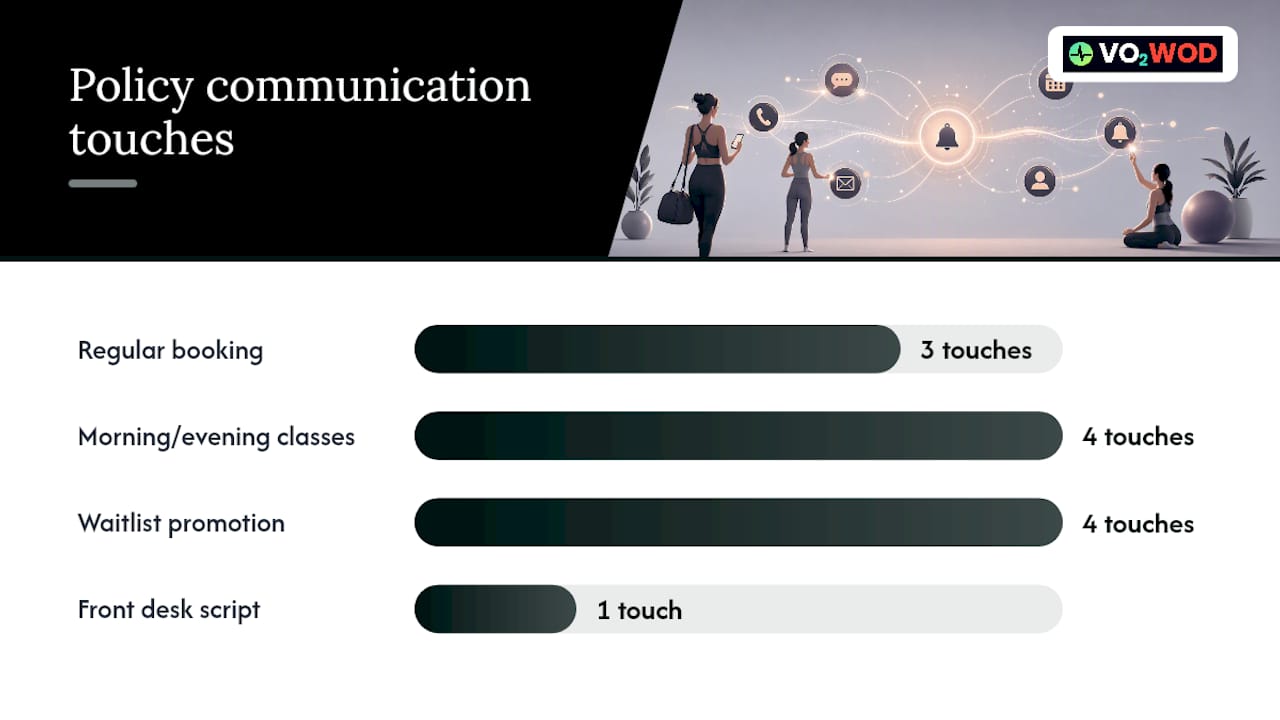
Put the cutoff and fee amount in the booking screen, the confirmation email, and a reminder 24 hours before class. Send a second, shorter reminder two hours out for morning and evening classes where forgetting is most common. Waitlist members need a distinct message when they're moved into a class, since a different cutoff often applies to them.
- Booking screen: "Cancel by [time] to avoid a $[amount] fee."
- 24-hour reminder: "You're booked for [class] tomorrow at [time]. Cancel by [cutoff] if you can't make it."
- Waitlist promotion: "You're in! Your cancellation window is now [time]."
Front desk staff need a script too: acknowledge the frustration, check for a documented exception, and explain the reasoning once without being defensive. Reminders paired with a visible policy are strongly linked to large drops in no-shows because members simply forget less often when the deadline is in front of them repeatedly.
Pro Tip: Never let the first time a member hears about the fee be the moment they're charged for it. That's the single biggest driver of angry reviews.
What Alternatives Work Better Than Fees for Repeat No-Shows?
Money isn't always the right lever. A member who no-shows once might just need a reminder. A member who no-shows five times needs a structural change, not a bigger fine.
- Shorten the advance-booking window for repeat offenders, from two weeks down to 48 hours.
- Place a temporary 24-hour hold on new bookings after a second no-show in 30 days.
- Use graduated enforcement: reminder on offense one, warning on offense two, booking restriction on offense three.
- Reserve fee waivers for genuine first mistakes and documented medical issues, and reserve restrictions for patterns.
Limiting how far ahead a repeat offender can book protects the class roster without feeling like a punishment, since it's a scheduling adjustment rather than a charge on their card.
How Do You Know If the Policy Is Working?
Track four numbers monthly: no-show rate, late-cancel rate, class fill rate, and fee revenue against estimated lost revenue from empty spots. Run the policy for 30 to 60 days before changing anything, since shorter windows won't show a real pattern.
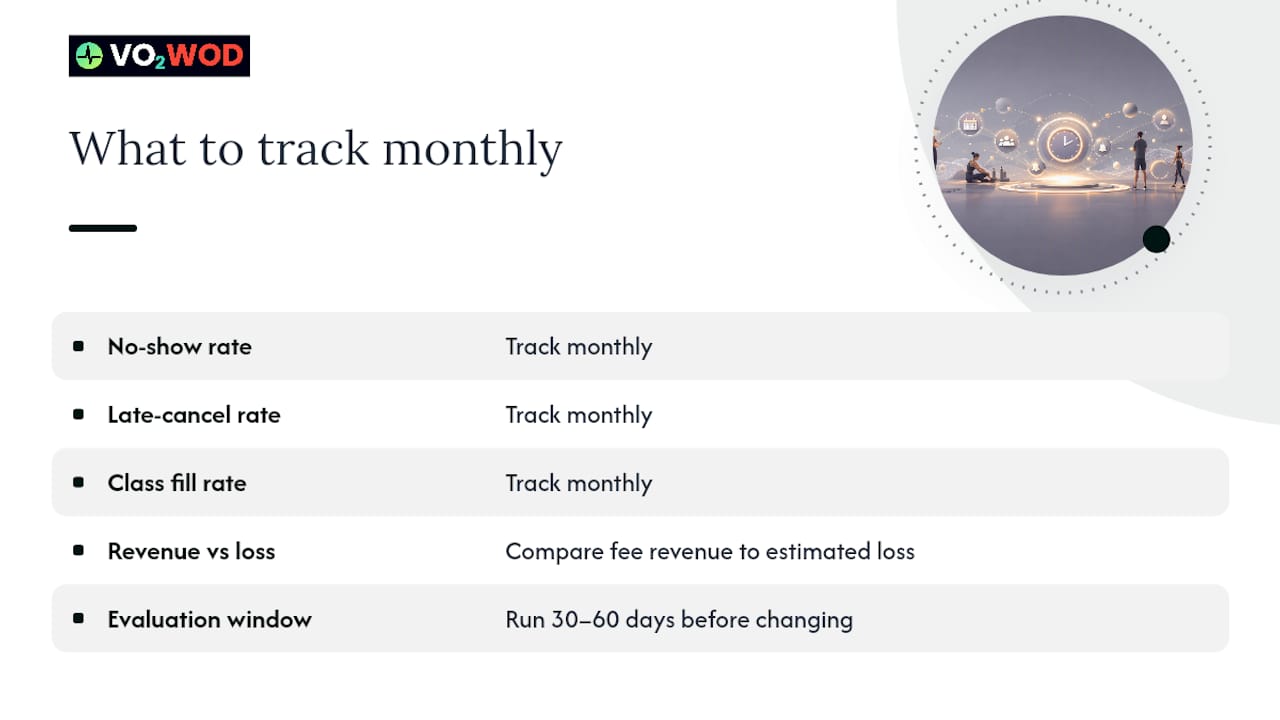
Test one variable at a time. Try a second reminder text, then adjust the fee amount, then reword the consent language. If no-shows aren't dropping after two full cycles, escalate to shorter booking windows before raising the fee.
An Operator's View on Fees, Fairness, and What Actually Sticks
The gyms that get this right treat the fee as a nudge, not a punishment. One studio dropped its no-show rate noticeably just by moving the cutoff time into the confirmation email instead of leaving it buried in a signup PDF.. The lesson holds regardless: members don't resent fair rules. They resent rules they never saw coming.
— Marcus
Let Your Software Handle the Enforcement, Not Your Front Desk
Every feature this article recommends, from policy display at booking to auto-charge with a waiver override, is easier to run when your booking platform is built for functional fitness gyms specifically, not adapted from a generic scheduling tool.

VO2WOD handles the mechanics your policy depends on: card-on-file billing, automated class scheduling, waitlist promotion, and reporting that separates no-shows from late cancels so you're not digging through spreadsheets to see what's actually happening. Consent capture happens at booking, so you have a documented timestamp if a member disputes a charge later. Gyms switching over get free data migration and one month of complimentary service, so your existing member records and booking history move over without a manual re-entry project. If you're currently comparing platforms, the side-by-side breakdown of functional fitness software options is a reasonable next stop before you commit. Book a walkthrough and see how your current cancellation window would translate into automated rules.
Sources
The Smart Health Clubs no-show benchmark analysis grounds the fee ranges and behavior-change data used throughout. The Bookicorn no-show fee guide covers the legal disclosure and proportionality standards that keep a policy enforceable. Mindbody's operator tips informed the reminder cadence recommendations, and studio operators managing private sessions with dedicated equipment can find operational context at Pilates de Mexico.