

Member milestone tracking means recording the moments that matter in a member's time at your gym, then acknowledging them on purpose. Those moments include a first class, a tenth visit, a six-month anniversary and a new personal record. The practice works because attendance is fragile in the first months and a well-timed acknowledgment gives a member a reason to come back. This guide covers what to track, how to set it up, and how to keep recognition respectful.
TL;DR
- Track two kinds of milestones: attendance and tenure (visits, anniversaries, streaks) and performance (personal records, benchmark scores, effort).
- Attendance falls fast. One study of 1,726 new members found average monthly visits dropped from 7.48 in month one to 0.92 in month twelve, so the first 60 to 90 days deserve the most attention.
- Use a central record, a few clear triggers and a cap on how often you message each member.
- Ask members how they want to be recognized. Private, small-group, public and none should all be real options.
- Software that scores workouts and logs check-ins removes the manual entry that makes spreadsheets fall apart.
Table of Contents
- What member milestone tracking means in a gym
- Why the first 60 to 90 days decide so much
- Which milestones are worth tracking
- Tracking performance milestones in a functional fitness gym
- How to put a milestone tracking process in place
- Our perspective on milestones
- Recognize members without overstepping
- Keep the message cadence humane
- What retention research says about the bigger picture
- Set it up in VO2WOD
- FAQ
- Sources
What member milestone tracking means in a gym
A milestone is a defined moment worth acknowledging. In a functional fitness gym it usually falls into one of four groups:
- Joining moments: the first class, the first week, the first month.
- Consistency moments: 10, 50 or 100 check-ins, or a run of consecutive weeks with at least three classes.
- Tenure moments: a three-month, six-month or one-year anniversary.
- Performance moments: a first rope climb, a first Rx workout, a new one-rep max or a benchmark workout beaten.
Tracking means the system notices each moment without a coach having to remember it. Acknowledging means a person or an automated message does something with it: a text, a push notification, a whiteboard shout-out, a handwritten card.
The point is not gamification for its own sake. Most members who quit never told anyone why, and many simply drifted. Milestones give you a regular, natural reason to talk to a member before that drift becomes a cancellation.
Why the first 60 to 90 days decide so much
Research on new members shows how steep the drop-off is. A 2020 study in the Journal of Sports Sciences followed the attendance of 1,726 new members for a year. Average attendance fell from 7.48 visits in the first month to 0.92 in the twelfth. The researchers also found that how often members attended in the first quarter, and whether they kept a stable time and place in month three, were linked to attendance later in the year.
A separate peer-reviewed study in Managing Sport and Leisure tracked 2,385 members across a chain of fifty fitness clubs for a year. It found that visit frequency strongly affects long-term retention, and that the first quarter shows a pattern that helps predict who stays.
What this means for you: early attendance is the best signal you have, and it is available from day one. You do not need a survey to know who is at risk.
A practical benchmark comes from an operator interviewed in Health & Fitness Business in November 2025. He suggests watching usage closely in the first 60 days, aiming for a new member to visit 20 times in that window, and following up with anyone who has come four times or fewer in the past 30 days. Treat those numbers as a starting point to adapt to your own schedule, since a gym with three classes a day has different rhythms than one with an open-gym model.

If you want the retention side in more depth, our guide to recovering hidden cancellations and fixing churn goes through how to find members who are quietly leaving.
Which milestones are worth tracking
More milestones is not automatically better. If a member gets a message every few days, the messages stop meaning anything. A short ladder of meaningful steps works better than a long list of trivia.
Here is a framework that suits a functional fitness gym. Adjust the numbers to your class frequency.
| Stage | Example milestones | Suggested acknowledgment |
|---|---|---|
| Onboarding | First class, third class, first full week | Coach welcome in person, short text or push notification |
| Habit forming | 10 visits, 20 visits within 60 days, first four-week streak | Badge in the app, a coach comment in class |
| Established | 50 visits, six-month anniversary, 10 consecutive weeks | Personalized stats summary, shout-out if the member agrees |
| Long term | 100 visits, one-year anniversary, 25 consecutive weeks | Personal note from the owner, a small gift or perk of your choosing |
| Performance | New PR, first Rx, benchmark improvement | Coach acknowledgment, leaderboard or movement history update |
Three habits keep the ladder useful:
- Make each milestone verifiable. A check-in count, a logged score or a recorded PR is evidence. A coach's memory is not.
- Tie milestones to behavior you want. If your goal is retention in the first quarter, put more steps early on and fewer later.
- Include milestones that are not about the body. Tenure, attendance and skill progress recognize effort without commenting on weight or appearance.
For a deeper look at how to group members so the right milestone reaches the right person, see our practical guide to member segmentation.
Tracking performance milestones in a functional fitness gym
Attendance tells you whether a member shows up. Performance data tells you whether showing up is paying off, and that is what keeps people motivated once the novelty fades.
Functional fitness gives you plenty to measure:
- Personal records in lifts, gymnastics skills and benchmark workouts.
- Workout scores across time, so a member can see the same benchmark improve.
- Movement history, such as the first time someone strings together unbroken pull-ups.
- Effort, which is where heart rate data adds something a whiteboard cannot show. A member who finishes mid-pack but works at a high effort level is making real progress, and a coach can say so.
This is the area where we built VO2WOD to help. It scores workouts automatically, keeps a movement library and personal-record history, and shows live heart rate during class for members using supported wearables from Garmin, Apple, Fitbit and Samsung. Coaches see effort in the moment and members see their history afterward, with no one retyping numbers into a sheet.
Coaches can then use that data to personalize. A member whose scores have stalled for six weeks may need a scaling conversation. A member who just hit a PR after months of work deserves a mention before the next class starts.
How to put a milestone tracking process in place
You can start with a spreadsheet, and many gyms do. The structure is what matters. A workable system has a central data source and automatic triggers that fire on specific events.
- Create one record per member. At minimum: name, join date, membership type, visit count, last visit date, and any milestones already reached. Add birthday and performance milestones only if you will actually use them.
- Define five to eight milestones. Use the ladder above. Write down what counts and who verifies it.
- Decide the acknowledgment for each. Some deserve a text, some a comment in class, some a note from the owner. Match effort to significance.
- Set triggers. A visit count hits 10, an anniversary date arrives or a PR is logged: something fires. If you do this by hand, build a weekly list of members approaching a milestone so coaches can plan to mention it.
- Add a risk trigger. Anyone below your early-visit benchmark gets a personal check-in from a coach, not a celebration message.
- Review monthly. Which milestones were reached, which messages were opened and who dropped off after reaching one.
The weak point in manual systems is data entry. Someone has to log every visit, every score and every date, and when the busiest week of the year hits, the log falls behind. Check-in through QR code or wristband, automatic scoring and triggered in-app messages take that burden away. Our walkthrough on turning on three gym messaging triggers shows a sensible order to start in, and our piece on milestone notifications and check-ins covers how to word them.
The same logic applies outside gyms. Any organizer who watches attendance patterns to keep people coming back is doing milestone tracking in another form, and using attendance trends for long-term retention shows how that thinking carries into league play.
Our perspective on milestones
Most gyms do not lose members because the programming failed. They lose them because the member stopped feeling known. A member who has come 50 times has told you something about themselves, and a coach who says so out loud changes how that member sees the gym.
We built VO2WOD around that idea. A functional fitness gym lives on community and on visible effort, so the software should capture both without adding paperwork. Automatic workout scoring and live heart rate in class mean a coach sees who is pushing and who is struggling in real time. Check-in, scoring, personal records and messaging live in one place, so a milestone can be triggered by what actually happened in the gym, not by someone's memory.
Our advice is to start small. Pick a handful of milestones, make sure each one is verifiable, and let coaches do the personal part. Software should find the moment. People should make it matter.
Marcus
Recognize members without overstepping
A milestone can feel wonderful to one person and exposing to another. Announcing a weight change, an age or an attendance record on a public board discloses information the member never agreed to share. Build consent into the system from the start.
- Offer recognition modes: private, small group, public or none. Ask at onboarding and let members change their mind at any time.
- Ask for specific permission. Agreeing to a shout-out for attendance is not agreeing to a before-and-after photo.
- Never make posting a condition of recognition. A member should be able to get the badge without appearing on your social feed.
- Avoid rankings that shame. A leaderboard for effort or consistency can motivate. A ranking that puts the same people at the bottom every week does the opposite.
- Use evidence, not recollection. Visit counts and logged scores are clear. A claim that someone "lost 10 pounds" rests on information you may not hold.
- Offer a way out. Any member can stop or remove future recognition.
Heart rate and wearable data are personal information too. Our checklist of seven data privacy controls is a good place to begin, and if you collect biometric data, our consent toolkit for biometric data explains what to put in front of members before you do. For specific legal questions in your state, talk to an attorney who handles privacy law.
Keep the message cadence humane
Over-communication is the quickest way to turn a nice gesture into noise. A simple rule helps: cap celebration messages at one per member per week, and when two milestones land together, combine them into one message. Reserve personal calls and texts from a coach for members who are slipping, since those carry more weight than any automated note.
Vary the channel as well. A push notification suits a small win. A personal word from a coach suits a six-month anniversary. A note from the owner suits a one-year mark. If members are responding to community more than to messages, our guide on building a gym community that members stay for offers ideas that do not rely on screens.
If you want to turn happy long-term members into new ones, anniversaries are also a natural moment to ask. Our ideas for automated gym referral programs show how to do that without sounding pushy.
What retention research says about the bigger picture
Milestones are one lever among several. The Association of Fitness Studios ran a Keys to Retention research report in 2017 with more than 600 studio owners and operators from all 50 US states. It set baseline retention figures by facility size, type and years in business and compared which retention strategies paid off best. That makes it a useful reference when you want to see how your own numbers compare with similar studios.
Price and convenience matter too. A December 2024 Sogolytics survey of 1,004 US adults found that 81% had not switched or left their gym in the past year. Among those who did leave, the top reasons were expensive fees at 28%, a shift to home workouts at 22% and an inconvenient location at 20%. Milestone tracking will not fix pricing or location, but it addresses the feeling of connection that makes members tolerate both.
Set it up in VO2WOD
VO2WOD is management software built for functional fitness gyms. It combines membership and recurring billing, class scheduling and reservations, QR or wristband check-in, a lead CRM, in-app messaging with milestones, a movement library with personal-record tracking and live in-class biometrics with automatic workout scoring in one platform. That means a milestone can be triggered by real activity, such as the 50th check-in or a new PR, without a coach updating anything by hand.
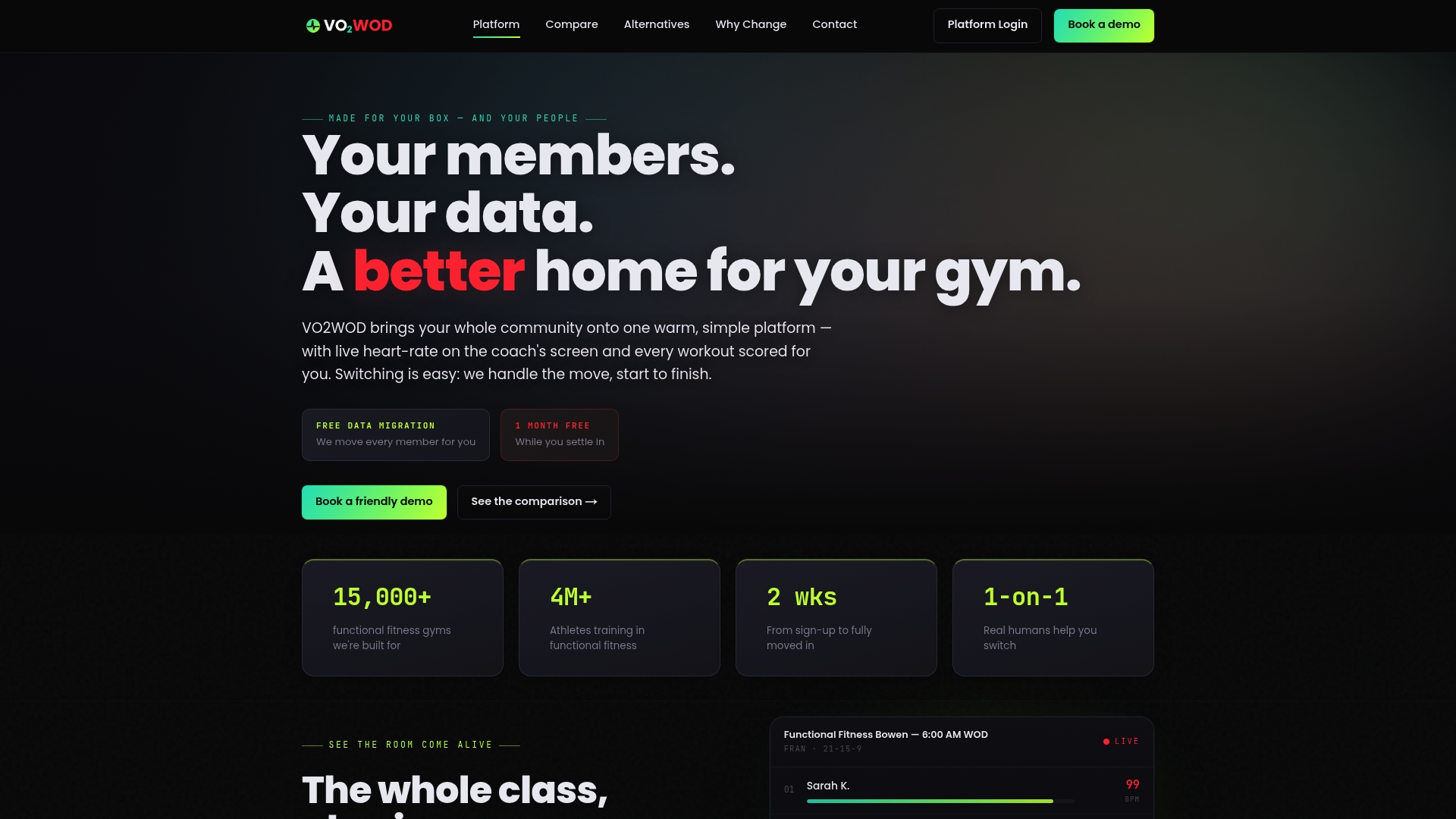
If you are switching from another system, we handle data migration for free, include one month of complimentary service and have a dedicated team to help you through the transition. You can see how VO2WOD compares on the alternatives page, learn what members and owners gain on the why switch page, or start at vo2wod.com to see the platform.
FAQ
What is member milestone tracking?
It is the practice of recording key moments in a member's journey, such as visit counts, anniversaries, streaks and personal records, and acknowledging them through messages, badges or coach recognition. The goal is to help members feel seen and to give you a natural reason to reach out early.
Which milestones should a new gym start with?
Begin with five to eight: first class, 10 visits, 20 visits in the first 60 days, 50 visits, a six-month anniversary and a one-year anniversary. Add performance milestones like a first PR once attendance triggers are running smoothly.
How often should I message members about milestones?
Keep celebration messages to roughly one per member per week at most, and combine milestones that land close together. Save personal check-ins for members whose attendance is slipping, since those matter more than automated notes.
Is it okay to post member achievements publicly?
Only with the member's specific permission for that information, channel and audience. Offer private, small-group, public and no-recognition options, and let members change their choice whenever they like.
Do I need software, or is a spreadsheet enough?
A spreadsheet works for a small gym that is willing to update it weekly. Software becomes worth it when manual entry starts slipping, because check-ins, scores and triggers can then update on their own.
Sources
- Why do new members stop attending health and fitness venues? (Journal of Sports Sciences, 2020)
- Should I stay or should I go? Visit frequency as fitness club retention predictor (Managing Sport and Leisure)
- Health & Fitness Business, Retention feature, November 2025
- The Keys to Retention Research Report, Association of Fitness Studios
- How Gyms Can Boost Retention and Attract Members, Sogolytics, December 2024 survey
- Using attendance trends for long-term retention, FlexLeague+