

A recurring reservation is one booking that repeats on a schedule: the same class, the same time, the same space, week after week. For a gym owner, the way to run them well is to set the repeat rule once in your scheduling software, tie it to clear cancellation and no-show rules, and let the system handle check-in and billing so nobody keeps a spreadsheet of who owns which spot. We built VO2WOD for functional fitness gyms with this routine in mind: class scheduling, reservations, QR or wristband check-in and recurring billing sit in one platform.
The phrase covers two different things, and the people searching for it are not all after the same one. Some want to rent a court or room every week from a city or a college. Others run a gym and want members to hold a standing spot in their favorite 6 a.m. class. This guide explains both briefly, then goes deep on the second, because that is where a gym owner can actually control the outcome.
TL;DR
- A recurring reservation repeats a booking on a fixed schedule. It is either a space rental (a team renting a gym) or a standing member spot in a class.
- Public facilities cap recurring blocks, usually at three to six months, and charge fees or forfeit them on late cancellation.
- For your own gym, the rules that matter are the booking window, the cancel cutoff, the waitlist and the no-show consequence. Write them down and automate them.
- Standing spots reduce empty classes only when a missed class is handled the same way every time, by the software and not by the front desk.
- Our platform combines scheduling, reservations, check-in and recurring billing, and migrates your existing data for free.
Table of Contents
- Two meanings of a recurring gym reservation
- What public facilities require for recurring bookings
- Why standing spots matter for your own gym
- How to set up recurring reservations in your gym
- Avoiding conflicts and double bookings
- Cutting no-shows without punishing loyal members
- A quick checklist before you launch
- Our perspective
- Run recurring reservations in one platform
- FAQ
- Sources
Two meanings of a recurring gym reservation
Space reservations. A youth league, a club or a company wants the gym floor every Tuesday night. The facility, often a city park district or a campus recreation department, reviews the request, checks it against its own programming and issues a permit. This is what most of the pages that rank for this search describe.
Member reservations. A member books a class, and the booking repeats. In a functional fitness gym this is the member who takes the 5:30 p.m. class Monday, Wednesday and Friday and wants the spot held without rebooking each week. This one belongs to the gym owner, the coach and the administrator, and it is the one you can shape with policy and software.
If you came to rent a space from a public facility, the next section shows what to expect. If you run a gym, skip ahead to the setup steps.

What public facilities require for recurring bookings
Public and campus facilities are a useful reference because they spell out the trade-offs that every gym faces: how far ahead to book, how long a standing booking lasts, and what happens when someone cancels.
| Facility | Recurring limit | Notice and process | Cancellation terms |
|---|---|---|---|
| City of Fresno athletic facilities | Three-month blocks | Quarterly applications; late requests are first-come, first-served | Refund if canceled at least 10 business days ahead; later cancellations forfeit fees |
| Conejo Park District | Up to six months; longer needs supervisor approval | Reviewed every six months | Full refund less the application fee with written notice at least 45 days ahead |
| LA Westwood Recreation Center | Quarterly permits | Applications at least 3 weeks before the start date; fees paid at least 2 weeks before | 50% of fees back if canceled more than 2 weeks ahead; none after |
The details differ, but the pattern is consistent. Recurring bookings come in fixed blocks, they are reviewed on a cycle instead of running forever, and the facility's own programs come first. Fresno also charges a 2.3% credit card convenience fee and a $15 refund processing fee. Westwood adds a 15% administrative fee on refunds and gives no credit for dates the group simply misses. Conejo may cancel a scheduled group with 30 days' notice and says it will try to relocate the activity.
What to prepare before you ask
If you are the one requesting space, plan on supplying the group name, the dates and times for the full block, the expected headcount and a payment method. Apply early: the Westwood procedures call for applications at least three weeks before the start date, and the agency notes that availability is not guaranteed until approval. Quarterly cycles mean that missing a deadline can push your start by months, so check the facility's own page for the current application windows rather than relying on last year's dates.
Why standing spots matter for your own gym
A gym is a habit business. IHRSA's 2021 Media Report puts the average at 109.5 club visits per member in 2019 and the average member tenure at 4.7 years. The same report found that 42% of gym-goers missed working out with other people and 36% missed their gym's sense of community. A member who has a recurring spot in a class with the same faces shows up in a pattern, and a pattern is what keeps a membership alive.
For functional fitness gyms that rely on small group classes, a standing spot does three practical things:
- It turns a decision into a default. The member does not have to remember to book every week.
- It gives you a predictable headcount, so coaching and programming can be planned around real numbers.
- It makes attendance visible. When a member with a standing spot stops showing up, you see it early and can reach out.
The same predictability is why large clubs use reservations for limited resources. National Fitness, for example, requires reservations for studio classes and select amenities, allows amenity bookings up to three days ahead, and cancels a booking automatically if the member has not checked in by the end of a 30-minute window. Those are rules you can copy in spirit: a short booking horizon, a cap per member and an automatic release of unused spots.
How to set up recurring reservations in your gym
Here is the routine, step by step, with the places it usually breaks.
1. Decide what repeats
Choose whether members repeat a specific class (Monday 6 a.m. strength), a time slot (any 6 a.m. class) or a pattern (three mornings a week). Specific-class standing spots are the simplest to explain and the easiest to enforce. Where it goes wrong: offering pattern bookings before your schedule is stable, so a changed class time quietly breaks dozens of reservations.
Clear class names help here too. Members book what they can recognize at a glance, and our guide to class naming templates for functional gyms shows how to label the schedule so standing spots are unambiguous.
2. Set the booking window and the repeat horizon
The public facilities above cap recurring blocks at three to six months and review them at the end. Do the same, in a lighter form: let a standing spot renew on a cycle you choose instead of running indefinitely, so inactive members do not hold seats forever. Where it goes wrong: no horizon at all, which leaves ghost reservations that crowd out new members. Our class reservations guide covers booking windows and rules in more depth.
3. Cap what any one member can hold
A per-member limit, like National Fitness's three bookings per amenity per day, keeps a handful of enthusiastic members from locking up every prime slot. Pick a cap that matches your membership tiers and state it on your schedule page.
4. Write the cancellation and no-show rules before you open the schedule
This is the step that makes recurring reservations work. Public agencies are blunt about it: a cutoff, a refund or forfeiture, a fee. A gym version is gentler but just as specific: a cancel cutoff (for example, a set number of hours before class), automatic release of the spot to the waitlist and a defined consequence for repeated no-shows. We publish a class reservation policy template and a set of copyable class cancellation policies you can adapt. If you charge a fee, tie it to your software so it applies without anyone making a judgment call at the front desk, as laid out in the no-show fee automation rules.
Where it goes wrong: policies that live in a PDF nobody reads and are applied inconsistently. A rule that is waived for some members and enforced for others costs you trust.

5. Connect reservations to check-in
A reservation only tells you who planned to come. Check-in tells you who did. When check-in is by QR code or wristband, as it is in VO2WOD, the system can mark attendance without a coach holding a clipboard, and the no-show rule has real data behind it. Where it goes wrong: separate tools for booking and check-in that never agree, leaving you to reconcile them by hand.
6. Notify members when something changes
Classes get canceled, coaches swap, holidays happen. Standing members should hear about it before they arrive. In-app messaging in our platform is built for this kind of communication. Where it goes wrong: changing the schedule and relying on members to notice.
Calendar visibility matters as well. Our write-up on calendar sync for gyms compares three approaches and a hybrid setup, so members see their standing classes in the calendar they already use.
7. Align billing with the reservation
A member with a standing spot is usually on a recurring membership, and the two should be linked so a lapsed payment is visible before the next class. Our guide to recurring billing for gyms walks through the setup. Fitness booking tools in other markets also pair recurring bookings with payments and automated reminders, as in this overview of recurring bookings for fitness studios, which shows how the scheduling and payment sides fit together.
Avoiding conflicts and double bookings
Conflicts come from three places: two reservations for one resource, a standing spot that collides with a schedule change, and a member holding overlapping bookings.
- One source of truth. Keep classes, reservations and check-in in one system. Every extra tool is a place where a booking can exist in one list and not the other.
- Capacity by class, not by room. If two classes share the floor, give each its own cap and its own start and end time, with a buffer for setup.
- Handle schedule changes deliberately. When you move or cancel a class, decide in advance what happens to standing spots: they move with the class, they pause or they are released. Tell members which.
- Use a waitlist. When a standing member cancels inside your cutoff, the spot should flow to the next person automatically.
- Review on a cycle. Like the quarterly reviews public facilities run, check every few months which standing spots are still used and which can be released.
Cutting no-shows without punishing loyal members
Standing spots only help when members show up. Our guide on reducing class no-shows covers the full toolkit. The core idea is to make canceling easy and no-showing visible. A one-tap cancel, a reminder before class and an automatic release at your cutoff do more than a harsh fee. Keep any penalty proportional and consistent, and apply it through the system so every member is treated the same way.
For gyms that also handle administrative compliance in an educational setting, such as campus recreation, attendance records matter beyond retention. Our piece on class check-ins for administrators covers what those records need to show.
A quick checklist before you launch
- Booking window and repeat horizon are defined.
- Per-member caps are set for each membership tier.
- Cancel cutoff, waitlist behavior and no-show consequence are written and automated.
- Check-in method is in place so attendance is recorded.
- Members know how they will be told about schedule changes.
- Billing is linked to membership status.
- You have a date on the calendar to review standing spots.
Our perspective
We look at recurring reservations as a retention tool first and a scheduling feature second. A member who has a spot waiting for them is a member who has already decided to come. Our job is to make that decision cheap for them and cheap for you.
The mistake we see in the way gyms are usually set up is the stack of disconnected tools: one for booking, one for billing, one for check-in, one for messaging. Every handoff is a place where a standing spot can fall out of sync with reality. That is why VO2WOD puts class scheduling and reservations, QR or wristband check-in, recurring billing, a lead CRM and in-app messaging in one platform, built specifically for functional fitness gyms.
We also think attendance should mean something beyond a checkmark. Live in-class heart rate tracking and automatic workout scoring give coaches real-time insight into how members work, and give members a performance history they want to keep building. A standing spot in a class where your effort is recorded and your progress is visible is a very different promise from an empty slot on a calendar.
If you are on another system today, moving should not be the obstacle. We migrate your data for free and a dedicated support team helps you through the transition.
Marcus
Run recurring reservations in one platform
VO2WOD is management software for functional fitness gyms, boutique studios and strength and conditioning facilities. It covers class scheduling and reservations, QR or wristband check-in, membership and recurring billing, a lead CRM, in-app messaging with milestones, a movement library with personal-record tracking and wearable integration with Garmin, Apple, Fitbit and Samsung. Live heart rate monitoring and automatic workout scoring show coaches how each class actually went.
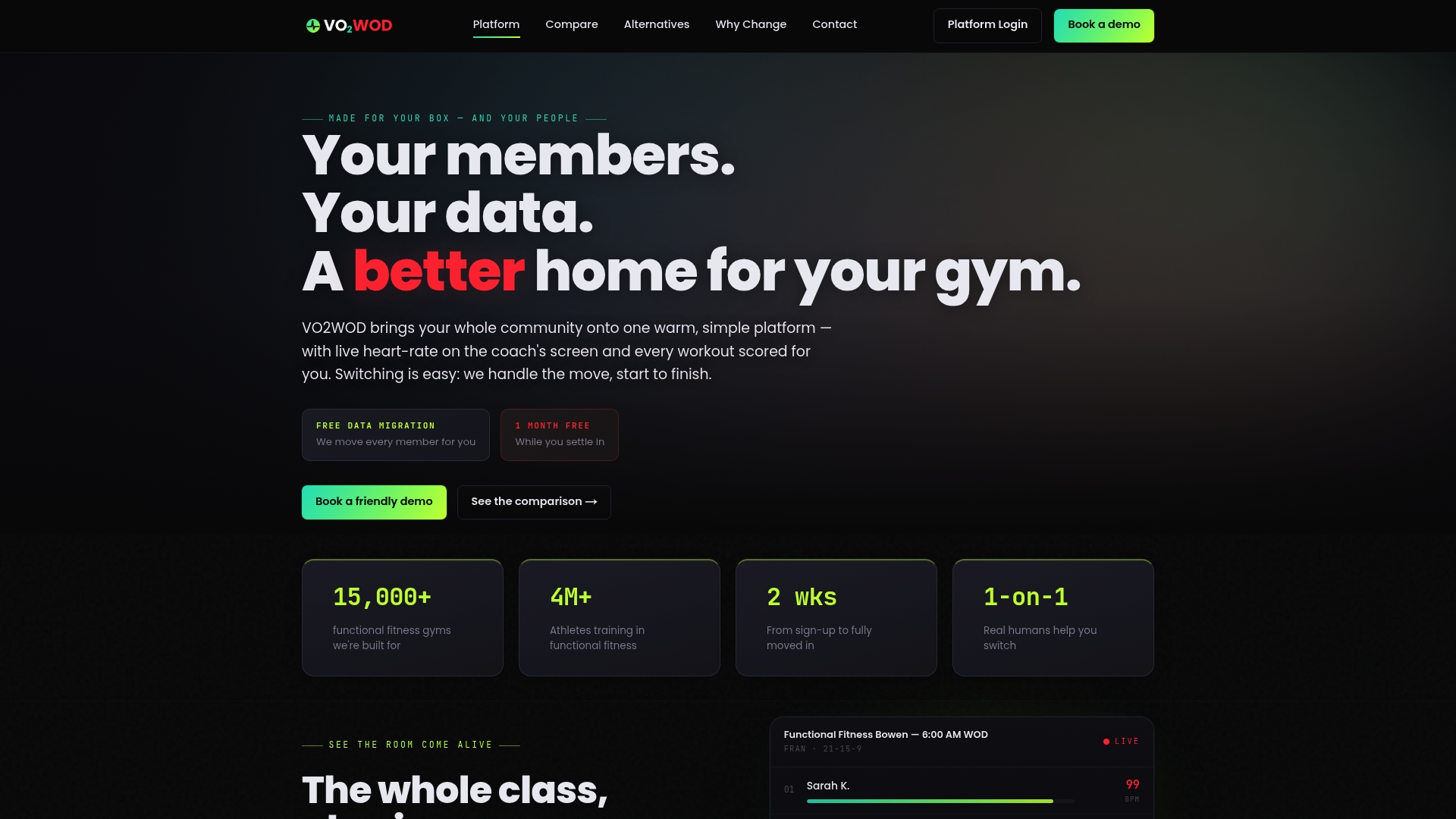
Switching comes with free data migration, a dedicated support team and one month of complimentary service. See how it works at VO2WOD, or explore the Vo2hub group-fitness hardware that powers in-class monitoring.
FAQ
Can a member hold the same class spot every week?
Yes, if your scheduling software supports repeating bookings. Decide whether the spot renews on a cycle, how many standing spots one member can hold and what happens when they cancel inside your cutoff. Written rules keep it fair for everyone on the waitlist.
How far ahead do public facilities require recurring bookings?
It varies by agency. The Westwood Recreation Center asks for applications at least three weeks before the start date, and Fresno takes applications quarterly for three-month blocks. Check the facility's own page for the current schedule before you plan.
What happens when someone cancels a recurring reservation?
At public facilities, refunds depend on timing: Fresno refunds cancellations made at least 10 business days ahead, and Conejo refunds in full less the application fee with 45 days' written notice. In a gym, the spot is usually released to the waitlist at your cancel cutoff, and a no-show rule applies if the member does not come.
How do I stop recurring reservations from creating no-shows?
Make canceling quick, send a reminder before class, record attendance at check-in and apply your no-show rule the same way every time. Large clubs also release a spot automatically if the member does not check in within a set window, such as 30 minutes.
Is it hard to move my existing members to new software?
It does not have to be. We migrate your data for free and a dedicated support team walks you through the transition, so your members and their schedules carry over.
Sources
- City of Fresno Athletic Facility Reservation Policy
- Conejo Park District Facility Reservations Policies and Procedures
- Westwood Recreation Center Permit Reservation Procedures and Policies
- National Fitness club reservations
- IHRSA 2021 Media Report