

The best policy is short and specific: set a cutoff, generally within about half a day to a full day before class starts, and tell members exactly what happens on either side of it. Cancel early, get a credit or refund. Cancel late or no-show, and a fee or forfeiture kicks in. Post the cutoff and the outcome right on the booking screen, not buried in a terms page nobody reads.
TL;DR:
- Shorter cutoff windows, such as 8 to 12 hours, are essential for high-demand classes where cancellations significantly impact revenue.
- Offering clear, published policies across booking pages, confirmation emails, and reminders reduces disputes and ensures members understand cancellation consequences.
- Automating policy enforcement and refunds with software like VO2WOD minimizes manual errors and helps track abuse or repeat offenders effectively.
- Refunds are appropriate mainly for operator-caused cancellations, while member-initiated cancellations within the window should typically result in credits instead of cash.
- Matching the cancellation window to class demand and waitlist size optimizes revenue protection without frustrating members unnecessarily.
Table of Contents
- What Every Class Cancellation Policy Needs to Cover
- Cancellation Policy Templates You Can Copy Today
- Refunds vs. Credits: What to Return and When
- Handling Exceptions Without Losing Control
- Communicating the Policy So Members Actually See It
- An Operator's Honest Take on Enforcement
- Let Software Handle the Enforcement For You
- Primary Sources for Policy Language
- Sources
What Every Class Cancellation Policy Needs to Cover
A workable class cancellation policy has to define three distinct situations, because treating them the same is where most disputes start.
- Early cancellation happens before the cutoff and should return a credit or refund automatically, no staff intervention required.
- Late cancellation happens after the cutoff but before class starts, and typically forfeits the credit or triggers a fee.
- No-show means the member never canceled at all, and it should carry the strictest consequence since the spot went completely to waste.
Each category needs a trigger tied to a timestamp, not a judgment call. "Cancel at least 12 hours before class starts" is enforceable. "Please cancel with reasonable notice" is not; it just invites arguments at the front desk.
The outcome for each category matters as much as the timing. Refunds return actual money, credits return a class or session to the account, fees charge a set amount, and forfeiture means the member simply loses what they paid. Momence's platform lets studios set an umbrella policy across all classes with per-class overrides and a specific cancellation credit cutoff, which reflects how most real studios actually operate: one baseline rule, with exceptions for specialty classes.
Publish the rule in three places: the booking page before checkout, the confirmation email sent right after booking, and a reminder message closer to class time. If a member only sees the policy once, they'll forget it exists by the time they need it.
Cancellation Policy Templates You Can Copy Today
Three cutoff models cover most fitness and training businesses, and the right one depends on how scarce your spots are.
- High-demand model (8 to 12 hour cutoff). Used for small-capacity classes like reformer Pilates or specialty strength sessions where one empty spot is a real loss. Cancel inside the window and the member loses the credit or pays a fee; cancel outside it and the credit returns. Solidcore uses a version of this, requiring cancellation at least 10 hours before class or the session gets charged.
- Standard model (12 to 24 hour cutoff). The most common approach for group fitness and open gym classes. Refund or credit depends on how the class was purchased, drop-in versus package versus membership.
- Flexible or community model (24+ hours, credit-first). Fits studios that prioritize retention over strict capacity management, often paired with generous makeup credit rules instead of refunds.
Pro Tip: Match your cutoff to your waitlist depth. If classes rarely fill, an 8-hour window just annoys members without protecting any revenue.
Sample wording: booking page: "Cancel 12+ hours before class for a full credit." Confirmation email: "You're booked. Cancellations after [time] forfeit your credit." Reminder text: "Class starts in 3 hours. Can't make it? Cancel now to avoid a fee."
Refunds vs. Credits: What to Return and When
Refund cash for a canceled series or an operator-caused cancellation like a sick instructor. Return a credit for member-initiated cancellations inside a reasonable window. Cash refunds feel generous but complicate accounting; credits keep the member engaged with your schedule instead of walking away with their money.
Class packs, drop-ins, and unlimited memberships each need consistent treatment written into the same policy, not separate ad-hoc rules:
- Drop-in purchases: refund if canceled within a short window, per Outschool's model of requiring cancellation within 24 hours of purchase for a refund.
- Class packs: return the session as a credit rather than cash once it's past the refund window.
- Unlimited memberships: no per-class refund logic applies, but late-cancel and no-show fees still enforce accountability.
If your studio runs recurring billing or auto-renewing memberships, the FTC's negative-option guidance sets a clear bar: cancellation has to be at least as easy as signing up, through the same channel used to enroll. A member who joined online should be able to cancel online, not be forced to call during business hours.
Automate what you can. Auto-refund cancellations that land inside the window, and label every transaction clearly as a "class credit" or "refund" so members and staff aren't guessing what happened weeks later.
Handling Exceptions Without Losing Control
Predefine exception categories before you need them: medical emergencies with documentation, instructor-initiated cancellations, and severe weather closures. Deciding these case by case at the front desk creates inconsistency and resentment.
Enforcement options range from full credit return for a documented emergency, to a fixed fee for a routine late cancel, to graduated penalties that escalate for repeat offenders. New members often get a one-time forgiveness pass in their first 30 days, since they're still learning the system.
- Track late-cancel rate and no-show rate separately; they signal different problems.
- Watch fee-dispute volume as an early warning that your window is too tight.
- Flag repeat offenders for a direct conversation rather than an automatic ban.
Pro Tip: Waitlists solve more no-show problems than fees do. An automatic backfill notification the moment someone cancels keeps the spot filled and the class full.
Communicating the Policy So Members Actually See It
Members should encounter the cancellation window at least three times before it ever costs them anything: on the booking page, in the confirmation email, and in a reminder sent a few hours before class.
- Booking page: "This class requires 12 hours' notice to cancel for a credit."
- Confirmation email: state the exact cutoff time and date, not just "12 hours."
- Reminder message: send one the morning of class and one closer to start time for tighter windows.
At the front desk, keep the script neutral: state the policy, ask if the situation fits a documented exception, and log the outcome either way. That log protects staff from repeating the same argument next month.
An Operator's Honest Take on Enforcement
Consistency beats leniency here.
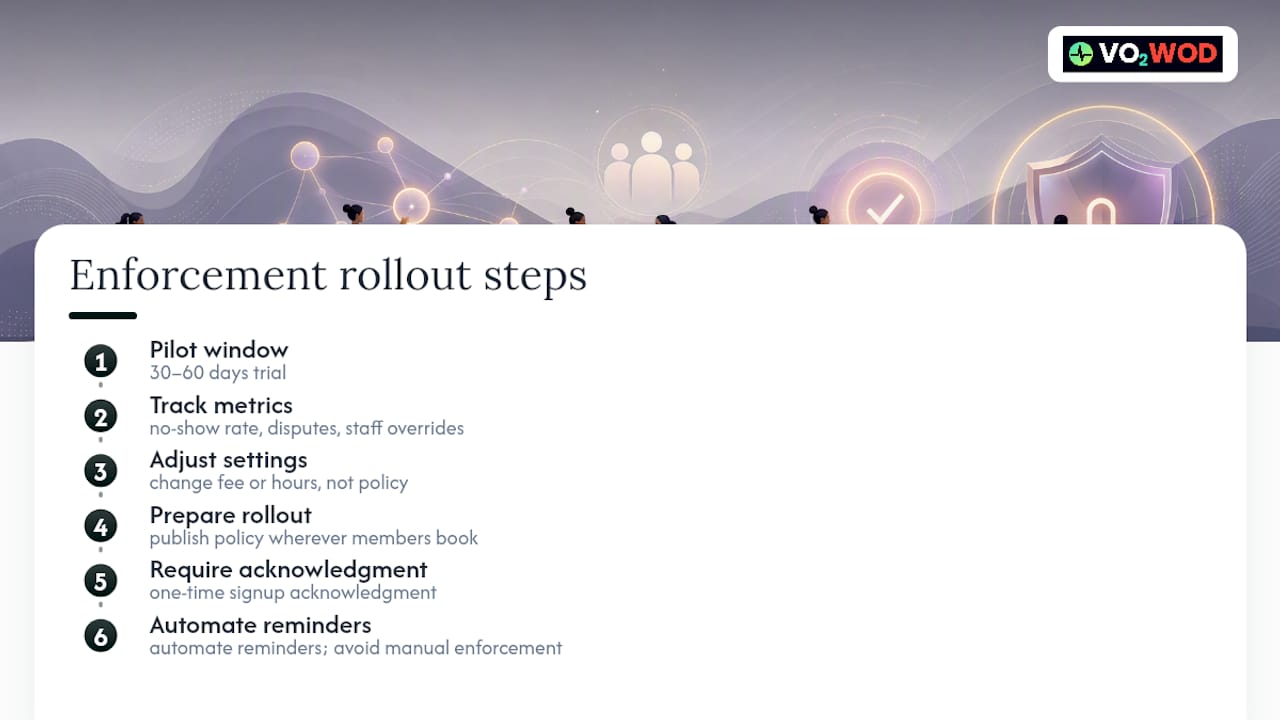
Pilot a new window for 30 to 60 days before locking it in. Track no-show rate, dispute volume, and how often staff override the rule. If disputes climb, adjust the fee or the hours, not the whole approach.
Before rollout: publish the policy everywhere a member books, require a one-time acknowledgment at signup, and automate the reminders so enforcement never depends on someone remembering to send a text.
— Marcus
Let Software Handle the Enforcement For You
Writing the policy is half the battle. Applying it consistently, across every class, every day, without a staff member manually checking timestamps, is where most studios actually lose money. VO2WOD automates the part that wears people down: cutoffs apply automatically, credits return without a manual refund request, and canceled spots backfill from the waitlist before the instructor even notices a gap.

Every late cancel and no-show gets logged the same way every time, so you get real reporting on who's abusing the window instead of a front-desk employee's memory. The software also offers free data migration and a full month of complimentary service, helping gyms switch without losing their existing booking history or member records. If you're comparing options against what you're using now, the VO2WOD alternatives page breaks down how it stacks up. Book a demo and watch your own cutoff rule run on autopilot before you commit to anything.
Primary Sources for Policy Language
- Outschool's refund eligibility guidelines for platform-specific cutoff wording.
- FTC negative-option policy statement for auto-renewal compliance.
- Red Cross course cancellation policy for sliding-scale refund examples.
- Group training guidelines from RALLIO for structured class rule examples.
Sources
- Class Cancellation Policy and Refund Eligibility Guidelines (Outschool)
- Cancellation Policy Setup / FAQ's (Momence)
- Enforcement policy statement regarding negative option marketing (FTC)
- Red Cross course cancellation policy
- Do cancellation policies work for boutique fitness studios? What to know in 2026 (SmartHealthClubs)