

An anti-churn automation is a rule that spots a member drifting toward cancellation and starts a response before they leave: a message, a task for a coach, an offer. The ones that work run on attendance and billing events, not on cancellation forms, and they hand your highest-value members to a human. Below is what to watch, what to automate, where staff step in, and the US texting rules to respect.
TL;DR
- Anti-churn automation means detecting risk signals (a drop in visits, a failed payment, a stalled first month) and triggering a response without someone watching a spreadsheet.
- The first 48 hours and the first month matter most, so build onboarding triggers before win-back campaigns.
- Match effort to risk and value: automated sequences for most members, a coach or manager call for the high-value ones.
- Track retention, visits per member and reactivation, not just messages sent.
- Marketing texts in the US need recorded consent and quiet hours. Set this up before the first send.
Table of Contents
- What anti-churn automation means for a gym
- The signals worth watching
- Seven automations to build, in order
- Automated or personal: matching effort to risk and value
- How to set it up
- Metrics that show it is working
- Texting members: the US rules to follow
- Our perspective
- Run these automations in one platform
- FAQ
- Sources
What anti-churn automation means for a gym
Outside fitness, "anti-churn" usually means a cancellation-flow tool: a member clicks cancel, sees a discount, and maybe stays. That is one narrow piece. In a gym, cancellation is the last symptom. The cause shows up weeks earlier, when someone who trained three times a week drops to once, stops booking classes, or never comes back after their intro sessions.
So a gym's anti-churn system has three parts:
- Signals: the data that shows engagement is changing (check-ins, bookings, class results, payment status).
- Triggers: rules that fire when a signal crosses a line ("no visit in 14 days", "card declined").
- Responses: an automated message, a task for staff, or both.
The stakes are not abstract. The Health & Fitness Association's 2026 consumer report, based on a 2025 survey of about 18,000 US residents, put industry-wide churn at 7.1% in 2025, down from 10.2% in 2024. That is good news for the industry, yet boutique studios have had a harder time: Athletech News reported that 91.2% of boutique studios were not sustainably profitable at the end of 2023, with retention around 9%, meaning roughly 7.5% of clients lost each month. A small gym cannot refill that leak with marketing alone.
The signals worth watching
You do not need a data science team. You need four or five signals you can actually capture, and all of them come from systems you already run.
Attendance and booking patterns
Visit frequency is the most direct signal. The same HFA report found average attendance of 81 days per year in 2025, against 109 in 2019, and the share of members who never visit fell to 4.6%. Frequency is part of the story, but your own members' trend matters more than any benchmark. Someone who drops from three sessions a week to one is a better target than someone who has always come once a week.
A fitness-app case study from Amplitude on Lindywell found that the first 48 hours after signup are critical to one-month retention, and that members training three times a week were more likely to still be around after seven months than once-a-week members. Treat those as directional, since it is one company's data, but they point at the same place: early habit formation.

Onboarding milestones
Did the new member book a first class? Attend it? Come back within a week? Each is an event you can trigger on. Les Mills' work with Customer.io is a good illustration. Their breakthrough, as Customer.io describes it, was moving from static profile attributes to event data such as signup, first workout completed and plan abandonment, so messages landed at the right moment instead of in a weekly batch.

Billing signals
Failed cards and expiring payment methods cause cancellations nobody chose. They are also the easiest to automate: a retry plus a short, friendly update-your-card message. Our guide to membership billing automation covers the four requirements that stop this kind of revenue leakage, and our piece on hidden cancellations explains how much of the churn you see is really payment failure.
Performance and effort
In functional fitness, members stay when they can see progress. A stalled personal record, a missing score, or effort that has dropped class after class says something attendance alone cannot. Heart rate and workout score data show whether someone is still being challenged or is coasting. Those are the signals a general-purpose scheduling tool does not see.
Seven automations to build, in order
Build in this order. Each one is simple on its own, and together they cover the member lifecycle.
| Automation | Trigger | Response |
|---|---|---|
| Welcome sequence | Membership starts | Message with how to book, what to bring, a first-class prompt |
| First-visit follow-up | First class attended | Coach note the same day, invitation to book the next class |
| No-show on first booking | Booked first class, did not attend | Friendly reschedule message within hours |
| Attendance drop | No visit in 10 to 14 days (set to your own norm) | Check-in message, escalating to a staff task |
| Payment failure | Card declined | Retry plus update-card message |
| Milestone recognition | Visit count, anniversary, new PR | Congratulation message |
| Win-back | Frozen or cancelled | Short sequence tied to the stated reason |
The thresholds are yours to set. Start with one gap length for your typical member, watch for a month, then tune it. A gym where members train five days a week needs a shorter fuse than one with a two-day average.
Why milestones belong on the list
Recognition is the cheapest retention automation there is, and it works for the members who are not at risk yet. Our look at milestone notifications covers how check-in rates move when members get acknowledged, and what to track for milestones lists the events worth counting.
Automated or personal: matching effort to risk and value
The biggest mistake is sending everyone the same message. AdAI's May 2026 guide reports that a generic "we miss you" message gets about a 5% response, while reason-specific interventions get 30 to 50%. The figure comes from a vendor guide, so read it as a sign of direction rather than a promise, but the logic holds for any gym: a message that fits the reason lands.
The same guide suggests a tiered approach that works well for a coach-led gym:
- High risk, high value (a long-tenured member on a premium plan who has gone quiet): a personal call from the owner or head coach within a day.
- High risk, lower value: an automated sequence.
- Medium risk: a nudge from their usual coach, in person or by message.
- Low risk: standard engagement, including milestones.
It also recommends a one-page brief for staff on each at-risk member: visit pattern, last positive interaction, talking points, and a suggested offer. That is a good habit even if you build it by hand. A coach who opens a call with "I noticed you loved the Saturday partner workouts" is having a different conversation than one who reads from a template.
Match the response to the reason
The reasons people drift fall into a few buckets, and each has its own fix:
- Price: offer a pause or a lower-frequency plan.
- Programming: invite them to a different class type or a skills session.
- Schedule: point to off-peak classes.
- Motivation: a coach reaching out personally, or a goal reset.
The Lindywell study found a similar split by engagement level. New content series kept medium and heavy users engaged but did not bring dormant members back; those members needed low-barrier, fun programs and seasonal promotions. Segmenting members and tailoring the content is the principle behind it. If you want a broader view of how client-facing businesses do this, these customer engagement strategies show the same segmenting idea in wellness.
How to set it up
Step 1: Get your data in one place
An automation is only as good as the events feeding it. If check-ins live in one tool, billing in another, and leads in a spreadsheet, every rule needs a manual export. The fewer systems, the fewer gaps. When you do change systems, plan the migration so that member history comes along; our guide to gym software onboarding walks through how to switch without losing members.
Step 2: Define "at risk" in your own numbers
Pull a list of members who cancelled in the last six months. Look at their last 30 days of visits. You will usually find a pattern: a drop of a certain size, a gap of a certain length. That pattern becomes your first trigger. Our attendance benchmarks help you tell whether your members are under or over a typical group-class rate.
Step 3: Write the messages like a coach
Short, specific and from a named person. Mention a class, a coach or a recent result. Skip discounts as the opener; save them for the price-driven reason.
Step 4: Add staff tasks, not just messages
For the top tier, the automation should create a task ("call Maria, 12 visits last month, 2 this month"), not send anything. Otherwise your best members get your most generic treatment.
Step 5: Review weekly for a month, then monthly
Check who got messages, who replied, who came back. Retire the triggers that nobody responds to.
Metrics that show it is working
Messages sent and open rates tell you the machine is running. They do not tell you whether it is helping. Track these instead:
- Monthly churn rate, ideally split by tenure (first 90 days vs. established members).
- Visits per member per month, compared before and after a trigger fires.
- Reactivation rate: of members flagged as at risk, how many came back within 30 days.
- Failed-payment recovery rate.
- Conversion of at-risk monthly members to longer plans, if you sell them.
The Les Mills example gives a sense of what a mature program measures: within two months of launching a risk model with event triggers, it retained 53% of subscribers predicted to churn and converted 80% of at-risk monthly subscribers to annual plans. That is a global brand with a data team, so use it as an example of what to measure rather than a target. For a small gym, our six gym KPIs with 2026 benchmarks are a better starting dashboard.
Texting members: the US rules to follow
Text messages are the most effective channel for a reminder and the one with the most legal exposure. This is general information, not legal advice; have your attorney review your consent language.
- Consent first. Under the Telephone Consumer Protection Act (TCPA), you need consent recorded before the first marketing text. Capture it at signup and store it.
- Quiet hours. Marketing texts are limited to 8 AM to 9 PM in the recipient's local time, per 47 CFR 64.1200(c)(1).
- Honor opt-outs. Since April 2025, the FCC rule lets people revoke consent by any reasonable method, and you have 10 business days to honor it. A separate part of the rule, the "revoke-all" provision, was extended by the FCC until January 31, 2027.
- Cancelling a membership is not an opt-out by itself. In Van Patten v. Vertical Fitness Group, the Ninth Circuit held that consent depends on the context in which the number was given, and cancelling does not automatically revoke it unless the person clearly says they want no more messages. Do not read that as permission to keep texting former members, though. Honor any STOP reply immediately.
In practice: put consent in your signup flow, include opt-out language in every marketing text, build send windows into your automations, and treat transactional messages (a class reminder, a billing notice) separately from promotional ones. Keep the record of when and how each member agreed.
Our perspective
Most gyms treat churn as a billing problem. We see it as an engagement problem that shows up in billing months later. In functional fitness, people stay because they feel seen: the coach knows their name, their score, their last PR.
That is why we built VO2WOD around live in-class heart rate monitoring and automatic workout scoring. When effort and results are recorded without anyone typing them in, you have a real picture of who is thriving and who is fading, and your coaches can act on it. Add milestone messages, class bookings, check-in by QR or wristband and recurring billing in the same platform, and the triggers described above do not depend on glue between five tools.
Automations should make your coaches more personal, not less. Let the system handle the reminders and the card retries, so your coaches spend their time on the member who needs a real conversation.
Marcus
Run these automations in one platform
VO2WOD is management software for functional fitness gyms. It combines membership and recurring billing, class scheduling and reservations, QR or wristband check-in, a lead CRM, in-app messaging with milestones, a movement library with personal-record tracking and live in-class biometrics through heart rate tracking, with wearable integration for Garmin, Apple, Fitbit and Samsung. Switching is handled for you: we offer free data migration, a dedicated transition support team and one month of complimentary service.
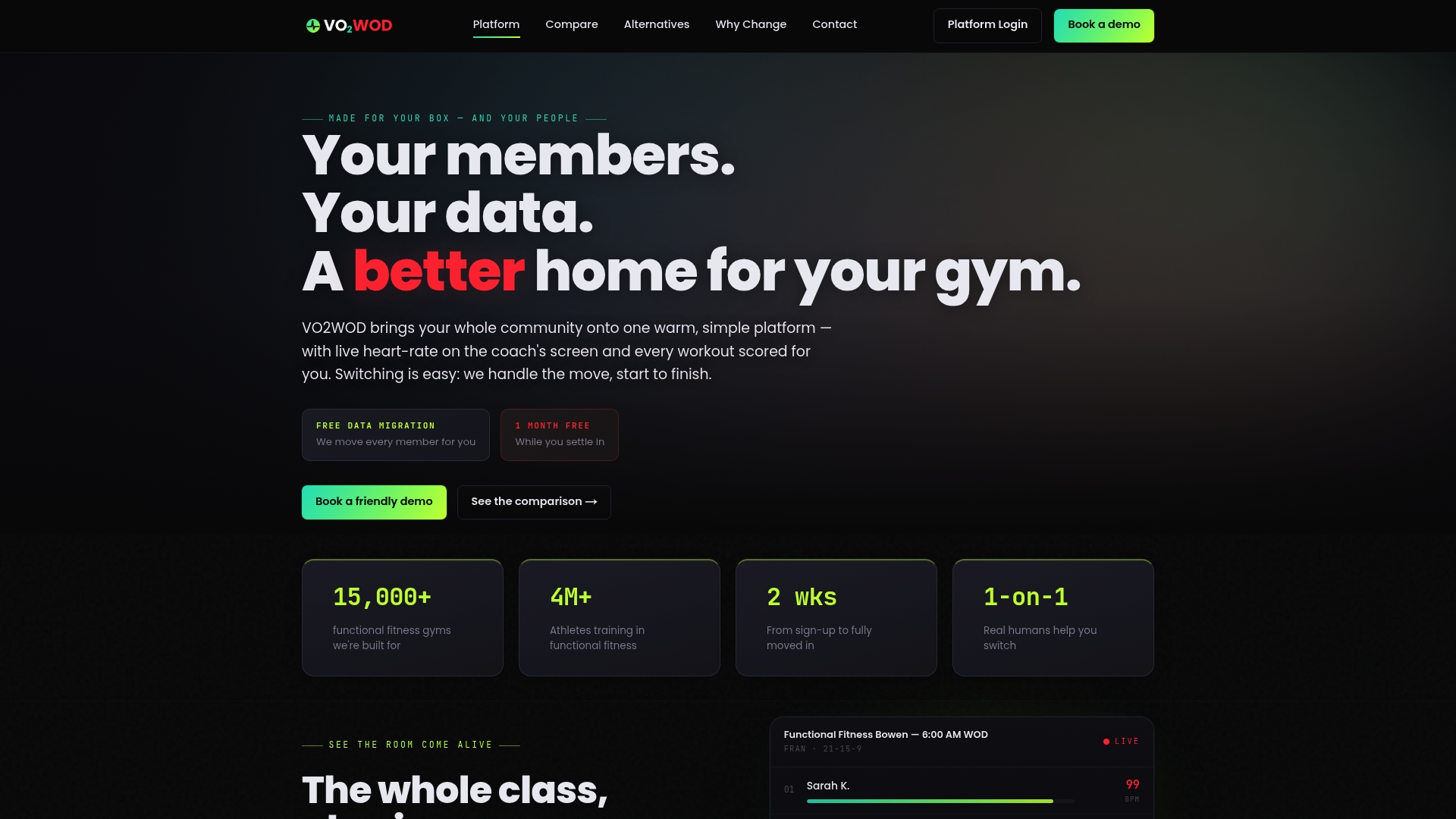
See how it works on the VO2WOD site, or look at the Vo2hub group-fitness hardware that brings heart rate data into class.
FAQ
What does "anti-churn" mean?
It describes anything that reduces the number of customers who cancel. In a gym, that means spotting members who are drifting away and responding early, through messages, staff outreach, billing recovery and recognition, rather than waiting for the cancellation request.
What are effective strategies for preventing churn?
Start with a strong first month: a welcome sequence, a first-visit follow-up and a rebooking prompt. Then add attendance-drop triggers, failed-payment recovery and milestone messages. Give your highest-value at-risk members a personal call instead of an automated message.
How early can I spot a member who might cancel?
Often weeks before. A drop in visits, a gap in bookings or a missed first class is visible in your own data. One vendor guide cites flagging members 30 to 60 days before they cancel, which depends on how much data you capture. Begin with a simple gap rule and refine it.
Do I need AI to run anti-churn automations?
No. Simple rules on attendance, booking and billing events cover most of the value. Scoring models can add precision later, once you have clean data from a single system and several months of history.
Sources
- Research: HFA Survey, Health & Fitness Business, May 2026
- Boutique Fitness Is Evolving: Can Studios Keep Up? Athletech News
- Lindywell case study, Amplitude
- Les Mills customer engagement strategy, Customer.io
- AI Retention Automation for Fitness Gyms, AdAI
- SMS Marketing Laws: Federal, Carrier, and State Rules (2026)
- FCC Extends Limited Waiver for Part of the TCPA Consent Revocation Rule
- Van Patten v. Vertical Fitness Group, Ninth Circuit opinion
- Spa customer engagement strategies that retain clients