
Benchmark workout tracking comes down to three habits: repeat the same workouts on a schedule, record the result the same way every time, and look at the trend instead of any single day. Do that with a notebook, a spreadsheet or gym software, and a benchmark turns from a hard afternoon into a number you can act on. This guide covers what to log, how often to retest, and how gym owners and coaches can stop chasing scores on whiteboards.
TL;DR
- A benchmark only means something if the workout, load, scaling and conditions stay the same each time. Log all four, not just the time or score.
- CrossFit's list of 15 benchmarks suggests testing one from each energy-system group every 2 to 3 months, so you do not need to retest everything at once.
- Skip special testing days. Fold benchmarks into existing programming and treat those dates as your data points.
- For gym owners, the failure point is rarely the workout. It is scores living on whiteboards, in texts and in separate apps that never connect.
- Pair the score with effort data such as heart rate, so a slower time can be read as fatigue, pacing or real regression.
Table of Contents
- What a benchmark workout actually measures
- What to log every time
- How often to retest
- Tracking methods compared
- Why gyms struggle to track benchmarks
- How to build benchmarks into your programming
- A worked example: reading a Fran trend
- Our perspective: scores should record themselves
- Bringing benchmark tracking into your gym with VO2WOD
- Common mistakes to avoid
- FAQ
- Sources
What a benchmark workout actually measures
A benchmark workout is a standardized, repeatable test. You do the same movements, the same loads and the same format, then compare today's result with your last one. The point is not the workout itself. It is the comparison.
CrossFit describes the idea as measurable, observable, repeatable, and that phrase is a good filter for anything you decide to track. If a workout changes every time you do it, it is training. If it stays fixed, it is a measurement.
The official list of 15 covers different demands. It includes max-effort lifts such as the back squat, clean and jerk, snatch and deadlift, short couplets such as Fran and Grace, and longer efforts such as Murph, Fight Gone Bad and a 5K run. According to CrossFit's own breakdown, these span the strength, stamina, aerobic and phosphocreatine pathways, which is why one score never tells the full story of someone's fitness.
Examples worth knowing
Fran is 21-15-9 reps for time of thrusters and pull-ups. The Rx'd standard uses 65 lb for women and 95 lb for men, and the score is your finishing time.
Helen is three rounds for time of a 400-meter run, 21 kettlebell swings and 12 pull-ups. The Rx'd weights are 35 lb for women and 53 lb for men. It mixes running with gymnastics and kettlebell work, so it exposes different weaknesses than Fran does.
Grace is 30 clean and jerks for time at 95 lb for women and 135 lb for men, according to the same CrossFit benchmark guide. It is a pure test of how fast you can cycle a barbell under fatigue.
Notice that each of these has an Rx'd version and scaled versions. Fran, for example, has intermediate and beginner options with lighter loads and fewer pull-up reps. A scaled score and an Rx'd score are not the same data point, and mixing them is the most common way tracking goes wrong.

What to log every time
A time of 6:42 on its own is almost useless. Six months later you will not remember whether it was Rx'd, whether you did banded pull-ups, or whether you slept four hours. Log these fields and your history becomes trustworthy.
- The workout name and version. Fran Rx'd, Fran intermediate, Fran beginner.
- The score. Time, rounds plus reps, or load, depending on the workout.
- Load and scaling. Exact weights, the pull-up variation, the run distance if you modified it.
- The date. Obvious, but trend lines depend on it.
- Context. Time of day, whether it was in class or solo, whether you were fresh or coming off a heavy week.
- An effort marker. Heart rate, perceived exertion on a 1 to 10 scale, or both.
- A one-line note. "Broke thrusters at 15 reps, pull-ups unbroken" is more useful in three months than the time alone.
The effort marker deserves more attention than most people give it. Two identical times can come from very different efforts. If your Fran time is the same as in January but your average heart rate is lower, you are fitter. If the time is slower and your heart rate is higher, you may be tired or under-recovered. Without effort data you are guessing.
How often to retest
More testing is not better testing. CrossFit's guidance recommends testing one benchmark from each group every 2 to 3 months to gather enough data. That means a strength lift, a short high-intensity couplet and a longer aerobic piece, not all fifteen in a single month.
A simple rotation for an individual athlete looks like this:
| Month | Strength | Short and fast | Long and aerobic |
|---|---|---|---|
| January | Back squat | Fran | 5K run |
| March | Deadlift | Grace | Helen |
| May | Clean and jerk | Fran | Murph |
| July | Snatch | Grace | Fight Gone Bad |
This is an example, not a prescription. What matters is that each workout comes back often enough to show a trend and rarely enough that you can recover and train in between.
Strength testing fits with broader training science too. The American College of Sports Medicine updated its resistance training guidance in March 2026, and the ACSM announcement stresses that the biggest gains come from moving from no resistance training to any form of it, with consistency and effort doing the heavy lifting. Tracking is useful because it keeps you consistent, not because it demands perfection.
If you are new to lifting or have a medical condition, talk to a physician or a certified coach before attempting max-effort tests. A heavy single or a long, hard benchmark like Murph is a poor place to learn your limits unsupervised.
Tracking methods compared
There is no single right tool. There is a right tool for your situation.
| Method | Best for | Weak spot |
|---|---|---|
| Paper notebook | Individual athletes who like simplicity | Hard to chart trends, easy to lose |
| Spreadsheet | Data-minded athletes and small coaching groups | Manual entry, no effort data unless you add it |
| Standalone benchmark tracker | Solo athletes who want a personal-best list | Disconnected from class, billing and coaching |
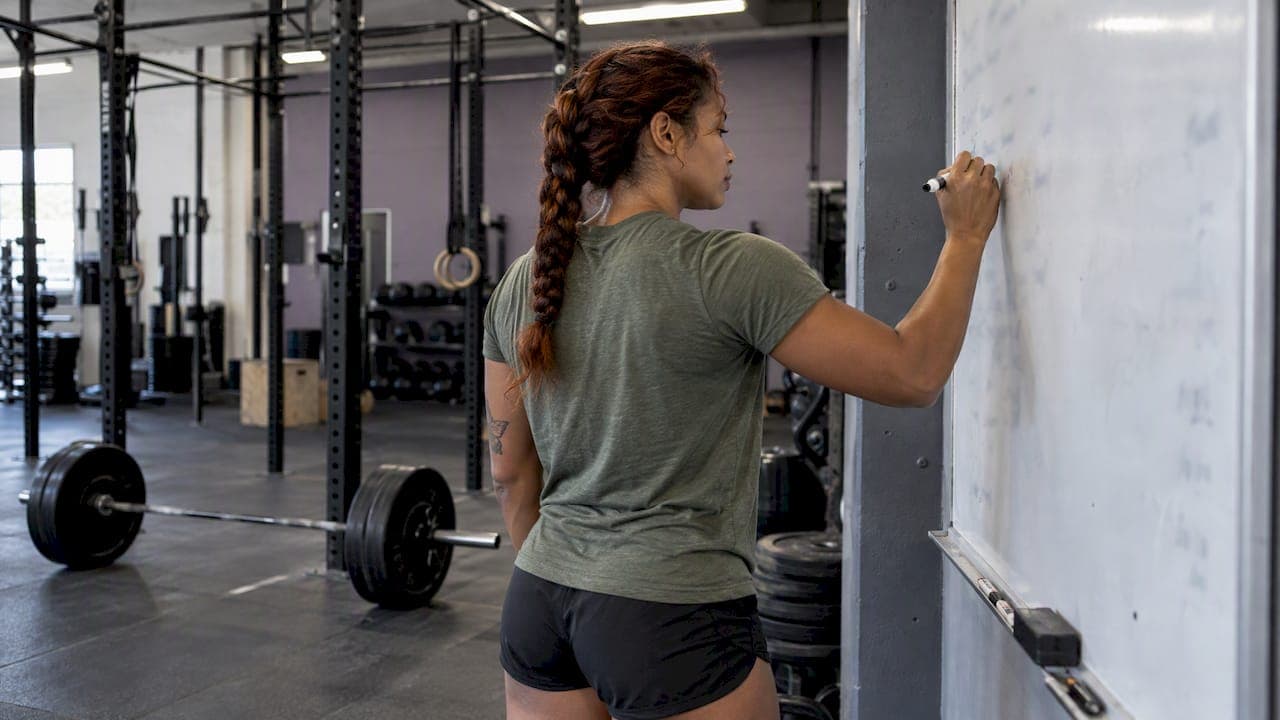
| Whiteboard in the gym | Community energy on the day | Erased by the next class, no history |
| Integrated gym software | Gyms that want scores, attendance and effort in one record | Needs rollout and member buy-in |
The whiteboard deserves a defense. It creates energy in the room that no app can replicate. The problem is only that it forgets. The best setups keep the whiteboard for the moment and a system of record for the long term.
Why gyms struggle to track benchmarks
For a gym owner, the challenge is different from an individual's. You are not tracking one person's Fran. You are trying to give a few hundred members a reliable history without adding work for coaches.
The usual blockers are predictable:
- Scores live in too many places. Some members photograph the whiteboard, some text the coach, some use a personal app.
- Coaches become data-entry clerks. If recording a score takes a coach five minutes after class, it will not happen on busy days.
- Effort data disappears. When heart rate shows on a wall screen during class and then vanishes, you lose the context that makes the score meaningful.
- Systems do not talk. One case study from an app developer describes a multi-location franchise running bookings, billing and heart-rate data through three separate systems, which pushed routine questions back onto staff. Any gym with a similar patchwork will recognize the pattern.
Technology alone does not fix this. A 2021 experimental study on fitness apps and gym users' habits and intentions to stay frames technology as a facilitating medium, not a cure. An app members download and ignore will not change behavior. Tracking works when it is part of how the gym already runs, from class to leaderboard to the coach's feedback. Other writers have made a similar point about apps that simplify coach admin, where the real gain is hours given back to coaching.
How to build benchmarks into your programming
You do not need a testing week. In fact, CrossFit advises against special testing days that disrupt normal programming. Instead, use the calendar you already have.
Step 1: Pick your anchor dates
Choose recurring events your community already cares about. Memorial Day Murph is the obvious one. Add a fall Chad 1000X, a July 4th run, and a January strength block. Those dates become your official data collection points, so members know when scores count.
Step 2: Assign one benchmark per energy system
Across each quarter, make sure the programming touches one strength test, one short high-intensity test and one longer aerobic test. Do not stack them in the same week.
Step 3: Standardize the record
Decide what every score entry includes: version (Rx'd or scaled), load, score and effort data. Write it down and make it the same for every coach. Consistency across coaches matters as much as consistency across members.
Step 4: Show the history back to members
A benchmark is motivating when an athlete can see "Fran, 7:15 in March, 6:48 now." If members cannot see their own trend, they stop logging. Make history visible inside the same place they book classes.
Step 5: Review the trend with the athlete
Once a quarter, coaches should spend two minutes with each athlete who hit a benchmark window. Ask what changed, what felt different, and what the next block should target.
A worked example: reading a Fran trend
Imagine an athlete who logs Fran Rx'd three times in a year.
| Date | Time | Average heart rate | Note |
|---|---|---|---|
| February | 7:30 | High | Thrusters broken early |
| May | 6:55 | Slightly lower | Pull-ups in two sets |
| August | 6:58 | Lower still | Slept poorly, same pacing |
The August time is basically flat compared with May. On times alone, you would say progress stalled. With heart-rate data, you see the athlete produced the same result at lower cardiovascular cost, and the poor sleep note explains the plateau. The coach's conclusion changes from "push harder" to "keep the plan, protect recovery."
This is the kind of read that makes tracking worth the effort, and it is why we recommend logging an effort marker alongside every benchmark. For a primer on which effort numbers to start with, see our post on three athlete effort metrics coaches can use this week.
Our perspective: scores should record themselves
We build software for functional fitness gyms, and the same pattern shows up across the boxes and studios we talk to. Coaches care deeply about benchmarks. They also finish a 6 a.m. class with twelve athletes waiting for feedback and no spare minutes to copy results into a system.
So our view is simple. If a score takes manual effort to record, a share of scores will never be recorded, and the gaps will be exactly the days that mattered. The workout should be scored automatically, the heart-rate data should be attached to the athlete's record without anyone typing, and the history should be waiting in the member's app after class. That is what we designed automatic workout scoring to do.

We also believe the tool only works when it supports the community. A leaderboard that makes beginners feel invisible does more harm than good, which is why we have written about inclusive WOD leaderboards and about building a gym community members stay for. Data should make every athlete's progress visible, scaled or Rx'd, not rank people against each other by default.
And as the ACSM-linked advice reminds us, the best program is the one a member will actually stick with. Tracking exists to serve that, not to replace it.
— Marcus
Bringing benchmark tracking into your gym with VO2WOD
If you run a functional fitness gym and want benchmarks, heart rate, scheduling, billing and member messaging in one place, VO2WOD was built for that. It combines live in-class biometrics, automatic workout scoring, personal-record tracking with a movement library, and connections to wearables from Garmin, Apple, Fitbit and Samsung. We offer free data migration, dedicated transition support and one month of complimentary service, so you can bring your existing member history over without starting from zero.
If you want to see how it stacks up against other kinds of gym software, our comparison page lays out the differences. For gyms interested in the in-class display side, take a look at the Vo2hub group-fitness hardware.
Common mistakes to avoid
- Comparing scaled and Rx'd scores. Track them as separate series, and celebrate the move from one to the other as its own milestone.
- Testing too often. Retesting Fran every two weeks measures fatigue, not fitness.
- Ignoring conditions. A benchmark done after a heavy squat day is a different test than one done fresh.
- Chasing only one number. A faster Fran with a stalled deadlift tells you something. So does the reverse.
- Making it a ranking exercise. Use leaderboards for energy, and use personal history for progress.
- Forgetting wearables. Many members already own a watch. Letting them connect a Fitbit or another device captures effort data they would otherwise lose.
FAQ
What is the best way to track benchmark workouts?
The best way is the one you will use consistently, as long as it records the version, load, score, date and an effort marker. Solo athletes do fine with a notebook or spreadsheet. Gyms get more from a system that attaches scores to member profiles automatically.
How often should I repeat a benchmark workout?
CrossFit suggests testing one benchmark from each energy-system group every 2 to 3 months. That spacing gives you enough data to see a trend without turning every week into a test. Retesting the same short workout every few weeks mostly measures day-to-day fatigue.
Should I log scaled benchmark scores?
Yes, but keep them separate from Rx'd scores. A scaled Fran and an Rx'd Fran are different tests, and combining them will make your trend line misleading. Moving from scaled to Rx'd is a legitimate milestone worth recording.
Can gym software replace the whiteboard?
It can replace the whiteboard as the record, not as the atmosphere. Many gyms keep the board for the energy in the room and use software for the permanent history. That way members get both the moment and the data.
Sources
- CrossFit: Beyond the Open, 15 Benchmark Workouts
- CrossFit: Community Invited to Complete Benchmark Workouts, Log Score in App
- CrossFit: Fran benchmark
- CrossFit: Helen benchmark
- ACSM: Updated Resistance Training Guidelines
- Influence of Fitness Apps on Sports Habits, Satisfaction, and Intentions to Stay in Fitness Center Users
- OrganByte: Member app with live heart-rate zones case study