
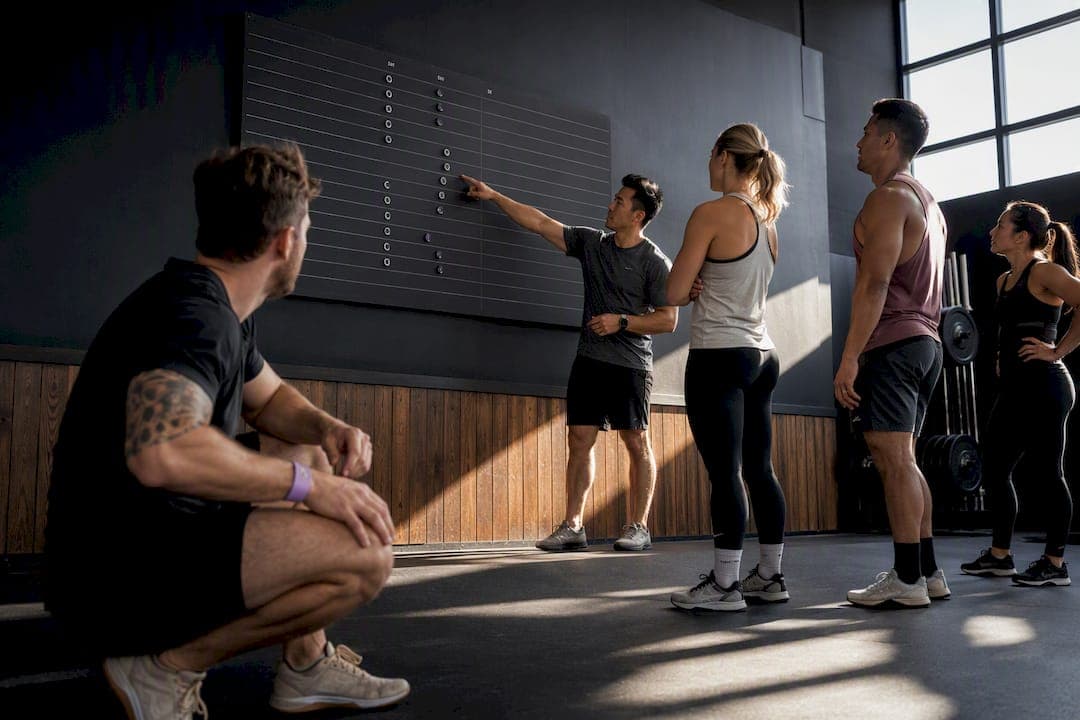
The best leaderboard for WODs is opt-in, effort-based, and visible where members already look, whether that is a wall screen or a member app. Rank athletes by relative effort or heart rate zones instead of raw time or weight, so beginners and veterans can both show up on the board. Start a 60-day pilot with one class before you buy hardware or roll out gym-wide, and evaluate a platform like Vo2wod that automates the scoring for you.
TL;DR:
- Running a 60-day pilot with one class type allows gyms to evaluate effort-based leaderboards without significant hardware investment.
- Effort-based scoring, using heart rate or effort points, encourages broader participation and retains beginners better than performance-only rankings.
- Using wired Ethernet and dedicated media devices ensures reliable display of leaderboards, with font size tested from the farthest gym point for visibility.
- Automating score capture through wearable integration and setting clear validation and tie-breaking rules improves leaderboard accuracy and trust.
- Opt-in participation and explicit privacy measures are essential for displaying biometric data, especially in public settings, to protect member privacy and comfort.
Table of Contents
- Why Gyms Use a WOD Competition Leaderboard
- Performance Vs. Effort-Based WOD Scoring
- Display Options and Network Setup for WOD Leaderboards
- Running Leaderboards Day to Day: Logging, Cadence, and Fairness
- Rolling Out a Leaderboard Without Disrupting Your Gym
- How Vo2wod Solves Common Leaderboard Headaches
- Matching Leaderboard Style to Your Gym's Culture
- How Leaderboard Design Affects Beginners Vs. Advanced Athletes
- Keeping Competition Friendly Without Losing the Less Competitive Crowd
- Keeping WOD Rankings Accurate and Fair
- Legal and Privacy Considerations for Publishing WOD Scores
- Author Perspective: What Coaches Actually Need to Get Right
- Start a 60-Day Vo2wod Pilot for Your Gym
- Sources
- FAQ
Why Gyms Use a WOD Competition Leaderboard
Gyms post a workout leaderboard because visible progress keeps people coming back. Gamification features like leaderboards, challenges, and badges correlate with higher visit frequency and lower churn when tied to a clear business goal, not just novelty. CrossFit's own culture built this playbook decades ago with chalk whiteboards tracking PRs and daily scores, and the psychology hasn't changed even as the tools have.
That is why segmentation and opt-in participation matter more than the software itself.
Three numbers to watch once you launch:
- Attendance lift among members who opt in versus those who don't.
- Opt-in percentage across your total membership, tracked monthly.
- Churn differential between leaderboard participants and non-participants after 90 days.
Performance Vs. Effort-Based WOD Scoring
A live in-class leaderboard shows real-time rankings during a single WOD. A benchmark or PR board tracks named workouts like Fran or Murph over months and years. A challenge leaderboard runs a fixed window, often 30 days, around a specific goal like total rowing meters or push-up volume.
Scoring splits into two camps:
- Performance scoring ranks by raw time, weight, or reps completed. It works for competitive classes but can discourage newer athletes.
- Effort-relative scoring ranks by heart rate percentage or effort points relative to an individual's own baseline.
Wearable and heart-rate integration into leaderboards drives higher effort and satisfaction, and it works best inside a platform members already open daily.
Pro Tip: Run performance and effort-based boards side by side for the first month. Members self-select which one motivates them, and you get data on which format actually drives attendance.
Display Options and Network Setup for WOD Leaderboards
Start cheap before you commit. An iPad propped on a stand tests member reaction to a live leaderboard without a dime spent on mounting hardware. Once you confirm engagement, move to a wall-mounted TV.
- Pick your display. A standard TV paired with Apple TV, Google TV, or a similar media device handles most gyms. Use a dedicated media device per screen, since sharing one device across multiple TVs causes lag during class transitions.
- Wire the network. Wired Ethernet beats Wi-Fi for reliability, and a separate VLAN for display devices keeps them off your guest network entirely. Digital screens that display timers and leaderboards shift member behavior and improve class flow, but only when the connection doesn't drop mid-WOD.
- Plan the layout. Pair the timer and leaderboard on the same screen so athletes never look away mid-set. Keep lobby or promotional content on a separate screen from the training floor.
Pro Tip: Test text size from the farthest point in your gym, not from three feet away. If you can't read a score from the back row during a metcon, nobody else can either.
Running Leaderboards Day to Day: Logging, Cadence, and Fairness
A leaderboard only earns trust if the numbers behind it are consistent. That means a clear daily workflow, not a coach scribbling scores on a whiteboard when they remember.
- Assign logging responsibility. One coach per class owns score entry, and every member gets a visible opt-in toggle before their result posts anywhere.
- Verify modified scores. Flag scaled or modified workouts separately from prescribed ("Rx") scores so nobody gets ranked against a standard they didn't attempt.
- Reset on a schedule. Monthly resets keep the board fresh and give slower starters a clean slate. Tiered boards by experience level or age bracket prevent a 22-year-old and a 60-year-old from competing on the same curve.
- Automate what you can. Manual entry invites errors and burns coach time. Automating score capture through wearables or app integration removes both problems.
- Set a tie rule in advance. Decide whether ties split rank or share it, and post the rule once so nobody argues about it in the moment.
- Separate PR history from live rankings. A member's all-time PR board should persist independent of monthly leaderboard resets.
Rolling Out a Leaderboard Without Disrupting Your Gym
Run a 60-day pilot before touching your whole schedule. Enroll opt-in participants from a single class type, capture baseline attendance and participation numbers before day one, and name one or two champion coaches to run point on training and troubleshooting.
A staged rollout with trained champion coaches reduces friction and speeds adoption compared to flipping the switch gym-wide on day one. Track these through the pilot:
- Participation rate among eligible members.
- Attendance lift for participants versus a matched group of non-participants.
- Churn change over the 60 days compared to the prior period.
- Direct member feedback, collected informally or through a short survey.
Check in at week 4 and again at week 8. The heart-rate and wearable data guide recommends exactly this kind of controlled comparison, since it separates "members like leaderboards" from "this specific leaderboard design is working." If attendance among participants outpaces non-participants by week 8, you have your answer. If not, adjust scoring or display before scaling.
How Vo2wod Solves Common Leaderboard Headaches
Most leaderboard frustration traces back to manual data entry and disconnected tools. Vo2wod removes both by pairing live heart rate monitoring with automatic workout scoring, so a coach never types a score into a spreadsheet after class.
- Real-time monitoring shows effort as it happens, not after the fact.
- Automatic scoring eliminates the manual entry errors that undermine trust in a leaderboard.
- Wearable integration with Garmin, Apple, Fitbit, and Samsung devices means members' existing gear feeds the board directly.
- Free data migration moves your history over without your team rebuilding it by hand.
Gyms switching from another system get one month of complimentary service and a dedicated support team for the transition, a detail worth comparing against other functional fitness platforms before you commit to a rebuild. For a gym running the 60-day pilot described above, that free month covers roughly the whole test window at no cost.
Matching Leaderboard Style to Your Gym's Culture
A competitive box built around the CrossFit Open crowd wants raw performance data front and center: time, load, reps, full stop. A boutique functional fitness studio with a heavier beginner mix needs a softer format, one built around effort points or attendance streaks rather than head-to-head ranking.
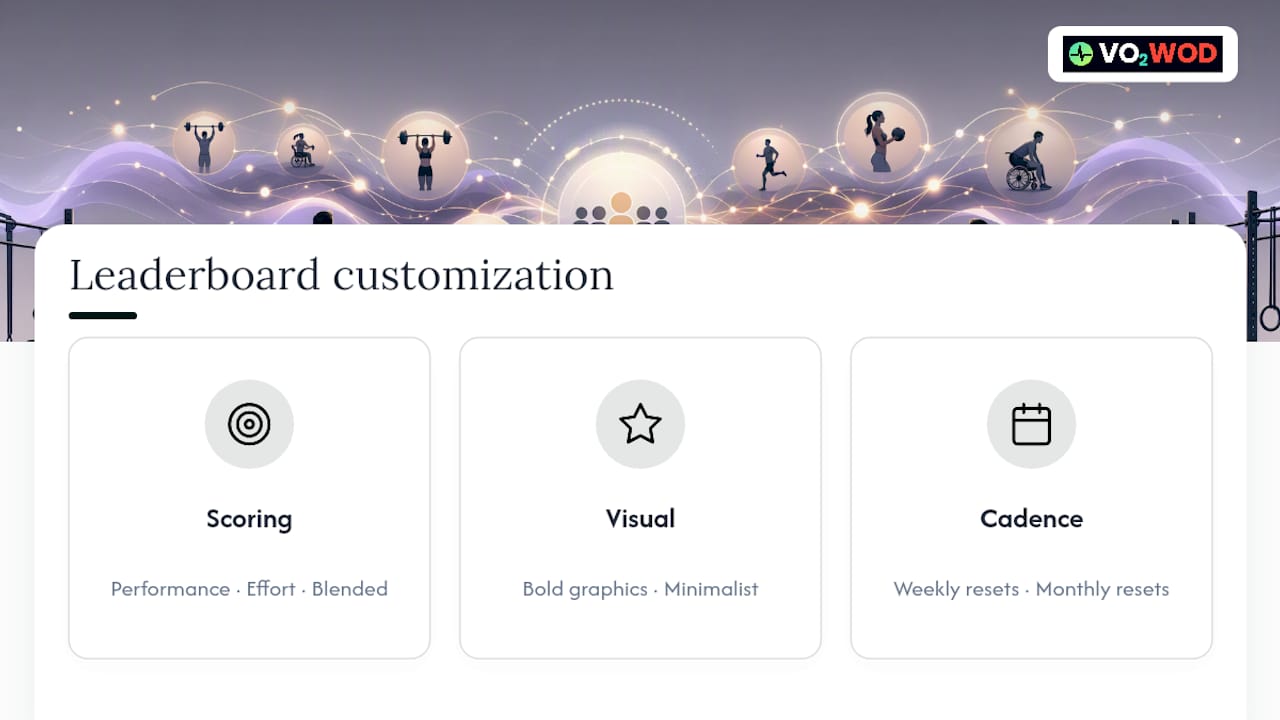
Customize around three variables. First, scoring philosophy: performance-based for competitive classes, effort-based for general population classes, and a blended option for gyms running both under one roof. Second, visual identity: some gyms want bold, loud graphics that match a hardcore brand; others want a calmer, minimalist board that fits a wellness-focused studio. Third, cadence: a competition-heavy gym might reset weekly to keep intensity high, while a community-focused box benefits from monthly resets that give more members a shot at recognition.
Team-based formats work well for gyms built around partner WODs or class camaraderie, ranking squads instead of individuals so no single athlete carries the social pressure of a public score. Age-and-experience tiers matter just as much as scoring style. A masters division (typically 40 and up) and a beginner tier prevent a leaderboard from becoming a showcase for the same five athletes every month.
The gyms that get the most mileage out of a leaderboard treat it as a living format, not a fixed feature. Revisit scoring rules and display design every quarter based on member feedback, because a format that worked for your 2025 roster might frustrate the members you sign in 2026.
How Leaderboard Design Affects Beginners Vs. Advanced Athletes
A raw-time leaderboard flatters advanced athletes and, often unintentionally, discourages everyone else. New members who see the same three names at the top every week tend to disengage from the leaderboard entirely, even if they keep attending class.
Advanced athletes generally respond well to performance-based ranking. It reflects real competitive standing, feeds directly into goals like Open qualification or regional competition, and gives them a public marker of progress they've earned through months of training.
Beginners need a different signal entirely. Effort-based scoring, calculated from heart rate percentage or relative pace improvement, lets a brand-new member rank near the top on a given day simply by pushing hard relative to their own baseline. That single design choice does more to retain new members than any onboarding email sequence.
The safest approach for a mixed-membership gym is running two boards simultaneously: a performance board for members who want the competitive format, and an effort-based board that's visible by default for everyone else. Let members choose which one they see, rather than forcing a single ranking system on a roster with wildly different fitness backgrounds and goals.
Watch drop-off patterns closely during your first few months. If new members stop opting into the leaderboard within their first 30 days, the scoring format is probably too performance-heavy for where they are in their fitness journey, not a sign they lack competitive drive.
Keeping Competition Friendly Without Losing the Less Competitive Crowd
The gyms that get leaderboards right treat them as optional flavor, not a mandatory scoreboard everyone gets judged against. Opt-in participation at both the platform and individual session level protects members who'd rather train quietly, and it removes the social pressure that pushes people toward disengagement.
Public recognition works better when it's spread wide rather than concentrated. Highlight a "most improved" category alongside the top finishers, celebrate consistency streaks, and rotate which achievements get featured on screen so the same three names don't dominate every week. Team and partner formats also diffuse pressure. Ranking squads instead of individuals means a less competitive member's contribution gets absorbed into a group result rather than exposed on its own.
Coaches set the tone more than any software feature does. A coach who calls out effort and improvement during class, not just finish times, trains the whole room to value the same things the leaderboard should reflect. Pair that coaching habit with a leaderboard that defaults to effort-based scoring, and competitive and non-competitive members can share the same room without one group's motivation coming at the other's expense.
Keeping WOD Rankings Accurate and Fair
A leaderboard is only as trustworthy as the process behind it. Manual entry is the single biggest source of errors, whether that's a coach mistyping a score or a member self-reporting a round they didn't finish.
Standardize how scores get validated before they post. Require a coach sign-off on any Rx or modified designation, and separate scaled scores from prescribed ones so nobody ends up ranked against a movement standard they didn't actually perform. Automating score capture through wearable integration or app-based entry removes most of the human error that manual logging introduces, since the data comes straight from the workout rather than from memory after the fact.
Build a correction process members can actually use. Give athletes a simple way to flag a wrong score, and set a deadline (24 hours is common) after which the leaderboard for that day locks. Without a deadline, boards stay in permanent dispute and coaches spend more time adjudicating scores than coaching.
Tie-breaking rules deserve the same rigor. Decide in advance whether ties split a rank or share it, post that rule somewhere visible, and apply it consistently across every board format in the gym, not just the ones that get the most attention.
Legal and Privacy Considerations for Publishing WOD Scores
Publishing a member's name, score, and sometimes heart rate data on a public screen touches personal data, and that carries real obligations depending on where your gym operates and who's in the room. Design leaderboards to be opt-in at both the platform connection level and the individual session level. That protects member privacy and reduces the social pressure that drives disengagement among members who'd rather not have their numbers on display.
Get explicit consent before displaying any biometric data, including heart rate, and make it easy for a member to opt out of a specific leaderboard without opting out of the software entirely. Minors training in youth classes need parental consent handled separately from adult membership agreements, and gyms operating internationally should check local data protection rules before extending any leaderboard feature involving personal health metrics.
Keep a clear record of what data gets displayed, where, and for how long, since a member who wants a score removed later needs to know that request is something your system can actually fulfill.
Author Perspective: What Coaches Actually Need to Get Right
The hardest part of a WOD ranking system isn't the technology, it's resisting the urge to let your loudest, fastest members define what the board rewards. A leaderboard should measure effort for everyone in the room, not just crown the same five athletes every month. Give new members a low-friction opt-in and a scoring path where showing up hard counts as much as finishing first. Track your opt-in rate and churn differential for real signal, and treat the first 60 days as a test, not a verdict.
— Marcus
Start a 60-Day Vo2wod Pilot for Your Gym
Vo2wod removes the two biggest leaderboard headaches: manual score entry and disconnected wearable data. Real-time heart rate monitoring and automatic scoring mean your coaches log zero paperwork after class, and wearable integration with Garmin, Apple, Fitbit, and Samsung devices means most of your members' existing gear works out of the box.

Switching gyms get free data migration and a trial period to test the effort-based leaderboard approach this article recommends without paying for the pilot. Support is provided to handle the transition so your coaches can focus on coaching during the initial period. Compare the full feature breakdown against what you're running now, or head straight to the Vo2wod landing page to start your 60-day pilot today.
Sources
- Wearable Integration for Gyms: Heart Rate Tracking, Leaderboards & Partner Devices - 2025 Guide
- A Gym's Guide to Using Challenges, Leaderboards, and Gamification to Reduce Churn
- Gym digital screens that drive real member engagement
- How to Set Up a Gym Screen Display System | CloudFit
FAQ
What Is a Leaderboard for WODs?
A leaderboard for WODs is a display, either on a screen or in a member app, that ranks athletes on a given workout using either raw performance (time, weight, reps) or effort-relative scoring like heart rate percentage.
Should I Use Performance or Effort-Based Scoring?
Effort-based scoring, ranked by relative heart rate or effort points, broadens participation and reduces churn among mid- and lower-tier members compared to raw performance scoring alone.
How Long Should a Leaderboard Pilot Run?
Run a 60-day pilot with one class type before a gym-wide rollout, tracking participation rate, attendance lift, and churn differential at the week 4 and week 8 checkpoints.
Does Vo2wod Handle Automatic WOD Scoring?
Yes. Vo2wod pairs real-time heart rate monitoring with automatic workout scoring, removing the manual data entry that causes most leaderboard errors.
Do Members Need to Opt In to Appear on a Leaderboard?
Yes. Opt-in participation at the platform and session level protects member privacy, especially when heart rate or other biometric data is involved, and reduces the social pressure that drives disengagement.