

An attendance streak is the number of consecutive weeks (or classes) a member has shown up, and it is one of the simplest ways to see who is building a habit and who is about to quit. It only works if you define it once, count it automatically and act on it quickly. At VO2WOD, check-in, class scheduling, automatic workout scoring and messaging live in one platform, so a streak comes from the same record as everything else a member does at your gym.
TL;DR
- A streak is consecutive weeks or classes attended. Write down what breaks it (a cancelled class, a late cancel, a holiday) before you show it to anyone.
- Weekly streaks with a one-week grace period match how habits actually break: research found that a two-week gap is the real warning sign.
- The first six weeks are the critical window. About half of members in one study lost their streak by week six.
- Use streaks to trigger a personal message from a coach, not to push people to train through fatigue or injury.
- Count streaks from check-ins automatically (QR or wristband), never from a sheet someone fills in by hand.
Table of Contents
- What an attendance streak is, and what it is not
- Why streaks matter for retention
- How to define your streak: a worked rulebook
- Tracking streaks accurately
- The numbers to watch alongside the streak
- The first six weeks decide most streaks
- Using streaks to motivate without pushing unsafe habits
- Reading a streak in context
- When a streak breaks
- Our perspective
- Put streaks to work in your gym
- FAQ
- Sources
What an attendance streak is, and what it is not
Total attendance tells you how often someone came. A streak tells you how steadily. A member with 40 visits in a year could have come twice a week for five months and then vanished, or once a week all year. Those are very different retention stories.
The definition matters more than the number. One research brief on streak reports says a streak must state whether a cancelled class breaks it, whether a late cancellation counts and whether a holiday pause is allowed. Without those rules, a streak that quietly changes meaning is a marketing device rather than a measure.
A streak also has limits. It cannot tell you whether a member is progressing, healthy or connected to your community. Someone with a 30-week streak who has never tried a new format or logged a score improvement may be stuck in a rut. Pair the streak with other signals, which we cover below.
Why streaks matter for retention
The case rests on a simple finding: consistency predicts who stays. A peer-reviewed study of 661 fitness center members tracked over 56 weeks with turnstile data found that average attendance and attendance consistency were among the most useful predictors of retention, more so than satisfaction measures.
The industry numbers point the same way. IHRSA's 2020 consumer report found US club members averaged a record 109.5 visits in 2019, and that members with 200 or more visits a year, about four days a week, were the most likely to reach a 10-year membership. The same report defines core users as 100 or more visits annually, roughly twice a week.
For a functional fitness gym that runs scheduled classes, the practical target is usually weekly consistency rather than daily. If you want benchmarks for your class fill and show rates, see our guide to attendance rate benchmarks.

How to define your streak: a worked rulebook
Pick one definition and keep it. Here is a rulebook that works for a class-based gym.
- Unit: consecutive weeks with at least one attended class. Weekly beats daily because members have different schedules and a Tuesday-Thursday member should not look worse than a Monday-Wednesday-Friday one.
- Grace period: allow one missed week. In a January 2025 habit-formation study, researchers counted consecutive weeks with at least one visit and tolerated one week of absence for travel or illness. They chose that because half of all gaps between attendance periods were exactly one week long, so a two-week absence is the real sign of a broken habit.
- Cancellations: decide in advance. A common choice is that a class cancelled in time under your policy does not break the streak if the member attends another class that week.
- Pauses: let members on a holiday or medical freeze keep their streak frozen rather than reset.
- Attendance means checked in: a reservation is not attendance. Only a QR scan or wristband check-in counts.
Write these five lines in your member handbook and your coach training notes. When a member asks why their streak reset, every coach should give the same answer.
Tracking streaks accurately
Manual sheets fail in predictable ways: coaches forget, names are misspelled, and nobody totals the weeks. Accuracy comes from three habits.
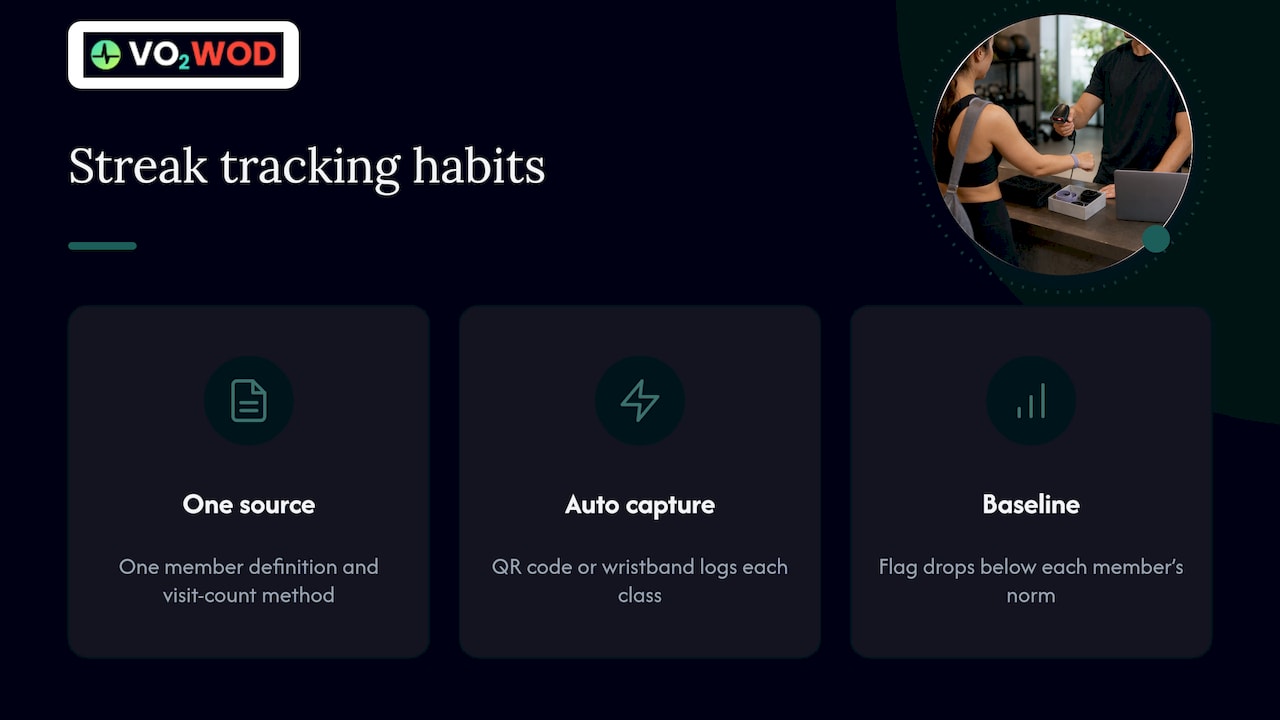
One source of truth. Industry guidance for gym managers recommends one consistent definition of an active member and one method for counting visits, then segmenting retention by membership type, tenure, coach and acquisition source. If check-ins live in one tool and reservations in another, the two never agree.
Automatic capture at the door. VO2WOD supports check-in by QR code or wristband, so every attended class is logged without the coach taking roll. Because scheduling, reservations and memberships sit in the same platform, a freeze or a cancelled class is already in the record when the streak is calculated.
Personal baselines. The same analytics guidance advises flagging members whose visit pattern falls below their own baseline, not just a gym-wide average. A member who normally comes four times a week and drops to one deserves a message sooner than a once-a-week regular who stays at one.
If you are moving from another system, your streak history should come with you. We offer free data migration and a dedicated support team for the transition, and our guide to switching gym software walks through how to keep members' history intact.
The numbers to watch alongside the streak
A streak is one lens. A coach looking at real-time participation should also see:
| Signal | What it tells you | Source |
|---|---|---|
| Return within 48 hours of first class | Early activation | Health & Fitness Business, Feb 2026 |
| Sessions in weeks 2 to 4 | Whether the habit is forming | Same article |
| Weekly attendance per active member | Engagement depth | Same article |
| Missed sessions followed by outreach | Whether you are closing the loop | Same article |
| Class attendance and waitlist demand | Which formats to add or adjust | Club Solutions Magazine, Nov 2025 |
For a fuller set of metrics, see our walkthrough of six gym KPIs.
The first six weeks decide most streaks
The January 2025 study found that about 50% of members had not maintained their streak at the six-week mark, and only 20% still had at 17 weeks, which makes week six a critical habit milestone. That is where your effort pays most.
A retention expert quoted in Health & Fitness Business suggests tracking new members closely over their first 60 days, aiming for 20 uses in that window and following up with anyone who used the gym four times or fewer in the previous 30 days. For a class-based gym, translate that into a simple trigger list:
- No second visit within a week of the first class.
- A drop below two classes in any week during weeks two to four.
- A first missed week, before it becomes two.
Each trigger should produce a human message from the member's coach. In-app messaging in VO2WOD lets you send that nudge from the same place you see the attendance record.
Using streaks to motivate without pushing unsafe habits
Streak rewards are tempting, but evidence on incentives is modest. An NBER experiment with 836 new members of a US gym found that financial incentives had moderate effects on attendance during the first six weeks and no effect on later visit trajectories. Habit building, not prizes, carries a member past week six.
A few ways to design streaks that support safe training:
- Reward weeks, not days. Celebrating a four-week streak at three classes a week is healthier than a seven-day challenge that punishes rest.
- Let rest count. If your programming includes recovery days, make them part of the plan so members do not feel they must train through soreness to protect a number.
- Start small. A Colorado recreation center supervisor grew group training attendance 68% by having new members build a habit first and add sessions as they progress, rather than starting at four days a week.
- Celebrate milestones, not only length. A first benchmark, a new personal record or a 50th class is a better moment to message than an arbitrary streak day. Our guides on member milestone tracking and milestone notifications cover what to track and when to notify.
When a member reports pain, illness or an injury, their coach should tell them to pause and see a health professional, and the streak freeze should be there so they never feel penalized for it.
Reading a streak in context
A long streak with no variety may signal a rut, while a member with fewer classes and a clear goal may be doing better. Streaks can also point to members who have built a routine and are good candidates for a different program or a community role, such as helping welcome newcomers.
This is where performance data completes the picture. With automatic workout scoring, personal-record tracking and a movement library, VO2WOD lets a coach see whether a streaking member is also improving. Live heart rate monitoring during class shows effort, so a coach can tell the difference between consistent and consistently exhausted. For the scoring side, see our piece on benchmark workout tracking, and for the human side, coach feedback tracking.
When a streak breaks
A broken streak is not a failure. It is your best prompt for a conversation. Reach out after the first missed week with something specific: a note about their last score, a class they might like, an offer to adjust their schedule. Operators in the same retention feature caution against reacting only after the fact, so build the trigger before you need it.
If a member has fully lapsed, move them into a win-back sequence. Our guide to reactivation campaigns covers the timing and message, and our post on gym churn rate shows how hidden cancellations hide behind attendance drops.
Our perspective
Most gyms already have the data to run streaks. What they lack is a record they trust. When check-ins, billing, scheduling and workout scores sit in separate tools, no one can answer a simple question: is this member still coming, and are they getting better?
We built VO2WOD for functional fitness gyms so a coach can see attendance, effort and performance together. A streak becomes a conversation starter, not a vanity number: you see who is consistent, who is slipping and who just hit a personal record, and you message them from the same place.
Our advice is to keep the rules short, count automatically, and treat every streak as a reason to talk to a member, never as a reason to push them harder than their body wants.
Marcus
Put streaks to work in your gym
VO2WOD is management software for functional fitness gyms, with QR and wristband check-in, class scheduling, recurring billing, a lead CRM, in-app messaging with milestones, personal-record tracking and live heart rate monitoring. We migrate your data for free and give you a month of complimentary service while you switch.
See how it fits your gym at vo2wod.com, or look at the Vo2hub group-fitness hardware that brings live in-class biometrics to your floor.
FAQ
How long should an attendance streak be before we celebrate it?
Celebrate early and often at first. Because about half of members lose their streak by week six in the research cited above, a four-week and a six-week mark are the most meaningful early milestones. After that, tie celebrations to personal achievements as well as length.
Should a missed week reset the streak?
We suggest not. Allowing one missed week for travel, illness or work matches how real habits behave, since a two-week gap is the stronger sign that a habit has broken. Whatever you choose, write it down and apply it to everyone.
How many visits a week is a good target?
IHRSA's data puts the US industry average around 1.9 visits per week and defines core users as about twice a week. Treat two classes a week as a healthy baseline for most members and let experienced athletes choose more.
Can streaks hurt members?
Only if they reward training through pain or fatigue. Count weeks rather than days, allow freezes, and have coaches tell any member who feels unwell to rest and see a doctor.
Sources
- What a member attendance streak report can and cannot prove
- Exploring the interplay between attitudinal and behavioural loyalty (Taylor & Francis, 2023)
- IHRSA 2020 Health Club Consumer Report
- From Occasional to Steady: Habit Formation Insights (arXiv, 2025)
- Gym Manager Analytics: The Key Metrics to Track and Improve
- Data Driven, Health & Fitness Business, February 2026
- The Power of Programming to Create Connection, Club Solutions Magazine
- Retention, Health & Fitness Business, November 2025
- Can Financial Incentives Help People Trying to Establish New Habits? (NBER)
- The secret to boosting new member attendance 200% this January