

The best gym membership add-ons are the ones that solve one clear problem for a member (childcare, recovery, extra classes, coaching, 24/7 access), carry a simple monthly or per-visit price, and bill automatically next to the base membership. Add-ons fail when the price is unclear, the cancellation terms are hidden, or nobody can see who actually uses them. For a functional fitness gym, that means running add-ons from the same system that handles billing, scheduling, check-in and performance data, so every extra you sell is visible and easy to manage.
TL;DR
- Keep the base membership simple and sell extras as add-ons: coaching, recovery, childcare, guest access, extended hours and class packs are the common ones in the U.S.
- Real U.S. price points run from about $4.99 to $15 a month for light access upgrades and $30 to $50 a month for classes, nutrition or childcare, with coaching priced per session or per month.
- Every add-on is a recurring charge, so disclose it clearly and make it easy to stop. The FTC has put hidden add-on terms at the center of a lawsuit.
- Test one add-on at a time and track how many members attach it, how it affects visits, and why people cancel it.
- Run add-ons from one platform that bills, books and checks members in, so the numbers are never split across tools.
Table of Contents
- What counts as a gym membership add-on
- What U.S. gyms charge for add-ons
- Which add-ons earn their place
- How to price and package add-ons
- Billing add-ons the right way
- Measure what each add-on does
- Where a single system helps
- Promo
- Perspective
- FAQ
- Sources
What counts as a gym membership add-on
An add-on is an optional paid extra that sits on top of a base membership. The member chooses it, pays for it on its own line, and can usually remove it without cancelling the membership. One U.S. club describes its add-ons as options that personalize a Core Membership, such as childcare, unlimited instructor classes, Recovery Room access and guest or family options that can be combined.
For a functional fitness gym, add-ons usually fall into five groups:
- Access: 24/7 entry, guest privileges, family or friend add-ons, open gym.
- Instruction: extra classes, small group training, personal training, specialty skill sessions.
- Recovery: compression, massage, sauna, cold plunge.
- Convenience: childcare, lockers, towel service, parking.
- Digital and nutrition: an app, programming for travel or paused members, nutrition coaching.
The point of the structure is clarity. The base membership stays easy to explain at the front desk, and each extra has its own reason to exist.
What U.S. gyms charge for add-ons
Prices vary by region and format, so treat these as a map of the range rather than a rate card. The figures below come from each gym's own published pricing.
| Add-on | Example price | Gym |
|---|---|---|
| 24/7 access | $4.99 per adult per month | YMCA of South Hampton Roads |
| 24/7 access | $10 per month | The North Club |
| 24-hour access | $12 per month plus $10 set-up fee | Northgate Health Club |
| Unlimited group classes | $30 per month, or $5 per class | The North Club |
| Personal training | $60 per session, or $50 each in a 10-pack | The North Club |
| Recovery lounge | $15 per month, any membership | Raintree Athletic Club |
| Recovery suite, unlimited | $39 per month | Northgate Health Club |
| Childcare | $45 per month for the first child, $40 for each additional | Raintree Athletic Club |
| Fitness app | $25 per month | CoreFit Studio |
| Nutrition coaching | $50 per month for members | CoreFit Studio |
| Guest privileges | $20 per month | Powerhouse Gym, 2024 price sheet |
Two patterns stand out. First, many add-ons carry two prices: a monthly unlimited rate and a per-visit rate. The North Club offers unlimited classes at $30 a month or $5 a class, which lets a casual member try the add-on before committing. Second, the gap between member and non-member pricing is part of the pitch. The YMCA of South Hampton Roads lists its REGYMEN unlimited workouts at $59 a month for members, with a $16 member drop-in and $22 for non-members.
Fees around the membership matter too. Powerhouse Gym's price sheet lists a $60 enrollment fee, a $60 annual fee and a $25 cancellation charge alongside its add-ons. Members add all of this up, so your add-on prices should be easy to read next to those fees.
Which add-ons earn their place
Not every add-on is worth the effort. A useful test is whether it solves a real problem for a specific type of member and whether you can deliver it repeatedly without heavy staff time.
Coaching and small group work
Coaching is the add-on most functional fitness gyms already know how to deliver. An industry report summarized by Alloy Franchise says personal training is the most lucrative profit center at fitness-only clubs, at nearly 9% of total revenue. In a coached-class gym, the natural versions are small group sessions, skill clinics and programming for members with specific goals.
Sell the outcome, not the hours. A member who wants a first strict pull-up or a faster mile responds to a defined block of coaching better than to "four sessions." Avoid promising a specific result, since a promise that stalls becomes a cancellation reason.
Recovery
Recovery add-ons need little space and little staffing. Members tend to use them right after a hard class, which links them directly to attendance. At Raintree Athletic Club, the Recovery Lounge with HydroMassage, compression and percussion therapy is a $15 a month unlimited add-on to any membership. If you want to see how recovery-style services are priced by sessions and memberships, hydromassage session and membership pricing shows how a single service can be sold both ways.

Useful amenities also keep people coming back. The same logic applies in other sports: keeping league players coming back comes down to removing friction around access, which is exactly what a recovery or access add-on does for a gym member.
Childcare
Childcare removes the most common scheduling barrier for parents, and it is usually priced per child. Raintree charges $45 a month for unlimited childcare for the first child and $40 for each additional child, or $10 per visit. CoreFit Studio lists $100 a month unlimited, $30 for a second child, and $15 an hour drop-in. Childcare needs staffing and space, so confirm you can run it consistently before you sell it.

Access and guests
Extended hours and guest privileges cost you little and members value them. The $4.99 to $20 monthly range in the table above shows how many gyms use them as low-priced entry add-ons. Friend and family add-ons also work as acquisition: the people a member brings are warm leads. If you want a structured way to turn those into new members, our guide to automated gym referral ideas covers it.
Digital programming
A digital add-on keeps people connected when they cannot attend in person. Gym Membership Tips describes three models: a premium add-on with an extra monthly fee, a hybrid with one or two in-person sessions plus app programming, and a lower-priced digital-only option for members who moved, travel or paused. The third is worth thinking about, because it keeps a relationship alive with someone who would otherwise cancel.
Nutrition
Nutrition coaching sells well alongside training, but it has a legal edge. Coaches can usually give general guidance on portions and meal timing, while diagnosing deficiencies or prescribing therapeutic diets is reserved for registered dietitians or licensed nutritionists. Members with a medical condition that requires dietary management should be referred to a registered dietitian, so write your add-on description around general guidance.
How to price and package add-ons
Start from the base membership and work outward. Gym Membership Tips recommends keeping the core unlimited membership simple and using add-ons instead of complicating it, for example selling personal training separately so casual members do not subsidize intensive support. Our own guide to gym membership pricing and billing walks through the base-price side of that decision.
A workable approach:
- Write a mini-business plan for each add-on. Who it serves, what problem it solves, what it costs to deliver, the price, who on staff owns it, and a one-sentence pitch for the front desk. This is the approach Gym Membership Tips recommends.
- Offer two ways to buy. A monthly unlimited rate and a per-visit or punch-pass rate, as the gyms in the table do.
- Use three tiers when you bundle. An entry package, a middle goal-based package, and a premium package with coaching and check-ins.
- Reward membership. A lower member price against a higher non-member price makes the base membership feel like the better deal.
- Change one variable at a time. Price, benefits, billing cadence or sales message: test one, then measure.
A worked example
Suppose your base membership is $150 a month and you add a $30 recovery pass. If 40 of your 200 members take it, that is $1,200 in extra monthly recurring revenue, an invented figure for illustration. Before you call it a win, check the same 40 members against the other 160: do they attend more, and do they stay longer? An add-on that raises revenue but not attendance is a weaker result than it looks.
Mid-month changes
Members will add and drop extras mid-cycle, so decide your proration rule in advance. Our guide to membership proration shows how to calculate it and set it up so members are not surprised by a charge.
Billing add-ons the right way
An add-on is a recurring charge, and U.S. regulators treat that seriously. In its complaint against LA Fitness, the FTC alleged the company offered more than 50 add-on services and amenities, including childcare and towel service, without disclosing that they were separate recurring programs with their own cancellation requirements. The suit rests on the Restore Online Shoppers' Confidence Act, which requires a seller to disclose all material terms before taking billing information, get express informed consent, and provide a simple way to stop recurring charges. Those rules apply to add-ons sold online.
For a gym owner, the practical checklist is:
- State the price, billing frequency and renewal terms next to the add-on before the member pays.
- Get the member's explicit agreement to the add-on itself, not only to the base membership.
- Make removing an add-on as easy as adding it.
- Keep contract-style add-ons, such as long personal training packages, clearly separate. FindLaw's coverage notes LA Fitness personal training contracts of six to twelve months, with a fee of half the remaining balance for early cancellation.
- Talk to a lawyer about your state's rules on automatic renewals and cancellation before you launch.
Billing is also where the day-to-day mess shows up. Mismatched cycles and unclear invoices create the charge disputes members remember. Our guides on recurring billing for gyms and billing cycle math and compliance cover the setup.
Measure what each add-on does
An add-on you cannot measure is a guess. Track these for each one:
- Attach rate: the share of members who take it.
- Attendance: do add-on members visit more than similar members without it?
- Retention: do they stay longer?
- Cancellation reasons: why do people remove it?
- Delivery cost: staff hours and space against revenue.
Gym Membership Tips advises testing one add-on at a time by comparing attach rate, member feedback and cancellation reasons.
Be careful with how you promote them. One industry guide suggests no more than two personal-training messages per member per month, and none in the first 14 days after a purchase. More messages do not mean more sales; they mean more members muting you.
There is a useful way to time offers: reach members at moments they feel good about their progress. Milestone messages do that, and our piece on milestone notifications for gym owners explains how they lift check-ins.
Where a single system helps
Most owners who struggle with add-ons are not short of ideas. They are short of visibility. Memberships live in one tool, class bookings in another, check-ins on a clipboard, and add-on purchases in a spreadsheet. Then no one can say who bought what, whether they came, and whether they stayed.
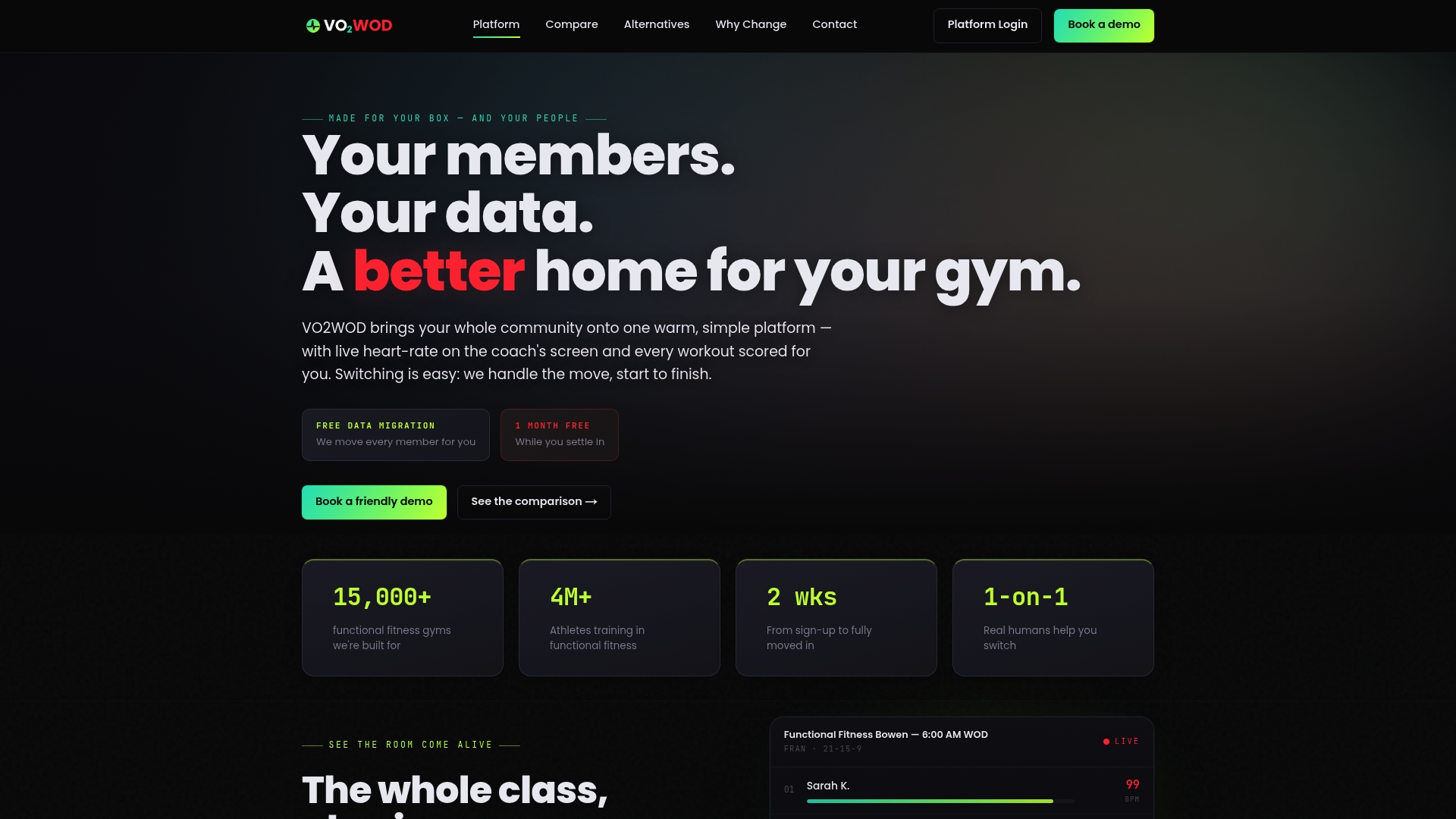
VO2WOD is built for functional fitness gyms and puts membership and recurring billing, class scheduling and reservations, QR or wristband check-in, a lead CRM, in-app messaging with milestones, a movement library with personal-record tracking and wearable integration in one platform. Coaches get live in-class heart rate data and automatic workout scoring, so you can see how members actually train.
Promo
If you want add-ons to run from the same place as your billing, classes and check-ins, VO2WOD is designed to do that for functional fitness gyms. We offer free data migration, a month of complimentary service and a dedicated team to help you move over, so you do not start from scratch.
See how it fits your gym at vo2wod.com, and compare options by type on our alternatives page. If you are budgeting, read what gym software really costs in 2026 first. Gyms that want in-class heart rate screens can also look at Vo2hub group-fitness hardware.
Perspective
Gyms get add-ons wrong in a predictable way. They add a sauna, a cold plunge or a nutrition package, price it on a hunch, and then have no idea whether it changed anything. The add-on is rarely the problem. The missing data is.
In a functional fitness gym, the add-on that matters most is the one that gets a member to show up and see progress. That is why we built VO2WOD around what happens in the class: live heart rate, automatic scoring, personal records and milestone messages. When you can see a member's effort and history, you know which coaching package or recovery pass fits them, and you can offer it at the right time instead of blasting everyone.
Our advice is to keep the base membership plain, add one extra at a time, and put billing, booking and check-in in one system so every add-on has a number next to it. Fewer tools means fewer surprises for you and for your members.
Marcus
FAQ
What are the most common gym membership add-ons?
The most common are personal or small group training, extra classes, childcare, recovery services, 24/7 access, guest privileges, lockers and towel service. Larger clubs list dozens. A functional fitness gym can start with two or three that fit its members.
How much should I charge for a gym add-on?
Look at what your members already pay and what your delivery costs. Published U.S. examples run from $4.99 a month for 24/7 access to $30 a month for unlimited classes, with training priced per session. Offer a monthly rate and a per-visit rate where it makes sense.
Can members cancel an add-on without cancelling their membership?
They should be able to. The FTC's case against LA Fitness centers on add-ons sold without clear disclosure of their separate recurring terms and cancellation requirements. State the terms before purchase and make removal simple.
How many add-ons should a gym launch with?
One at a time is a good rule. Gym Membership Tips recommends testing a single add-on and comparing attach rate, feedback and cancellation reasons before adding the next.
Can coaches give nutrition advice as an add-on?
General guidance on portions and meal timing is typically fine, but therapeutic diets and medical nutrition therapy belong to registered dietitians or licensed nutritionists. Check your state's rules and refer members with medical conditions to a registered dietitian.
Sources
- Membership, Courtside Fitness
- Membership Add-Ons, YMCA of South Hampton Roads
- Flexible Gym Memberships, The North Club
- Memberships, Northgate Health Club
- Raintree Athletic Club FAQ
- 2024 Membership Price Sheet, Powerhouse Gym
- Pricing, Core Fit
- How to Create Multiple Profit Centers for Your Fitness Business, Alloy Franchise
- Top Add-On Services for 2026, Gym Membership Tips
- Subscription Pricing Examples for Gyms, Gym Membership Tips
- FTC Amended Complaint against LA Fitness
- FTC Flexes Against LA Fitness, FindLaw
- How to Add Nutrition Coaching to Your Personal Training, Gymkee
- Triple PT Package Sales with Upsell Automation
- Hydromassage Cost: Sessions, Memberships and Home-Unit Prices
- Retain League Players: Fix Court Access