

Gym management software typically runs between free (basic, ad-supported tiers) and $300 or more per month, but that sticker price is not what you actually pay. Transaction fees, add-ons, and onboarding costs usually determine your real monthly bill, often by hundreds of dollars.
If you're budgeting right now, skip the marketing pages and do this instead: pull together three numbers, your member count, your average payment amount, and your card-versus-ACH payment split, then run a basic total cost of ownership calculation against any quote you receive. A vendor's advertised base price rarely survives contact with real transaction volume.
For functional fitness gyms specifically, VO2WOD offers free data migration and one month of complimentary service, which removes two of the biggest hidden costs (switching friction and duplicate-month billing) before you even sign a contract. That alone is worth factoring into any comparison you build.

Key Takeaways
Total gym software cost is driven far more by transaction fees, add-ons, and pricing model than by the advertised base subscription price.
| Point | Details |
|---|---|
| Sticker price misleads | Base plans run $0 to $300+ monthly, but processing fees often add hundreds more. |
| Processing fees compound at scale | A gym with several hundred members can see thousands of dollars monthly in card processing alone. |
| Pricing model determines growth cost | Flat-rate plans beat per-member pricing once you cross roughly 125 members. |
| Proration formula is standardized | Monthly rate divided by days in month, times days remaining, though vendor behavior varies. |
| VO2WOD cuts stacked add-on costs | Free migration, one complimentary month, and built-in HR tracking reduce switching and tool-stacking costs for functional fitness gyms. |
Table of Contents
- What Drives the Real Cost of Gym Management Software?
- How Do Different Pricing Models Affect Your Costs as You Grow?
- What Do Real Gym Software Costs Look Like at Different Sizes?
- How Does Proration Work When You Start or Change Plans?
- How Do You Calculate Total Cost of Ownership Before You Sign?
- Why VO2WOD Reduces Total Cost for Functional Fitness Gyms
- Get an Accurate Cost Picture With VO2WOD
- Frequently Asked Questions
- Sources
What Drives the Real Cost of Gym Management Software?
Base subscription price is just one line item, and usually not the biggest one. Published ranges cluster around $0 to $300+ per month, with GymWyse publishing starter pricing at $59 a month, a professional tier at $99, and a top tier at $149, all with no setup fees. Those numbers look manageable until you stack the rest of the bill on top.
Payment processing is where costs quietly balloon. If your gym runs $40,000 a month in membership dues through cards at a typical blended rate, you could be paying $1,000 to $1,400 a month in processing alone, separate from whatever the software vendor charges for the platform itself. ACH transfers tend to run cheaper than card transactions, so a gym that shifts autopay members toward bank transfers can meaningfully cut this line. Stripe's payment documentation is a useful baseline for understanding how card and ACH rates are structured before you negotiate with any vendor.
Beyond the subscription and processing, budget for these recurring and one-time items:
- Add-on modules: nutrition tracking, advanced reporting, or CRM upgrades often run $20 to $80 per month each.
- Hardware: card readers, kiosks, or wristband scanners can add $200 to $800 upfront, sometimes more for multi-location setups.
- Onboarding and setup: some vendors charge $100 to $500 for implementation; others waive it entirely.
- Data migration: moving member records, billing history, and class schedules from an old system can cost extra unless the vendor includes it.
- Custom integrations: connecting a separate CRM or accounting tool sometimes requires a developer fee.
Then there's the cost nobody puts on an invoice: staff time. If your front desk manager spends five hours a week manually reconciling payments or chasing failed charges, and you value that time at $20 an hour, that's $400 a month in administrative labor the software should be eliminating, not creating.
How Do Different Pricing Models Affect Your Costs as You Grow?
The pricing model you choose matters more than the sticker price, because it determines whether your software bill grows faster than your revenue. Get this wrong and you'll be renegotiating in eighteen months.
Per-member pricing charges a flat fee per active member, often $1 to $3 monthly. A gym with 150 members at $2 per member pays $300 a month. Grow to 400 members and that same rate costs $800 a month, even though your software usage barely changed. This is the "growth tax" every operator eventually notices: the platform that felt cheap at launch becomes one of your top five expenses at scale.
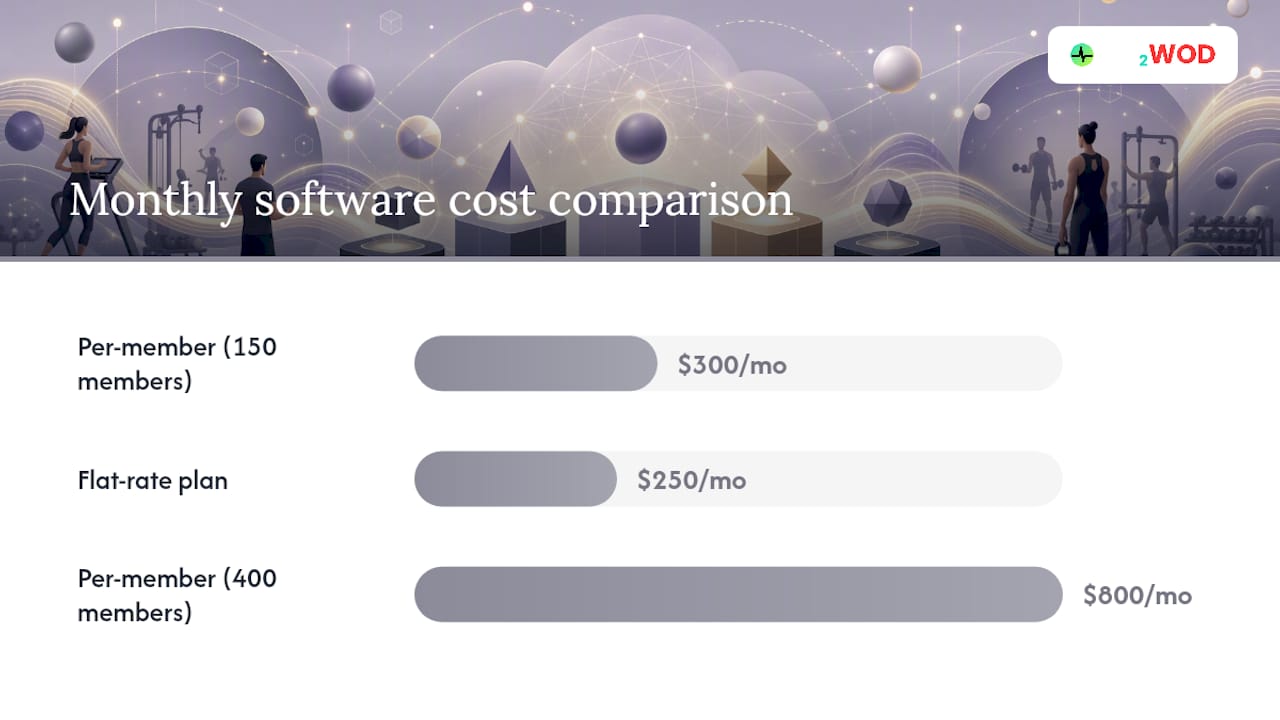
Flat-rate or unlimited-member models charge one price regardless of headcount. If a flat plan costs $250 a month, it beats per-member pricing the moment you cross roughly 125 members at a $2 per-member rate. Below that member count, per-member pricing is usually cheaper. Above it, flat-rate wins every time, and the gap widens the more you grow.
Tiered pricing with feature gating locks capabilities like online booking, CRM tools, or advanced reporting behind higher tiers. Watch for these common gates:
- Class scheduling and reservations
- Lead management or CRM features
- Custom or exportable reporting
- API access and third-party integrations
Revenue-share models, where the vendor takes a percentage of dues instead of a flat fee, occasionally make sense for brand-new gyms with unpredictable cash flow, but they scale badly once revenue climbs, since the vendor's cut grows in lockstep with your success.
What Do Real Gym Software Costs Look Like at Different Sizes?
Numbers convince better than generalities, so here are three scenarios built on published pricing structures and typical processing rates.
-
Small gym, 75 members, per-member pricing. Base software fee at $2 per member runs $150 a month. Average monthly payment per member is $150, so total dues processed is $11,250. At a blended card processing rate, that adds roughly $325 to $340 a month. Add a basic reporting add-on at $30. Total: approximately $505 to $520 monthly, or about $6,100 to $6,240 annually.
-
Mid-size gym, 300 members, tiered plan. A GymWyse-style $99 professional tier covers scheduling and CRM. Dues processed at an average $140 per member totals $42,000 a month, generating roughly $1,200 to $1,300 in card processing costs. Add a $50 nutrition module and amortized hardware (a $600 kiosk spread over 24 months, about $25 a month). Total: approximately $1,375 to $1,475 monthly, or $16,500 to $17,700 annually.
-
Scaled gym, 600 members, flat-rate unlimited plan. A flat $250 monthly plan replaces per-member scaling entirely. Dues processed hit $84,000 a month, pushing card processing to roughly $2,400 to $2,500. Two add-on modules run $100 combined. Total: approximately $2,750 to $2,850 monthly, or $33,000 to $34,200 annually.
The crossover point is visible in scenario three: at 600 members, a per-member plan at $2 each would cost $1,200 just for the base subscription, nearly five times the flat-rate fee. Flat-rate models become the cheaper option well before a gym hits mid-size scale.
How Does Proration Work When You Start or Change Plans?
Proration determines what you actually pay the month you sign up or switch plans, and it catches more gym owners off guard than any other billing mechanic. The standard formula, confirmed across multiple vendor knowledge bases, is straightforward: monthly rate divided by days in the month, multiplied by days remaining.
A gym signing up on day 20 of a 30-day month on a $150 plan would owe $150 ÷ 30 × 10 days remaining, or $50 for that first partial month. Vendors vary widely on how they apply this in practice:
- Some prorate the first invoice automatically based on signup date.
- Others charge the full month regardless of when you start, then reset your billing anchor to that date.
- A few let you choose a fixed billing anchor (like the 1st of every month) so proration only applies once, at signup.
Vendor help documentation confirms proration settings are configurable, and cancellations or holds are typically handled the same way in reverse, crediting unused days rather than refunding a full month.
Pro Tip: Ask any vendor for their exact proration and billing anchor policy in writing before signing. This single question prevents most of the member billing disputes gym owners report during the first 60 days on a new platform.
How Do You Calculate Total Cost of Ownership Before You Sign?
A repeatable process beats comparing sticker prices side by side, because sticker prices hide the variables that actually separate a $200-a-month system from an $800-a-month one.
- Collect your own numbers first. Member count, average payment per member, your card-versus-ACH split, and expected monthly growth rate.
- Request full vendor figures, not just the base price: per-member fees, transaction rates, every add-on price, onboarding fee, and hardware cost.
- Compute monthly and annual totals, then subtract a reasonable dollar value for admin hours the software eliminates, like reduced front-desk reconciliation time. That savings is a negative cost, and it belongs in your math.
Before comparing quotes, run through this checklist:
- Contract length and any early-termination penalty
- Whether processing rates include a markup above standard card network rates
- Data migration terms, including whether it's free or billed hourly
- Cancellation fees or required notice periods
- Typical support response times, not just advertised availability
Red flags worth walking away from: vendors who won't quote transaction fees until after you sign, contracts that auto-renew with no cancellation window, and "free" migration that turns out to require a paid consulting hour. During a demo, ask directly: "What's my all-in monthly cost at my current member count, including processing?" A vendor who can't answer that in the room hasn't priced their own product honestly.
Why VO2WOD Reduces Total Cost for Functional Fitness Gyms
Functional fitness gyms carry a specific cost problem: they often stack a scheduling tool, a separate heart-rate monitoring system, a spreadsheet for tracking personal records, and a messaging app on top of their core management software. Each one is a separate line item.
VO2WOD folds real-time heart rate tracking, automatic workout scoring, a member-facing app, and built-in reporting into one subscription, which means gyms comparing total cost of ownership can subtract several standalone add-on fees from their competitor quotes before the comparison is even fair.
What that looks like in practice:
- Real-time performance monitoring replaces a separate heart-rate tracking subscription.
- Automatic workout scoring cuts the admin hours coaches spend manually logging results.
- Free data migration removes one of the largest one-time costs gym owners cite when switching platforms.
- One month of complimentary service offsets the overlap cost of running two systems during transition.
- Wearable integration with Garmin, Apple, Fitbit, and Samsung avoids a separate hardware purchase for many members.
A dedicated transition team handles the switch, which matters most in the first 30 days, exactly when proration disputes and onboarding confusion tend to spike.
An operator's take on the real cost surprise
I've watched gym owners get blindsided not by the subscription price, but by the processing bill that showed up 45 days later, once they'd fully migrated their dues. The lesson isn't "read the fine print," it's simpler: run the TCO math before you sign, not after your first invoice. Pull your member count and average payment today, plug them into the scenarios above, and see where your gym actually lands. If you're running a functional fitness box and want to see what a migration with a complimentary first month looks like, VO2WOD's platform is worth a direct look.
Get an Accurate Cost Picture With VO2WOD
Comparing vendor quotes line by line is the right approach, but it takes time most gym owners don't have between coaching classes and managing members. VO2WOD shortens that process for functional fitness gyms specifically: it replaces separate heart-rate monitoring, workout scoring, and member engagement tools with one subscription, which means fewer add-on lines to chase down when you're building your total cost of ownership estimate.
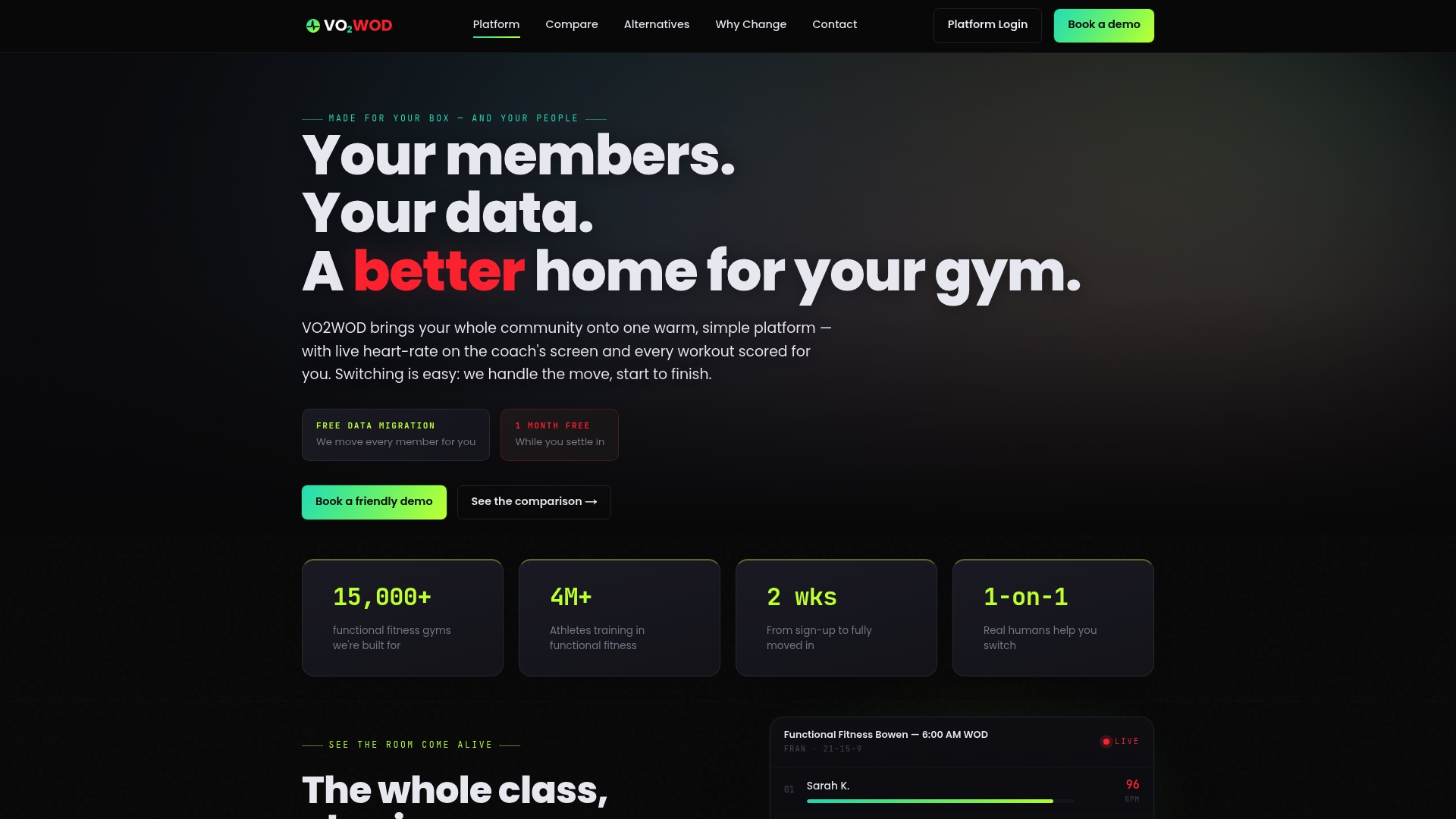
The offer that makes switching low-risk is straightforward: free data migration and one month of complimentary service, so you're not paying twice while your team learns the new system. A dedicated transition team handles the technical lift, and the platform's core features cover billing, scheduling, check-ins, and performance tracking without requiring separate tools bolted on afterward. If you're currently comparing VO2WOD against other platforms, the alternatives breakdown walks through how the migration and cost structure compares directly. Reach out to request a quote based on your actual member count and see the real monthly number before you commit to anything.
Frequently Asked Questions
What is a normal monthly cost for gym management software? Most gyms pay between $50 and $300 a month for the base subscription, but total gym management software cost, including processing fees and add-ons, is often significantly higher than the advertised price.
Does gym software pricing include payment processing fees? Rarely as a flat inclusion. Most vendors charge processing separately, often at rates similar to standard card network fees, and gyms with high dues volume should expect this to be a larger monthly cost than the software subscription itself.
Why did my first invoice cost more or less than the advertised monthly rate? That's proration. Vendors calculate your first charge using the monthly rate divided by days in the month, multiplied by days remaining, which almost never matches the full advertised price in your first billing cycle.
Is per-member pricing or flat-rate pricing cheaper for a growing gym? Per-member pricing is usually cheaper below roughly 100 to 150 members. Past that range, flat-rate plans tend to cost less, and the gap grows wider the more your membership expands.
What hidden costs should I ask about before signing a gym software contract? Ask specifically about onboarding fees, data migration charges, hardware costs, processing markups above standard rates, and cancellation or early-termination fees, since these rarely appear on the advertised pricing page.
How long does it typically take to switch gym management software? Evaluation and vendor comparison usually take two to four weeks, onboarding and data migration another one to three weeks, and full deployment with staff training typically wraps within 30 to 45 days total, though vendors offering free migration support, like VO2WOD, often compress that timeline.
Sources
- GymWyse Pricing - Transparent Gym Software Pricing
- How do prorated or partial billing charges work? — Octiv Fitness knowledge base
- What Does 'Prorate' or 'Prorata' Mean? — GymMaster help
- Stripe — Payments documentation