
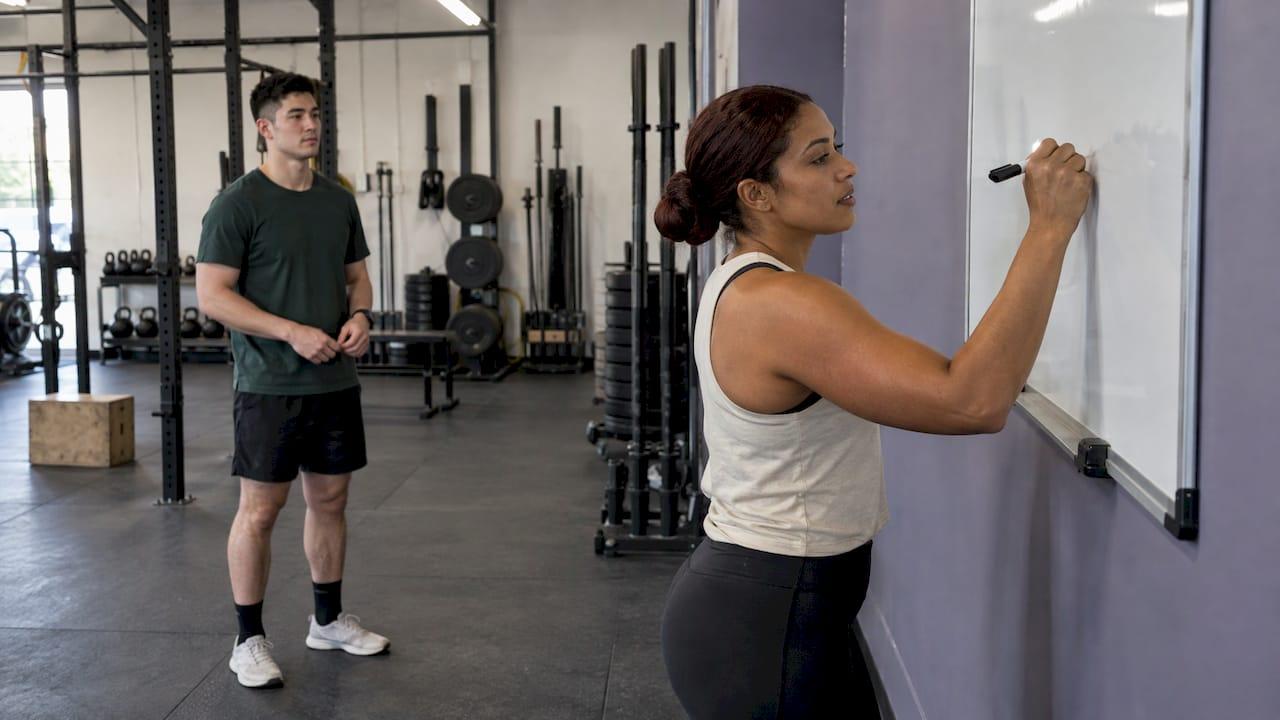
Good leaderboard etiquette comes down to four habits: record your score honestly, scale without apology, celebrate other people's effort instead of ranking it, and never let a number turn into a verdict on someone's worth. The board exists to build accountability and community, and every rule below follows from that purpose.
This guide covers what to do before, during and after a workout, how to handle first-timers and scaled scores, what coaches and owners can do to keep a board healthy, and how to treat the privacy of the people whose names are on it.
TL;DR
- Write down the score you earned, with the standard you actually trained to (scaled or as prescribed). An honest number is the only useful one.
- If it's your first class, your score is a starting point. Don't compare it to anyone else's.
- Cheer effort, ask questions, and skip unsolicited form advice or remarks about other people's numbers.
- Gym owners: make visibility a choice. Let members control how and where their results appear.
- General gym manners still apply around the board: don't block it, don't hog equipment, and put things back.
Table of Contents
- Why the leaderboard exists in the first place
- Before the workout: set yourself up honestly
- During the workout: effort first, scoring second
- After the workout: recording and reading scores
- What to say, and what to skip
- Filming, photos and privacy around the board
- For coaches and gym owners: build a board people want to be on
- Our perspective
- Make your gym's board work for everyone
- Etiquette checklist to share with your members
- FAQ
- Sources
Why the leaderboard exists in the first place
A whiteboard or a screen of scores can feel like a ranking. The people who built the culture around it describe it differently. CrossFit's own statement of its ethos says the whiteboard works as a scoreboard where athletes record results and share them with coaches and each other, which builds accountability. The same piece argues that sharing results makes athletes vulnerable in a way that fosters community: in effect, each person says, this is what I had in me today.
That framing is the key to etiquette. If the board is a way of saying "here is what I had today," then the right response from everyone else is respect, not scorekeeping against your own ego. The same goes for the person at the top of the list and the person at the bottom. Both showed up and both put their effort where others can see it.
There is also a practical side. Coaches use recorded scores to program, scale and spot progress over months. A score that was inflated, rounded up or skipped leaves a hole in that picture. If you want to understand how tracking over time helps you, our guide to benchmark workout tracking walks through how to log, compare and use your results.

Before the workout: set yourself up honestly
Etiquette starts before the clock does. A few habits keep the board clean.
Know the standard you're training to
If the workout is programmed with a prescribed weight and movement standard, either you did it that way or you scaled it. Both are legitimate. What isn't legitimate is logging a scaled workout as if it were prescribed, or counting reps that didn't meet the movement standard. If you're unsure whether a rep counts, ask your coach before the clock starts, not after you've seen the results.
Scale without apology
Scaling isn't a lower tier of membership. It's how a workout is matched to the athlete in front of it. Most gyms mark scaled scores in some way, such as a note beside the name or a different column. Use whatever marker your gym uses, and don't apologize for it out loud. Nobody needs a speech about why you used a lighter bar.
There's also the matter of rights to equipment. Laura Girard, a certified personal trainer at The Energy Academy in New York City, told The Guardian that you are no less deserving of a squat rack because you're only squatting the bar. The same principle applies on the board: a lighter load doesn't earn you a lesser place in the room.
Keep your space and gear in order
A classroom-style workout often has a shared whiteboard or a screen on the wall. Don't stand in front of it chatting, don't lean on it, and don't block mirrors or walkways while you check your number. Cleveland Clinic's gym etiquette guide lists not blocking mirrors, keeping noise in check and respecting personal space among the basics for any U.S. gym, and a crowded board area is where those rules get tested.
During the workout: effort first, scoring second
The middle of a workout is not the time for score talk. Some quick rules:
- Count your own reps. If you have a judge or a partner counting, accept the count and say thanks. If a rep is no-repped, fix it and carry on without a debate.
- Don't compare mid-workout. Glancing at someone's pace is normal, but narrating it ("you're ahead of me!") can drain the fun from the person you're talking to.
- Share equipment. When two people need the same piece of kit, alternate sets. A PureGym US survey of 2,000 people found that taking over multiple pieces of equipment was ranked the most annoying gym behavior, at 6.94 out of 10. The same page defines "working in" as two people alternating sets on the same equipment.
- Ask instead of hovering. Cleveland Clinic suggests that if you're waiting, you politely ask how many sets the person has left or whether they'd like to alternate sets, rather than standing over them. Nike's trainers add that during a longer rest, you can let someone waiting work in for a set instead of sitting idle.
- Don't coach other members. Aaron Leventhal, C.S.C.S., owner of Fit Studios in St. Louis Park, Minnesota, tells Nike readers not to hand out form tips, because in terms of liability it's a bad idea and it also feels awkward for the other person. Leave form feedback to the coach.
One caveat from the other direction: it's fine to ask. Girard told The Guardian that as long as you don't interrupt someone in the middle of a set, approaching someone for a quick form check or help with equipment is totally fine. Just pick your moment.
After the workout: recording and reading scores
This is the part where leaderboard etiquette gets specific. Here are the rules of thumb.
Record your score accurately and promptly
Post your result as soon as you've caught your breath, with the correct scaling note. Don't wait for a friend's result to decide what to write down. If you realize you miscounted, tell the coach and correct it. Honest corrections earn more respect than a number that stays wrong.
In organized competition the stakes are formal. According to the 2022 CrossFit Games season guidelines, scores submitted in the Open are immediately visible on the worldwide leaderboard, and any score that an affiliate manager hasn't validated by the Wednesday 5 p.m. PT deadline is removed. The 2024 rulebook adds that pending scores appear in italics until validated and in regular text afterward. Your gym's everyday board isn't the Games, but the principle carries over: a score counts when someone who watched it has confirmed it.

Your first score is a starting line
CrossFit's guide for first-timers says it directly: it's your first class, so don't worry about comparing your score to other athletes. It's your starting point. If you're new, post it proudly. If you're a regular watching a newcomer post a modest number, say welcome, not anything about the number.
Use scores to start conversations, not rankings
A March 2026 post from CrossFit Ellis recommends using scores for personal growth rather than comparison, and as a conversation starter. That's a handy test for anything you say about a score. Does it open a conversation ("how did the second round feel?") or close one ("you should have gone unbroken")?
Accountability also does real work for people on any fitness journey. If you're curious why public numbers help people stick with goals, this explanation of why accountability works is a good companion read.
What to say, and what to skip
A short cheat sheet for the floor:
| Do | Skip |
|---|---|
| "Nice work on that last round." | "I can't believe that's your time." |
| "How did the scaling feel?" | "Why did you scale that?" |
| Ask the coach about a movement standard | Correct someone's reps or form unprompted |
| Congratulate a personal record, big or small | Compare your result with theirs out loud |
| Look at the board, then step aside | Camp in front of the board or block the mirrors |
| Ask before filming | Film other members in the background |
Cleveland Clinic advises avoiding staring, judging, or making comments that could make someone uncomfortable, noting that everyone starts at a different level. Nike's trainer tips boil the whole subject down to communicating: etiquette, in that article's words, is about acknowledging other people, seeing them as equals and respecting what they need.
Friendly competition is fine
Nothing here means you can't chase the person ahead of you. Many athletes get their best work out of a friendly rivalry. The difference is consent. A rivalry where both people know about it and enjoy it is a game. A rivalry only one person knows about is pressure. If you want to challenge a friend, say so, and let them decline.
Filming, photos and privacy around the board
Phones are the modern flashpoint. Posting a photo of the leaderboard may feel harmless, but it puts other members' names and numbers in public without asking. Ellen Thompson, C.P.T., head personal trainer at Blink Fitness, told Nike that filming puts other members who would not like to be filmed in an uncomfortable position. Cleveland Clinic's list also includes avoiding filming others.
Some practical rules:
- Photograph only your own result, or crop others' names out.
- If someone else is in your video frame, ask first or move.
- Don't post anyone's scaled or incomplete score on social media without permission.
- If you don't want your result displayed, tell your coach. A good gym will find a solution.
That last point matters across fitness. Digital platforms have been moving toward member control: Peloton added features that let members block other members or hide leaderboard tags they object to. Gym members now expect similar choices.
For coaches and gym owners: build a board people want to be on
Etiquette is partly culture and partly design. The way you run the board determines how members behave around it.
Set the tone in the first class
Tell newcomers that the first score is a baseline and that scaled work is welcome. Introduce the marker for scaled scores as normal. When a coach celebrates effort out loud, such as the last finisher or a first pull-up, members copy it.
Make participation a choice
Members have different comfort levels. Offer ways to take part in the board without being exposed: initials instead of full names, an opt-out, or a view that shows personal progress alongside the group. We covered one such approach in our write-up of a pilot for more inclusive WOD leaderboards.
Remove manual friction
A whiteboard depends on everyone remembering to write something, and on someone erasing it. Missing scores make the board look empty, and mistakes feel personal. Automatic scoring takes that burden off the athlete and the coach. Our post on automatic workout scoring explains how it works.
Reward effort, not only output
If the board only rewards the fastest or heaviest, a big portion of the room will tune out. Effort measures such as heart rate zones give every athlete a way to see a personal win. If you want a starting point, read three effort metrics coaches can use this week. Pair that with coach feedback tracking so the recognition isn't only about numbers.
Keep the community bigger than the board
The board is one piece of what makes people stay. Events, check-ins, and celebrating milestones matter just as much. For ideas, see how to build a gym community that members stay for.
Our perspective
We build software for functional fitness gyms, and we think the leaderboard is one of the best tools a box has, as long as it's designed around the athletes and not just the top ten.
What we hear from coaches is that the scoreboard goes wrong for two reasons. First, scores don't get recorded accurately, because the person at the whiteboard is tired and the coach is busy. Second, the same few people always sit at the top, so everyone else quietly stops looking. We built VO2WOD to address both. Automatic workout scoring takes manual entry off the athlete's plate, and live in-class heart rate monitoring gives every member a way to see their own effort, whether or not they finished first.
We believe a healthy board shows effort, progress and personal records alongside rank. Personal-record tracking and performance history let an athlete compare against their own last month, which is the comparison that actually matters. When coaches can see who is working hard in the room, they can name it out loud, and that recognition tends to be what keeps members coming back.
Good etiquette isn't something software can force, but a platform can make the right behavior easy: honest numbers, visible effort and a community that celebrates everyone's work.
Marcus
Make your gym's board work for everyone
If your gym runs on a whiteboard and a spreadsheet, you can keep etiquette strong with culture alone. But as the membership grows, it helps to have the tools that make fair, accurate and motivating scoring the default. VO2WOD is management software for functional fitness gyms that combines automatic workout scoring, live in-class heart rate tracking, class scheduling, membership billing, check-in, a lead CRM, in-app messaging, a movement library and personal-record tracking in a single platform.
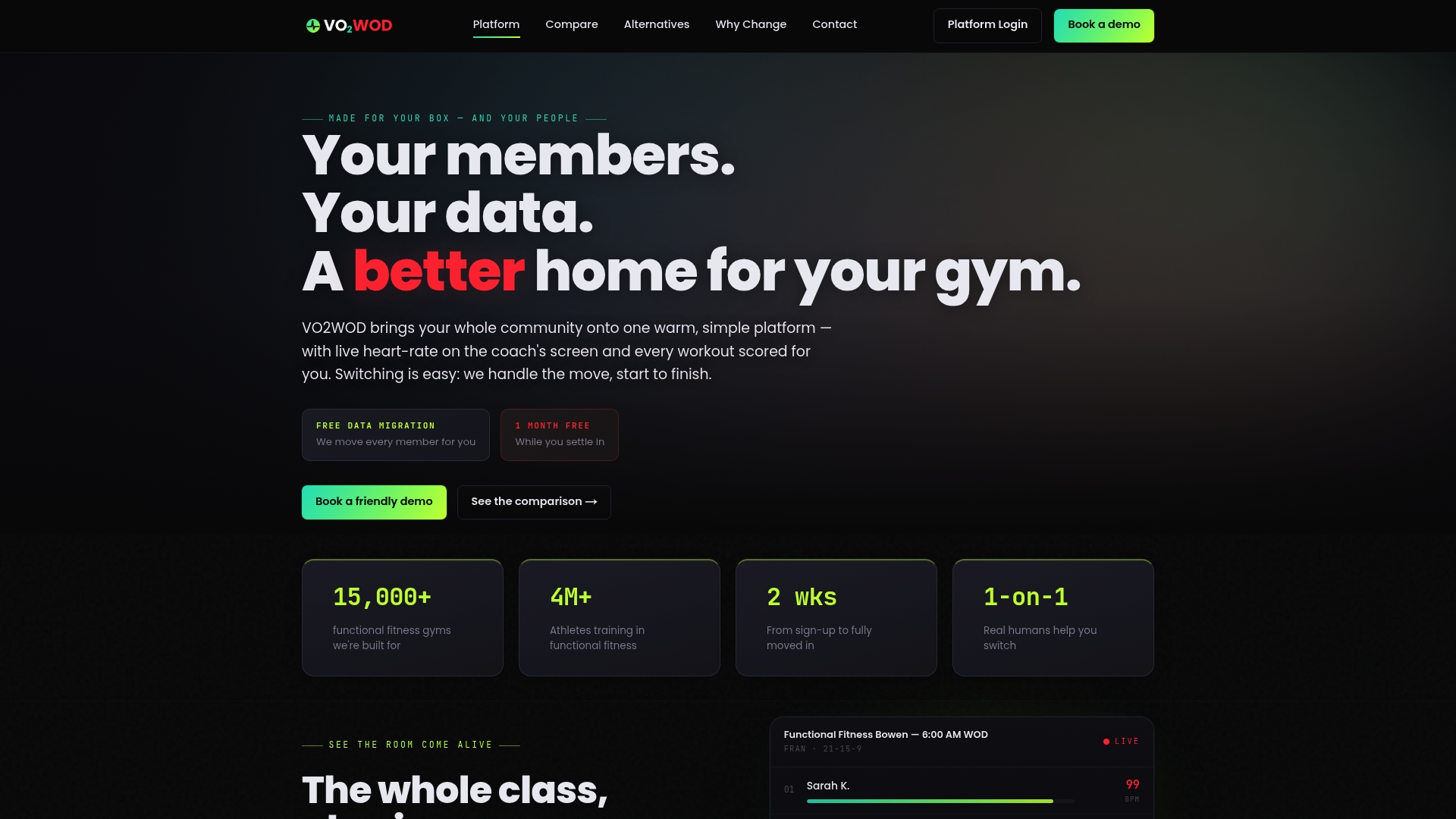
Switching doesn't have to be a project. We offer free data migration, one month of complimentary service and a dedicated support team to help you move over. See how VO2WOD works for your gym, compare it with other gym software options, or read why gyms switch. If you're also thinking about group-fitness hardware for in-class monitoring, take a look at Vo2hub.
Etiquette checklist to share with your members
Post this near the board or send it in your welcome message.
- Log the score you earned, with the right scaling note.
- Your first score is your starting point.
- Cheer effort. Skip comments on someone else's number.
- Don't coach other members unless they ask.
- Ask before filming or photographing anyone else.
- Alternate sets on shared equipment, and ask rather than hover.
- Re-rack, wipe down and put back what you used. Nike's trainers say to treat that as part of your workout.
- Talk to a coach if you'd like your name hidden or your score handled differently.
FAQ
Is it rude to look at other people's scores on the board?
No. The board is posted so members can see it, and the CrossFit ethos describes sharing results as part of building community. What matters is what you do next. Congratulate or ask a friendly question rather than critiquing someone's number or making comparisons out loud.
Should I scale my workout if I'm worried about my score?
Scale based on the movement standard and what you can do safely, not on how the number will look. Your coach can help you choose a version of the workout that suits the day's goal. Mark the score as scaled so the board stays accurate.
Can I give a fellow member a form tip?
It's best not to, unless they ask. Trainers quoted by Nike point out that unsolicited tips raise liability issues and can feel awkward. If you think something looks unsafe, tell a coach so they can step in.
What if I don't want my results public?
Tell your coach or gym owner. Many gyms can use initials, hide a name, or keep your results private to you and your coaches. A good gym treats that as a normal request and not a problem.
Is it okay to post the leaderboard on social media?
Post your own result freely. For anyone else's name or score, ask first or crop them out. Filming others without their say-so is one of the most common complaints in gym etiquette guides.
Sources
- Unspoken Gym Etiquette Everyone Should Know, Cleveland Clinic
- 11 Trainer Tips on Proper Gym Etiquette, Nike
- Hogging weights, loud grunting and sweaty benches: 11 gym etiquette tips, The Guardian
- Gym etiquette 101, PureGym US
- The CrossFit Ethos, CrossFit
- What Should I Expect at My First CrossFit Class?, CrossFit
- 2022 CrossFit Games Season Guidelines
- 2024 CrossFit Games Rulebook
- Your CrossFit Open Score Doesn't Matter, CrossFit Ellis
- Peloton member-blocking and tag-hiding leaderboard feature, The Clip Out