

Gym lead capture is the system that turns a stranger's interest into a name, a way to reach them and a next step on your calendar. It has three parts: a short form or intake path wherever people find you, a reply within minutes, and a follow-up cadence that ends in a booked visit or trial class. Most gyms that "have a lead problem" actually have a capture-and-response problem. This guide shows you how to build all three for a functional fitness gym.
TL;DR
- Ask for little at first: a name, one reliable contact route, the class or membership they are interested in, and when they want to start.
- Reply fast. The goal of the first contact is a booked tour or trial class, not a long conversation.
- Put every lead in one place with a source, an owner and a next step, so nothing sits in an inbox.
- Automate the first text, reminders and nurture emails. Keep the coach or owner for the call and the in-person welcome.
- Track time to first contact, contact rate, booking rate and show rate every week, then fix the weakest step.
Table of Contents
- What counts as a lead for a gym
- Where to capture leads
- What an effective lead form includes
- Respond fast: the first hour decides most of it
- A follow-up cadence that books the visit
- Organize, qualify and assign leads
- What to automate and what to keep human
- U.S. rules for texting and contacting leads
- Metrics that show where leads leak
- Perspective: why lead capture belongs inside your gym software
- How VO2WOD supports lead capture and follow-up
- FAQ
- Sources
What counts as a lead for a gym
A lead is anyone who has given you a way to contact them and shown interest in what you sell. That includes a web form submission, a DM that asks about pricing, a phone call about class times, a walk-in who grabbed a flyer and a friend referred by a member. It does not include a social media follower who never raised a hand.
The useful split is between leads who asked for something (a trial, a tour, a price) and leads who only downloaded or liked something. The first group deserves a call within minutes. The second goes into a slower email nurture.
What staff should record
Whoever picks up the inquiry, by phone, at the desk or in a DM, should capture the same few fields:
- Name and the best way to reach them (mobile number or email)
- Where they came from (website, Google, Instagram, referral, walk-in, event)
- What they asked about: a trial class, a program such as CrossFit-style classes, strength training, kids classes
- When they hope to start
- What happens next, with a date, and who owns it
That is the whole record. Everything else (goals, injuries, schedule preferences) can wait until they are in the door.
Where to capture leads
Capture works best when it sits where the interest already exists. For most functional fitness gyms that means five places.
- Your website. One clear call to action above the fold, such as "Book a free intro class", opening a short form. Put the same form on every program page, not only on a contact page.
- Your Google Business Profile. Theory Road's guide describes a local presence on Google as one of three pieces of working gym lead generation, because it catches people already searching for a gym near them. Make sure your booking link, phone number and hours are current.
- Social media and ads. Link ads and bios straight to the intro form, not to your home page. Instant forms inside the ad platform are fine as long as the follow-up is fast.
- The front desk and the floor. Walk-ins and class guests should be entered into the same system before they leave, ideally on a tablet or QR code at the desk.
- Members. A referral link, a bring-a-friend class or a challenge brings in people who already know someone. See our ideas for automated gym referral programs and gym challenge ideas.
The offer matters as much as the form. The same Theory Road guide recommends offers that attract people who will stay, such as a trial or a challenge, over a permanent discount.
What an effective lead form includes
Every extra field costs you submissions. A practical minimum, based on Gym Ledger's guidance on short enquiry forms, is:
- Name
- One reliable contact route (mobile number or email)
- Preferred location, only if you run more than one and need it for routing
- Program or membership interest
- Intended timeframe or preferred next action ("I want to try a class this week")
- A clear notice explaining how you will contact them and use their data
Templates from form builders usually add fitness goals, preferred membership type and consent checkboxes for terms and privacy, as in JotForm's gym inquiry template. A goals field is fine if it is optional and a single line.
Gym Ledger advises holding medical or injury history and body measurements for a later intake stage. We agree: a stranger filling in a web form should not be asked health details, and you should collect them only when someone is booked, under controls you can explain. Our post on data privacy controls for gyms covers what to put in place.
A simple form, field by field
| Field | Required | Why it is there |
|---|---|---|
| First and last name | Yes | Personal first reply |
| Mobile number | Yes (or email) | Text and call within minutes |
| Optional if mobile given | Nurture sequence | |
| Class or program interest | Yes | Routes the lead to the right coach |
| "When would you like to start?" | Yes | Sets urgency and the next step |
| Consent checkbox for texts and email | Yes | Records permission at the source |
| Goal (one line) | Optional | Gives the coach something to open with |
Respond fast: the first hour decides most of it
Speed is the cheapest improvement most gyms can make. Fit Strategies recommends contacting web leads within minutes during staffed hours, and within fifteen minutes of opening for overnight leads. It also suggests an automated text in the same minute, followed by a human call within five minutes if someone is at the desk, or fifteen if they are coaching on the floor.

If you cannot hit that, you can still close most of the gap with the first automated text. For benchmarks and a step-by-step plan, read our posts on lead response time and conversion benchmarks with a five-minute response playbook.
What the first message should say
Keep it short, human and specific:
Hi Sam, it's Jordan at [Gym]. Thanks for asking about our intro class! I have Tuesday 6:00 a.m. or Thursday 5:30 p.m. open. Which works better?
Offer two times. Do not send a link to a pricing page and hope. The goal of the first contact, as Fit Strategies puts it, is a calendar entry, not a conversation.
A follow-up cadence that books the visit
If the first call does not book a tour with a date and time, or a trial class, move the lead into a cadence. Fit Strategies lays out this pattern:
| Day | Touch |
|---|---|
| 1 | Call, text and email |
| 2 | Call and text |
| 4 | Text |
| 7 | |
| 14 | Last text, then long-term nurture |
Run the emails in parallel with the calls, so the prospect hears from you even when the calls miss. Each message should add something new: a coach introduction, a member story, a class schedule, a reminder of the offer. Not "just checking in".
For the full structure, see our guides to a gym lead nurture follow-up system and a seven-touchpoint trial sequence that cuts no-shows. Once someone books a trial, the work shifts to making the visit happen and making it count, which we cover in raising free trial conversion with visit triggers.
Organize, qualify and assign leads
Leads get lost when they live in five places: the website inbox, Instagram DMs, a clipboard at the desk, a coach's phone and a spreadsheet. Fix it with four rules.
- One list. Every lead enters one CRM or pipeline, whatever the channel. Staff who get a DM log it before they reply.
- One owner. Each lead has a named person responsible, with a backup for days off. Assign by rule (round-robin, or by program) so nobody has to decide.
- Clear stages. Keep them few: New, Contacted, Booked, Showed, Joined, Lost. A lead sits in exactly one stage and each stage has a next action with a date.
- Simple qualification. Score on two things: how soon they want to start and how well they fit your programs and schedule. A lead who wants to start this week and lives ten minutes away gets a call first.
A daily five-minute check closes the loop: open the "New" and "Contacted, no booking" lists and make sure each has a next action. If you want a rollout plan, our 30/60/90-day gym lead management pilot lays one out for functional gyms.
What to automate and what to keep human
Automation protects speed and consistency. People provide trust. Split the work like this.
Automate
- The instant text or email confirming the inquiry
- Booking links, so the lead can pick a time without calling
- Reminders before a tour or trial class
- Nurture emails on days 2, 7 and 14
- Task creation for staff when a lead goes quiet
- Source tagging, so reports run themselves
Keep human
- The call after the first text
- The welcome at the door and the introduction to a coach
- Replies to questions about injuries, goals or fears
- Any message after a lead replies, since a canned answer to a real question kills trust
The trick to keeping automation from feeling robotic is to make it sound like a coach wrote it, sign it with a real name, and stop the sequence the moment a person replies or books.
U.S. rules for texting and contacting leads
Texting is the fastest channel, and it carries obligations. Theory Road notes that business texting from a standard ten-digit number in the U.S. requires A2P 10DLC registration through your texting provider, and that unregistered traffic gets filtered or blocked. Its practical advice is to capture and keep consent on the form, include a way to opt out in every automated text and process opt-outs immediately.
In practice:
- Put a plain-language consent line beside the phone field, and store the date and form version with the lead record.
- End automated texts with opt-out instructions.
- Remove opt-outs from every list at once, not at the next export.
- Ask your texting provider and, for anything unclear, your attorney about the current rules for your state and your messages.
Gym Ledger adds a useful principle: ask for information at the stage where it becomes necessary. Asking for tour details does not mean you may market indefinitely on every channel.
Metrics that show where leads leak
Track a handful of numbers weekly, by source and by salesperson. Fit Strategies recommends:
- Time to first human contact. How long from submission to a real person calling or texting.
- Contact rate within 48 hours. Share of leads you actually reached.
- Booking rate among contacted leads. How many agreed to a tour or trial.
- Show rate among booked. How many came.
Add two more of your own: trial-to-member conversion and cost per lead by channel. For context, Ivy Forms reports a median Facebook Ads cost per lead of $38.15 in the fitness and training category, averaged from June 2025 to June 2026. Your own number matters more than any average, but a benchmark tells you whether a campaign is wildly off.
Reading the results
| Symptom | Likely cause | Fix |
|---|---|---|
| Slow time to first contact | No alert, no owner | Instant text, assigned owner, notification to phones |
| Low contact rate | Few attempts, one channel | Follow the day 1, 2, 4 cadence on call, text and email |
| Low booking rate | Vague ask | Offer two specific times |
| Low show rate | No reminders | Text and email reminders, coach introduction before the visit |
| Many leads, few members | Weak offer or fit | Tighten the offer and qualify by start date and program |
Fix one step at a time, starting with the earliest broken one. Raising the show rate does little if half your leads never get a call.
Perspective: why lead capture belongs inside your gym software
We built VO2WOD for functional fitness gyms, and we see the same pattern in gym after gym: the lead is captured in one tool, the schedule lives in another, billing in a third and class results on a whiteboard. Every handoff is a place where someone's interest goes cold.
Our view is that lead capture should sit next to the things a new member actually does: booking a class, checking in, scoring a workout, seeing their progress. When the lead CRM, scheduling and reservations, recurring billing and in-app messaging are one platform, the follow-up can reference what happened in the gym, and staff do not re-enter anything.
We also think the first visit is where leads are won. Live in-class heart rate monitoring and automatic workout scoring give a trial member something concrete to take home: how hard they worked, in a room with people who cheered them on. That is a better follow-up message than a generic "we hope to see you again".
If you are switching systems, we handle the data migration for free and our support team walks you through the transition, so your existing leads and members come with you.
Marcus
How VO2WOD supports lead capture and follow-up
VO2WOD is management software for functional fitness gyms. It includes a lead CRM, class scheduling and reservations, QR or wristband check-in, in-app messaging with milestones, membership and recurring billing, and live in-class biometric monitoring with automatic workout scoring. It also works with Garmin, Apple, Fitbit and Samsung wearables, and our Vo2hub hardware is built for group fitness. We offer free data migration, one month of complimentary service and a dedicated team to help you move over.
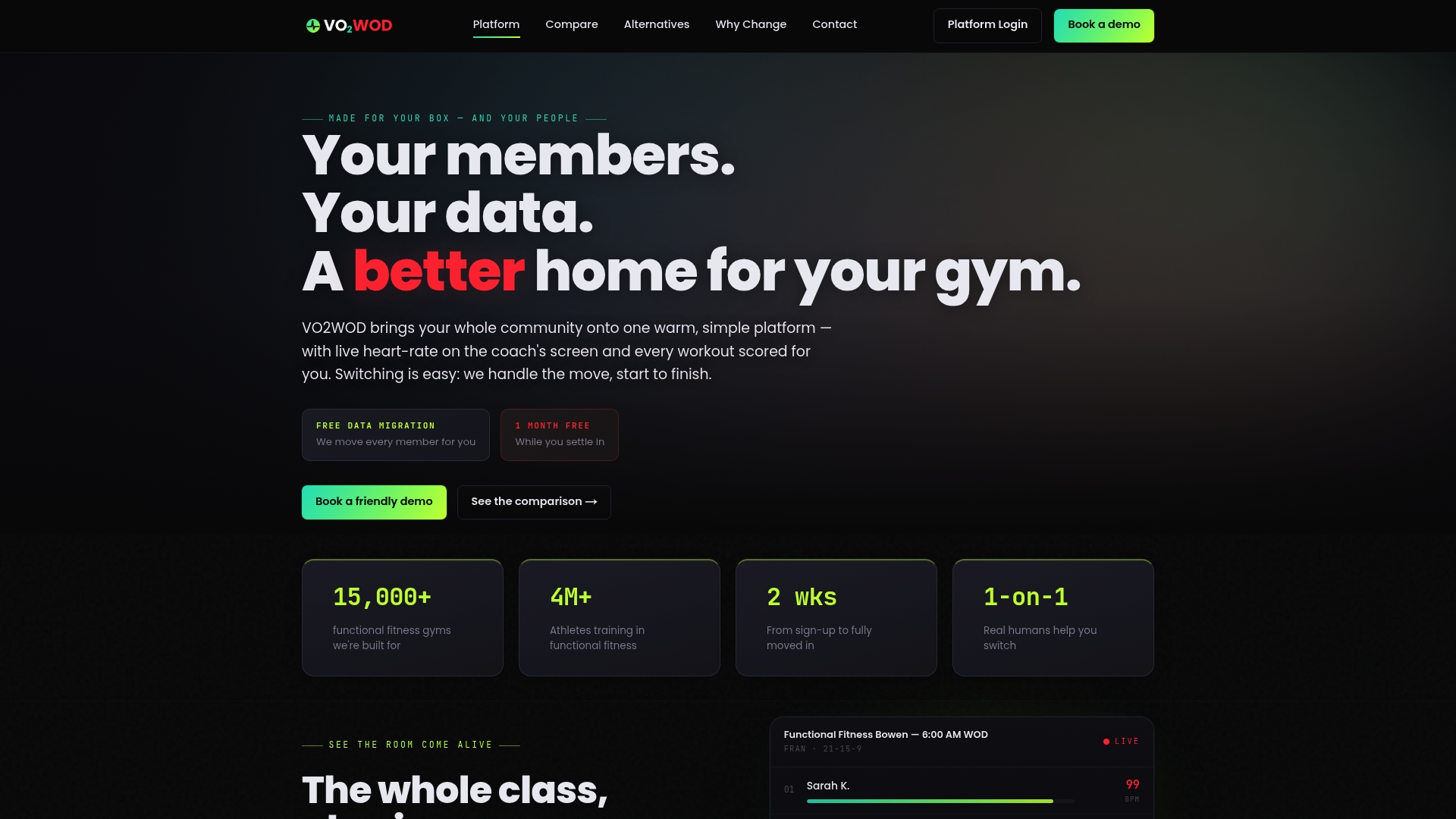
If you want your leads, schedule and member results in one place, see VO2WOD, look at the Vo2hub group-fitness hardware, or review how VO2WOD compares with other gym software.
FAQ
How many fields should a gym lead form have?
Five or six at most: name, one contact route, program interest, intended start and a consent checkbox, plus a location if you have several sites. Everything else can be asked on the first call or at onboarding. Medical history and body measurements belong at a later stage.
How fast should a gym respond to a new lead?
Within minutes during staffed hours. One approach is an automated text in the same minute and a human call within five minutes at the desk or fifteen on the floor. For overnight leads, reach out within fifteen minutes of opening.
Can a gym text leads automatically?
Yes, with preparation. Texting from a standard ten-digit U.S. number needs A2P 10DLC registration through your texting provider. Record consent on the form, include opt-out instructions in each automated text and honor opt-outs right away.
What should a gym track to measure lead capture?
Time to first human contact, contact rate within 48 hours, booking rate among contacted leads and show rate among booked tours, reported weekly by source and by staff member. Add trial-to-member conversion and cost per lead once those four are steady.
Sources
- Gym Lead Generation: Trials, Lead Ads and Same-Day Follow-Up (Theory Road)
- Gym Membership Inquiry Form Template (Jotform)
- Short Gym Enquiry Forms That Qualify (Gym Ledger)
- Gym Lead Follow-Up: Speed to Lead for Web and Phone Leads (Fit Strategies)
- Lead Generation for Gyms: Proven Tactics That Work (Ivy Forms)