
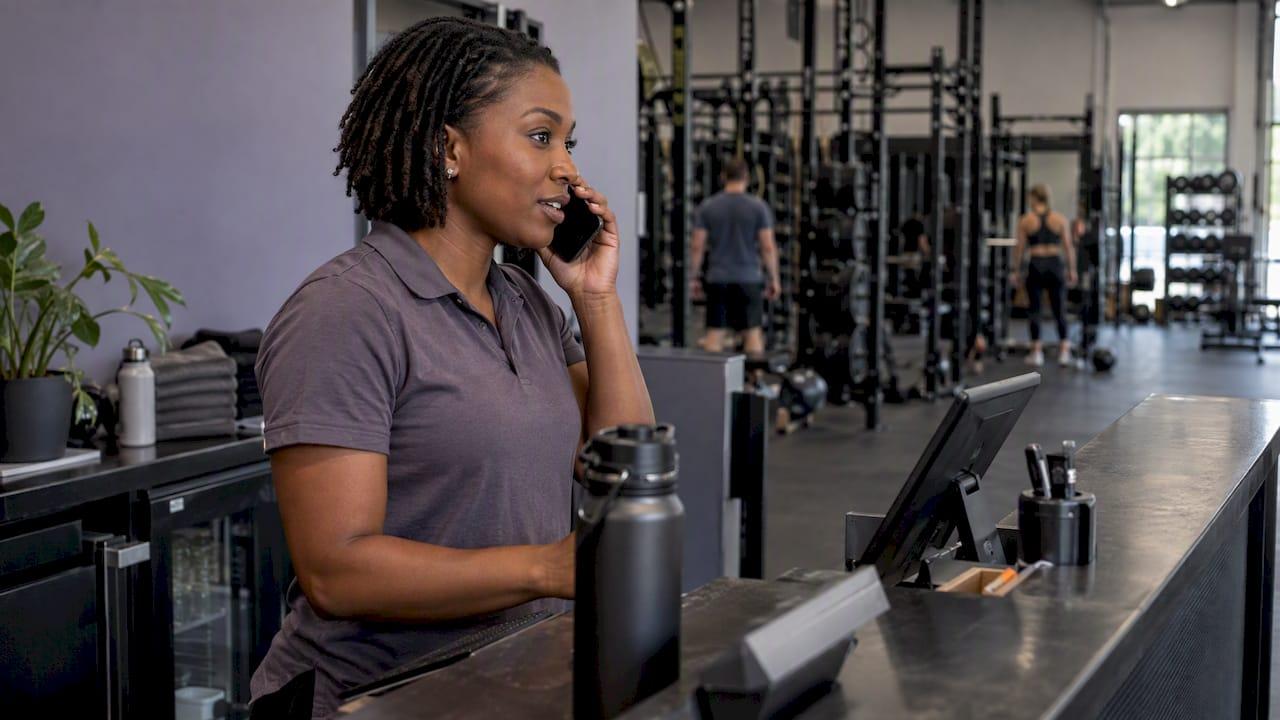
A gym should reply to a new lead within five minutes, and within about 90 seconds if you can manage it. Past an hour, you are competing with every other studio the prospect contacted that day. Most gyms are far slower than that, which is why this is one of the cheapest growth gains in the business. This guide covers the benchmarks, what to send first, how to handle nights and weekends, and how to measure your own numbers.
TL;DR
- Aim to make first contact within five minutes of a web form, DM or trial request. GymLaunch suggests 90 seconds if possible.
- A 2025 study of 99 fitness brands found most operators were nowhere near this. Treat speed as a standing advantage over your local competition.
- Call first when you can, text right after, and keep email for details. Plan about four to five touches over a week.
- Cover evenings and weekends with an instant automated text that promises a human follow-up at a set time.
- Measure time to first contact, contact rate and booked-tour rate, then compare fast and slow cohorts in your own data.
Table of Contents
- What lead response time means for a gym
- What the data says about speed and conversion
- A realistic response-time target
- Call, text or email: what to send first
- Leads that arrive after hours and on weekends
- How to measure lead response time
- Our perspective on speed to lead
- Building the system with VO2WOD
- Common mistakes that slow gyms down
- FAQ
- Sources
What lead response time means for a gym
Lead response time is the gap between a prospect raising a hand and a real person reaching out to them. The hand-raise might be a form on your website, a "book a free class" button, a missed call, an Instagram message or a Google Business Profile inquiry. The response is the first personal reply, not the automatic "thanks, we got your message" email.
The distinction matters. An auto-confirmation proves your form works. It does not tell the person that a coach is ready to talk about their goals, their schedule or their nervousness about trying CrossFit-style classes for the first time.
Gym leads are unusually time-sensitive. Someone who fills out a trial form at 7:40 p.m. is thinking about it now, usually with several other tabs open. The motivation that made them click fades quickly, and the studio that answers while they are still holding their phone gets the first conversation. Industry research backs the point: a professional-body write-up of fitness sales data notes that 78% of buyers choose the first company that responds.
What the data says about speed and conversion
No single study is a perfect fit for gyms, so it helps to read several and see where they agree.
Fitness-specific data
A 2025 Keepme study of 99 brands across 13,155 locations, reported by the Fit Tech Council, found that 60.47% of operators never attempted a call-back, and only 20% responded within an hour. Read that the other way: if you answer in minutes, you are in a very small group in your market.
Cross-industry research
The most cited academic work is the Harvard Business Review audit by Oldroyd, McElheran and Elkington. They tested 2,241 U.S. companies with a web lead. 37% responded within an hour, 16% within one to 24 hours, 24% took longer than a day, and 23% never responded at all. The same research found that firms that contacted a lead within an hour were nearly seven times as likely to qualify it as firms that waited even one more hour.

An earlier MIT and InsideSales study of more than 100,000 call attempts is where the famous "five-minute rule" comes from. It indicated that the odds of qualifying a lead were 21 times greater with a call inside five minutes than at 30 minutes. Velocify's report found that calling within one minute more than doubled conversion, yet only 7% of prospects got such a call.
How to read these numbers honestly
These studies are from software sales, real estate, education and other industries, and some are more than a decade old. Do not promise yourself a 21x lift on gym memberships. Three conclusions hold up everywhere:
- The first minutes are worth far more than the first day.
- Most competitors respond slowly or not at all.
- The size of the effect in your gym is something you can measure, and you should (see below).
A realistic response-time target
Pick a service-level goal your team can actually hit, then write it down. A workable ladder for a gym:
| Lead arrives | Target for first human contact | Backup |
|---|---|---|
| Staffed hours, web form or trial request | Under 5 minutes | Instant text if the phone is busy |
| Staffed hours, missed call or voicemail | Under 15 minutes | Text immediately, call back |
| Evening or weekend | Instant automated text, human contact by a stated time | Next-morning call before 10 a.m. |
| Social DM | Under 30 minutes in waking hours | Move the chat to text or phone |
Practitioners suggest treating five minutes as a service-level goal and checking it against your own booking data. That framing is useful: five minutes is not a magic number, it is a target you adjust once you see what your data says.
Call, text or email: what to send first
Pick the channel the lead is most likely to answer in the next ten minutes, and use the others to support it.
Phone call first when you have a number and a staffed front desk. A coach-led call lets you ask what they want to achieve and book an intro in the same conversation. One gym-coaching Q&A recommends personalized outreach and a call wherever possible, since a voice is harder to ignore than a message.
Text second, within a minute of the call. If the call goes to voicemail, a short text with your name and a direct question usually gets a faster reply than a voicemail does. Keep it human:
Hi Jess, it's Sam from Ironside Strength. Saw you asked about a free intro class. I tried your phone. Are weeknights or Saturday mornings easier for you?
Email third, for the details. Use it for the schedule, what to bring, parking and a booking link. Email rarely wins the race on its own, but it is the right place for information the prospect will come back to.
Before you text prospects at scale, check consent rules. U.S. text marketing falls under the Telephone Consumer Protection Act, so your form should include clear opt-in language, and your texting platform should handle opt-outs. Ask your attorney or platform provider what that means for your forms.
The follow-up sequence after the first touch
The first contact books some people, but most need more than one. A common recommendation for boutique studios is four or five touches over about a week. A simple pattern:
- Minute 0 to 5: call, then text.
- Same day: email with the schedule and a booking link.
- Day 2: short text asking which class time suits them.
- Day 4: a coach's note, perhaps a short video on what the first class looks like.
- Day 7: a last, friendly check-in with a clear yes or no question.
We go deeper on the nurture side in our guide to a gym lead nurture follow-up system that books tours.
Leads that arrive after hours and on weekends
Many inquiries arrive when nobody is at the desk: evenings after work, Sunday afternoon, late night after a social post. If your answer is "Monday morning," those leads have talked to someone else by then. You do not need night staff. You need a process:
- Instant text acknowledgment. Within a minute, send something like: "Thanks for reaching out to Ironside. A coach will text you by 9 a.m. tomorrow. Want to hold a spot in Saturday's 9:00 intro?"
- Self-serve booking. Put a link to open intro slots in the message, so a motivated person can book at 10 p.m. without waiting for you.
- A named morning owner. Someone is responsible for working the overnight list before 10 a.m. Make it the first task of the day, before email and admin.
- Weekend rota. One coach checks the inbox for 15 minutes at midday on Saturday and Sunday. It is a small cost for what are often your highest-intent leads.
It is honest to promise a time and keep it. "We'll text you by 9" and then doing it beats a vague "we'll be in touch" every time.
How to measure lead response time
The industry statistics are a starting point. What matters is how your own gym performs, and that takes three steps.
1. Record the right timestamps
For each lead, you need the time of inquiry, the time of first human contact (call, text or email, not the automation), the time a conversation actually happened, and the time an intro or tour was booked. If your lead data lives in a spreadsheet, a shared inbox and a notebook at the desk, you will not get reliable numbers. A lead CRM that logs these automatically solves most of it.
2. Track four numbers weekly
- Median time to first contact. Use the median, because a few very late replies skew an average.
- Percent contacted within five minutes during staffed hours.
- Contact rate: leads you spoke with, divided by all leads.
- Booked-intro rate: leads who booked, divided by all leads.
3. Compare cohorts
After 60 to 90 days, split leads into groups: under 5 minutes, 5 to 60 minutes, over an hour, and next day or later. Compare the booked-intro rate and the show rate of each group. If the fast group books at a clearly higher rate, you have your own proof, and you can use it to justify staffing changes or software. If it does not, look at lead source quality or the quality of your first conversation. Speed gets you the call, and the call still has to be good.
For benchmarks to compare against, see our conversion rate benchmarks and five-minute response playbook. If you want a structured rollout, the 30/60/90 day lead management pilot lays out what to set up in each stage.
Our perspective on speed to lead
We build software for functional fitness gyms, and we see the same pattern repeatedly. Owners invest in ads, referrals and a good website, then lose the lead in the gap between the form and the first reply. The cause is rarely laziness. Coaches are on the floor coaching, the front desk is empty at 6 a.m., and lead notifications go to an inbox nobody checks during class.

The fix is mostly about design, not effort. Decide who owns new leads at each hour of the day. Put the lead where that person already looks. Give them a short script and a booking link. Then look at the numbers every week, because what gets measured gets answered.
We also think response speed is only the first moment of a longer relationship. A prospect who gets a quick, friendly reply and then a good first class is a member the gym can keep. That is why we put lead tracking, scheduling, billing, messaging and performance data in one platform, so the story of a member from first inquiry to their hundredth class is not scattered across five tools.
— Marcus
Building the system with VO2WOD
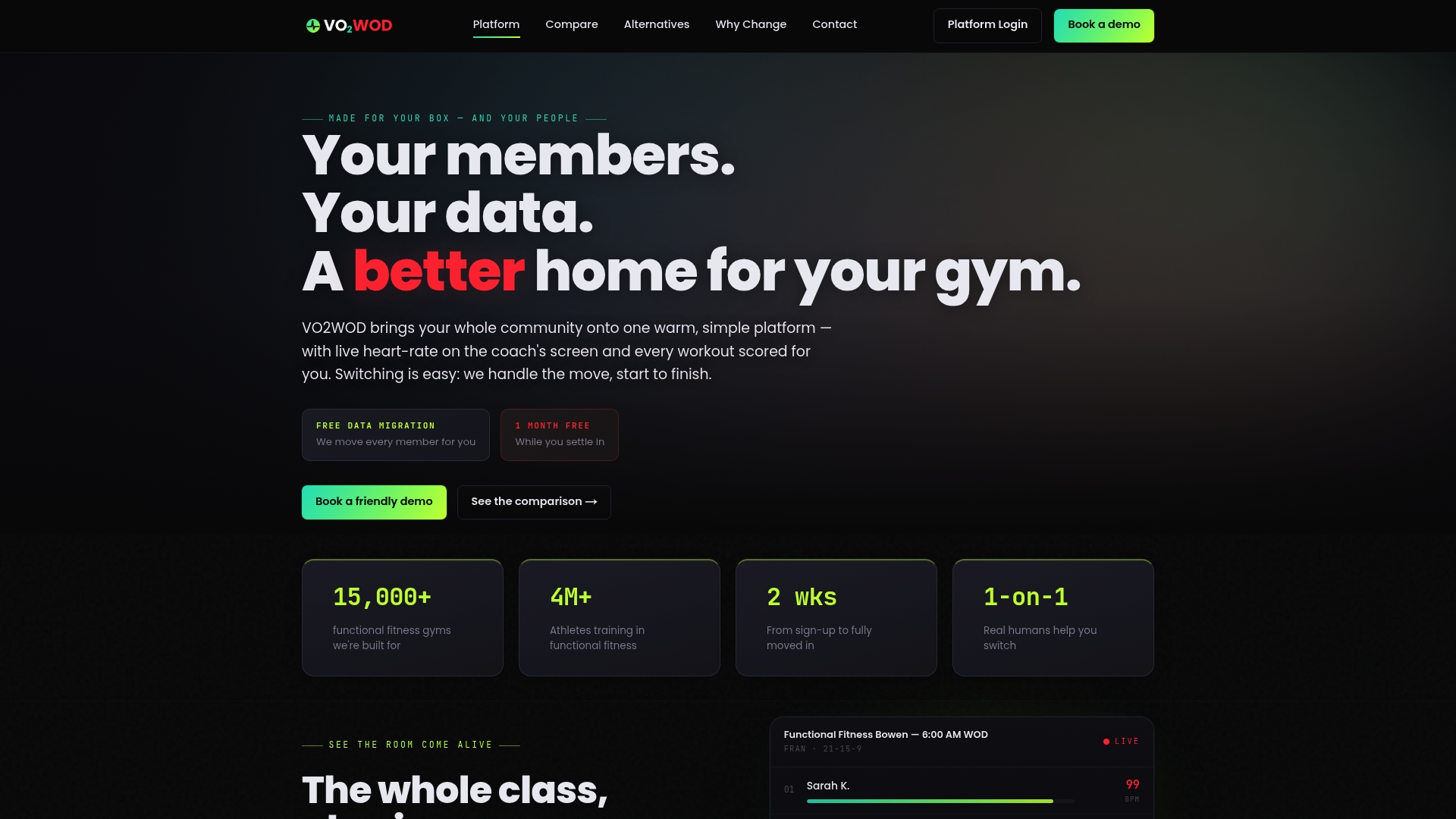
If your leads, schedule and members live in different tools, response time is hard to manage because nobody sees the whole picture. VO2WOD is management software built for functional fitness gyms. It includes a lead CRM, class scheduling and reservations, QR or wristband check-in, in-app messaging, and recurring billing, along with live in-class heart rate monitoring and automatic workout scoring. That means a lead can go from inquiry to booked class to active member without you retyping anything.
Switching does not mean starting from zero: we offer free data migration, a month of complimentary service and a dedicated team to help you move over. You can see what VO2WOD includes or read how it compares with other gym software. For trial details, our guide to free migration and a one-month test explains what to evaluate.
Common mistakes that slow gyms down
- Treating the auto-reply as the response. A confirmation email is not a conversation.
- Sending notifications to a general inbox. Route them to a phone, with a named person responsible.
- No owner during coaching hours. If every coach is on the floor, the lead waits. Assign a rotating 15-minute lead window around class changeovers.
- Calling once and stopping. One attempt is not a sequence. Persistence over a week is where many bookings come from.
- Selling on the first call. The goal of the first contact is a booked intro, not a long pitch. Ask one or two questions and offer two times.
- Ignoring what happens after the booking. A fast reply that leads to a no-show wastes the effort. Send a reminder and a short "what to expect" message, and use visit triggers to lift free trial conversion.
FAQ
What is a good lead response time for a gym?
Under five minutes during staffed hours is the standard target, and 90 seconds is better if you can reach it. After hours, send an instant automated text and make human contact by a time you state, usually the next morning. Check these targets against your own booking data after a couple of months.
Is texting or calling better for new gym leads?
Call first if you have a number and someone free to talk, then text within a minute if there is no answer. Texting often gets a faster reply from people who do not pick up unknown numbers. Make sure your forms capture consent for texts.
How many times should I follow up with a gym lead?
Four or five touches over roughly a week is a common recommendation for boutique studios. Mix calls, texts and a helpful email or video, and end with a clear final check-in. Stop when the lead says no or opts out.
Do I need to staff the gym at night to respond quickly?
No. An instant text with a self-serve booking link covers most after-hours leads, and a named person works the list first thing the next morning. A short midday check on weekends helps too.
How do I know if faster follow-up is working?
Log the time of inquiry and first human contact for every lead. After 60 to 90 days, compare the booked-intro and show rates of leads contacted in under five minutes with those contacted later. If the fast group does better, you have your own evidence.
Sources
- The Short Life of Online Sales Leads, Harvard Business Review
- Groundbreaking Study Uncovers The State Of Call-Back Services, Fit Tech Council
- Faster Is Better Lead Conversion Report, Velocify
- How to Use Lead Nurture to Grow and Scale Your Gym, GymLaunch
- The 5-Minute Rule: Speed-to-Lead
- Speed to lead for gyms