

The fastest wins come from three levers: give the trial a defined structure, cut your follow-up time, and automate the messages that fire when someone actually shows up to a class.
TL;DR:
- Tracking the signup-to-show-up, show-up-to-engaged, and engaged-to-member sub-rates helps identify the key leak points in your trial funnel.
- Responding to new leads within one hour significantly increases the likelihood of attendance, especially when paired with scheduled coach touchpoints.
- A structured trial with goal-based intake, pre-booked sessions, and final membership conversations reports a 30% to 45% conversion rate, unlike unstructured offers.
- Automated, visit-triggered follow-up messages can boost conversion rates by 15 to 20 percentage points, but manual closing conversations remain essential.
- Using a dedicated system like VO2WOD facilitates consistent tracking, in-class biometric data, and streamlined follow-up, accelerating your trial-to-member conversions.
Table of Contents
- How to Calculate Your Free Trial Conversion Rate (And the Three Sub-Rates Behind It)
- Which Sub-Rate Is Actually Your Bottleneck?
- What's a Realistic Free Trial Conversion Rate Target?
- The Trial Design Choices That Actually Move the Number
- Automating the Follow-Up Without Losing the Personal Touch
- A 14-Day Trial Timeline You Can Copy This Week
- Why Live Performance Data Changes the Final Conversation
- What the Data Actually Tells You to Prioritize
- Put This Playbook on Autopilot With Vo2wod
- Sources
- FAQ
How to Calculate Your Free Trial Conversion Rate (And the Three Sub-Rates Behind It)
The headline number is straightforward: members ÷ completed trials × 100. A trial only counts as "completed" once the prospect attends at least one session, not the moment they sign a waiver online. That distinction changes your denominator significantly if you're counting every signup instead of every actual visit.
But the overall rate hides where things break. You need three sub-rates:
- Signup to show-up rate: trial signups who attend a session ÷ total signups
- Show-up to engaged rate: attendees who return for a second visit or complete an intake conversation ÷ total attendees
- Engaged to member rate: trial participants who purchase a membership ÷ engaged trial participants
Track these separately because the fixes differ by stage. For data hygiene, exclude staff comps and internal referral trials from your denominator, define "completed" the same way every month, and segment by offer type. A 7-day unlimited trial and a single free class pulled from a Groupon campaign will never behave the same way in your funnel.
Which Sub-Rate Is Actually Your Bottleneck?
Most gyms assume they have a "closing problem" when the real issue is upstream. Low signup-to-show-up almost always means your follow-up is too slow or your scheduling is too loose. Low show-up-to-engaged usually points to a first class that felt intimidating or disorganized. Low engaged-to-member typically means nobody ever asked for the sale directly.
Run a 30-day diagnostic before you change anything. Pull every trial from the last month into a simple spreadsheet with columns for signup date, first class date, second class date, and outcome. Calculate all three sub-rates. Whichever one sits furthest below a reasonable range is your leak.
Then run these three experiments in sequence:
- Speed-to-lead test: Contact half your new leads within one hour and the other half within 24 hours, then compare show-up rates.
- Reminder cadence change: Add a text reminder 24 hours and 2 hours before the first booked class, then track no-show change over two weeks.
- Coaching-intake tweak: Add a two-minute goal conversation before the first class and compare second-visit rates against the prior month.
Pro Tip: Don't run all three experiments at once. You'll get a lift, but you won't know which change caused it, and you'll repeat the wrong tactic on the next batch of trials.
What's a Realistic Free Trial Conversion Rate Target?
Published benchmarks for this metric are almost useless taken at face value. Operator-reported ranges run from roughly 10% to more than 70%, depending on trial length, market density, and how loosely "converted" gets defined. A boutique studio in a competitive urban market and a strength-and-conditioning gym in a small town are not playing the same game, even if both call their metric "trial conversion."
The more useful split is structured versus unstructured. Gyms running a trial with goal intake, scheduled touchpoints, and a deliberate final-day conversation report 30% to 45% conversion, while gyms that hand out a punch pass and hope report closer to 10% to 20%. Ignore SaaS free trial benchmarks entirely. A 14-day software trial and a 7-day gym trial involve completely different buying psychology, and borrowing that number will set the wrong expectation for your staff.
Paid intro offers, covered below, tend to land at the higher end of that range because they filter out low-intent visitors before they ever book a class.
The Trial Design Choices That Actually Move the Number
Treat the trial as a sales process with a beginning, middle, and end, not a free sample you hand out and forget about. That means four fixed elements:
- Goal-based intake at the first visit, capturing what the person actually wants (weight loss, a specific lift, general fitness) so later conversations reference their words, not generic pitches.
- Pre-booked sessions rather than an open pass, since a prospect who has three classes on the calendar shows up far more often than one who has to remember to log in and book.
- Scheduled coach touchpoints at the second and fourth visits, brief check-ins that build a relationship before any sales conversation happens.
- A reserved final-day membership conversation, ideally in person, tied directly to the goals captured on day one.
Speed matters as much as structure; partnering with experts in personal trainer website design and build can improve how you capture leads and optimize landing pages, ultimately boosting your trial conversions. Contact new leads within the same hour when you can, since response time strongly affects whether a lead ever shows up at all. Track your average time-to-first-contact the same way you track show-up rate.
If your show-up or intent numbers stay weak despite fast follow-up, test a low-cost paid intro instead of a free trial. A small upfront fee filters for people who are actually planning to join, which raises conversion per visitor even though it shrinks your total signup volume. It's a trade worth making if your lead volume is high but your close rate is weak.
Pro Tip: The final-day conversation should never open with pricing. Open with what they told you on day one, then connect the membership to that specific goal before you mention a number.
Automating the Follow-Up Without Losing the Personal Touch
Automation's job is consistency, not replacement of the human conversation. The trigger matters more than the message. Generic weekly newsletters do almost nothing for trial conversion. Messages fired by an actual visit, an actual missed class, or an actual milestone perform far better because they land at the moment a prospect is already thinking about the gym.
| Trigger | Automated action | What it protects against |
|---|---|---|
| Check-in at first class | Welcome text referencing intake goal | Prospect forgetting why they signed up |
| No visit in 3 days | Reminder text with next open class time | Silent drop-off before day 5 |
| Post-class check-in | "Great session" message with a stat if available | Trial feeling anonymous |
| Day 10 to 12 with no rebooking | Time-limited membership offer | Losing momentum before the trial ends |
Operators running this kind of visit-triggered sequence report conversion lifts of roughly 15 to 20 percentage points compared with static, calendar-based email blasts. Keep two things manual no matter how good your automation gets: the final-day membership conversation and any moment where a prospect expresses frustration or hesitation. A bot should never be the one closing the sale or handling a complaint.
- Automate: reminders, goal capture forms, re-engagement nudges, milestone messages
- Keep manual: the closing conversation, objection handling, pricing discussions
A 14-Day Trial Timeline You Can Copy This Week
Here's a compact playbook that mixes automated and human touches across a standard two-week trial:
- Day 1: Capture goals during intake, send an automated welcome message referencing those goals.
- Day 2 to 3: Coach greets by name at second visit; automated reminder fires if no visit is logged by day 3.
- Day 6 to 12: Automated inactivity alert triggers after any 3-day gap, paired with a time-limited membership offer around day 10.
- Day 14: Coach holds the reserved membership conversation, followed by one automated follow-up message if no decision is made that day.
For a 7-day trial, compress days 1 through 3 into day 1 and move the offer to day 5. For a 3-day trial or paid day pass, skip the mid-trial offer entirely and go straight to the closing conversation at the final visit. Watch attendance, second-visit rebooking, and whether the closing conversation actually got booked. Those three checkpoints tell you more than the final conversion number alone.
Why Live Performance Data Changes the Final Conversation
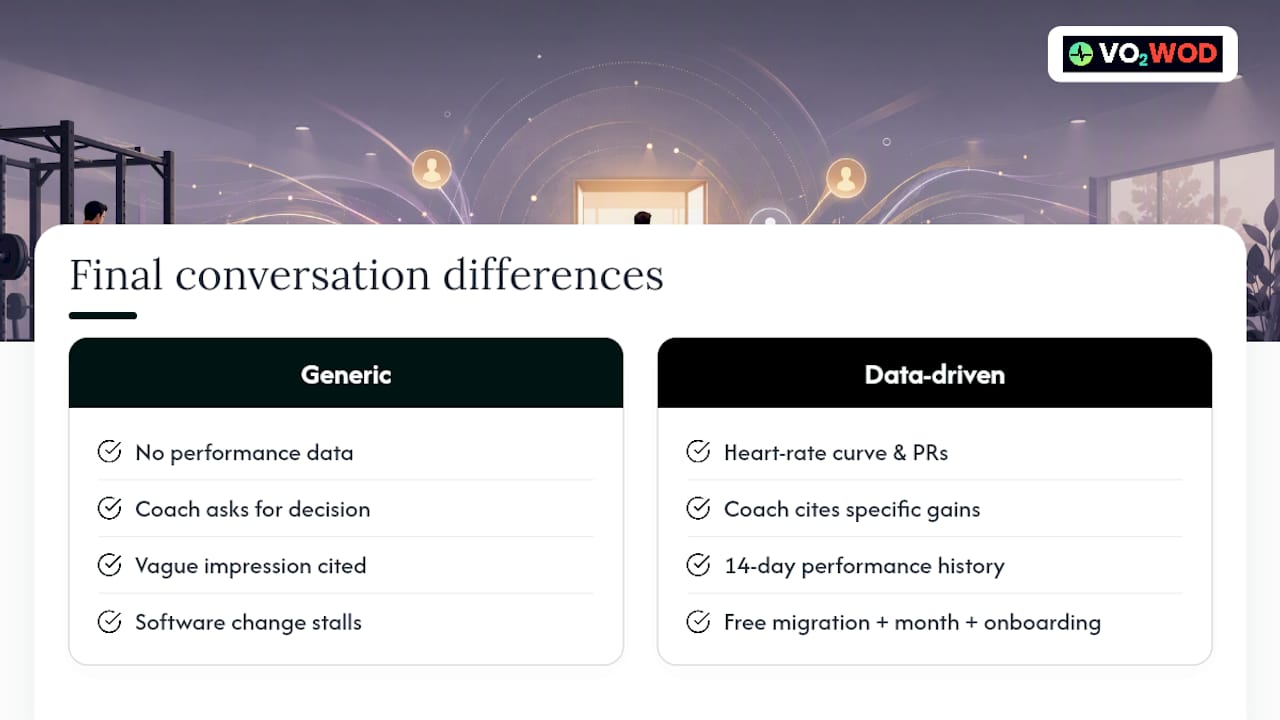
Most trial conversations fail not because the pitch is wrong but because it's generic. A coach who says "you're doing great, ready to join?" is asking for a decision with nothing behind it. A coach who can point to a heart rate curve from Tuesday's workout, or a personal record logged automatically during the trial, is having a completely different conversation.
VO2WOD captures in-class biometric data and scores workouts automatically as the trial unfolds, so by day 14 there's a real performance history to reference instead of a vague impression. Coaches gain insight into effort and achievement without touching a spreadsheet, which means the final-day ask can cite an actual improvement in heart rate recovery or a specific lift number rather than a generic sales line.
For gyms switching systems specifically to run this kind of trial, free data migration, a complimentary first month, and dedicated onboarding support remove the usual excuse for delaying the switch. The setup friction that normally stalls a software change disappears before your next trial cohort even starts.
What the Data Actually Tells You to Prioritize
The conventional advice on trial conversion treats it as a marketing problem: better ads, better landing pages, better offers. That's backwards. They're better at running the same trial the same way, every single time, with a closing conversation that never gets skipped because the coach forgot or ran out of time.
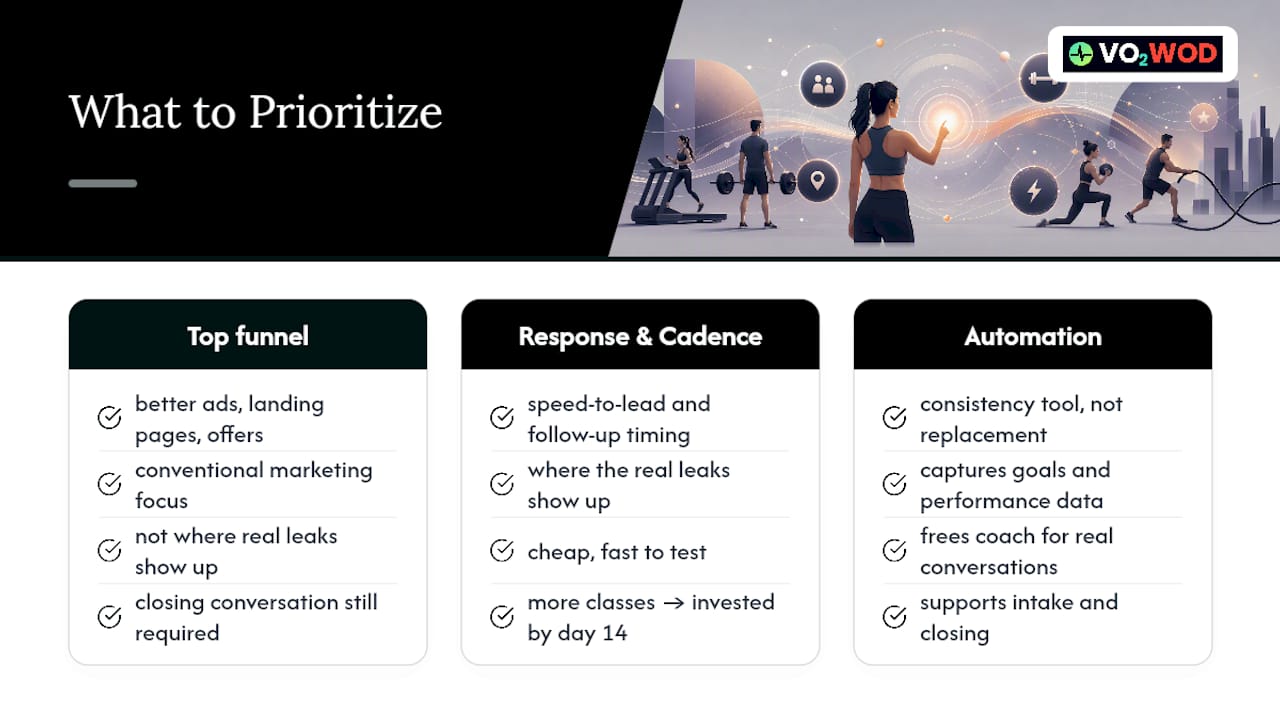
Most owners overweight the top of the funnel and underweight speed-to-lead and follow-up timing, which is where the real leaks show up. If you fix nothing else this quarter, fix response time and reminder cadence first. Those two changes are cheap, fast to test, and they compound because a prospect who shows up to more classes is simply more likely to feel invested by day 14, regardless of how good your close is.
Automation earns its place here, but only as a consistency tool, not a replacement for the intake conversation or the closing ask. A system that captures goals and performance data automatically, the way an integrated platform does, frees the coach to spend that saved time on the one part of the process that a message template can't replace: an actual conversation, grounded in actual data, about whether this person is close to what they came in for.
— Marcus
Put This Playbook on Autopilot With Vo2wod
Running goal intake, reminder sequences, and a data-backed final conversation manually works, until you're managing forty trials a month across three coaches and nothing gets tracked consistently. That's the point where a dedicated system pays for itself faster than another round of spreadsheet fixes.

Vo2wod is built specifically for functional fitness gyms trying to run exactly the process described above, without hiring another staff member to manage it. It gives you real-time monitoring of heart rate and effort during class, automatic workout scoring so coaches never manually log a PR again, and membership workflow tools that connect trial activity straight to a conversion conversation. If you're switching from another system, Vo2wod covers free data migration, gives you one month free, and assigns a dedicated support team so the switch doesn't cost you a single trial cycle.
Choosing a platform makes sense once tracking sub-rates by hand becomes the bottleneck itself. See how it compares to what you're running now on the VO2WOD alternatives page, or head to Vo2wod to start your complimentary month.
Sources
- Gym Free Trial & Day Pass Strategies That Convert
- How to Convert Gym Trial Members: Free vs Paid — Nutripy
- How Gyms Convert 50% of Trials to Members Guide
- Gym Industry Statistics 2026: 30+ Benchmarks
FAQ
What Is a Good Free Trial Conversion Rate for a Gym?
A well-structured trial with intake, scheduled touchpoints, and a deliberate closing conversation typically converts between 30% and 45%. Unstructured trials, where prospects get a pass and no follow-up plan, usually land closer to 10% to 20%.
How Do I Calculate My Gym's Trial Conversion Rate?
Divide the number of trial participants who purchased a membership by the number who completed at least one visit during the trial, then multiply by 100. Track the signup-to-show-up, show-up-to-engaged, and engaged-to-member sub-rates separately so you know exactly where the leak is.
Should I Offer a Free Trial or a Paid Intro?
A paid intro filters for higher-intent prospects and tends to convert at a higher rate per visitor, though it reduces total signup volume. Free trials generate more leads but require faster follow-up and tighter structure to hit comparable conversion numbers.
How Much Can Automation Improve Trial Conversion?
Operator reports show visit-triggered messaging and timed offers can raise conversion by roughly 15 to 20 percentage points compared with generic email campaigns. The lift comes from consistent timing, not from replacing the coach's closing conversation.
Does VO2WOD Track Free Trial Conversion Rate?
VO2WOD captures in-class biometric data and workout scores automatically, giving coaches concrete performance history to reference during trial follow-up and closing conversations. Pricing details and a full feature breakdown are available directly on the VO2WOD site.