

Use a five-stage model: Discovery → First Contact → Trial → Membership → First 90 Days. Track it with five transition rates and fix the two stages that bleed the most members: first response time and trial show rate. Tools like VO2WOD can automate both once you know where the leak actually sits.
TL;DR:
- The biggest leaks in a gym sales funnel occur due to response delays, trial no-shows, poor trial experiences, and lack of onboarding, not lead generation.
- Tracking five key weekly metrics, especially response time and trial show rate, helps identify the most significant stage leak effectively.
- Automating a seven-step trial nurture sequence and quick no-show outreach significantly improves conversions at the trial stage without extra ad spend.
- Building a CRM-driven pipeline with real-time dashboards and assigning ownership prevents data hygiene issues and supports ongoing improvements.
- Fixing the phase with the lowest transition rate offers the highest return, and implementing automated tools like Vo2WOD can streamline and sustain pipeline management.
Table of Contents
- What Is a Sales Pipeline for a Gym, and Which Stage Model Fits You?
- Where Do Gym Prospects Actually Drop Off?
- Which Metrics Should You Track Every Week?
- What Automation Sequence Actually Fixes the Trial Stage?
- How Do You Wire This Into Your CRM and Keep It Healthy?
- What the Data Says for Functional-Fitness Operators
- A Practitioner's Take on Fixing the Funnel
- How VO2WOD Runs This Pipeline for You
- Sources
What Is a Sales Pipeline for a Gym, and Which Stage Model Fits You?
A gym sales pipeline is just a sequence of measurable events that turn a stranger into a paying, retained member. Each stage has an entry trigger (something that happens) and an exit trigger (something that has to happen next, or the prospect stalls). Treat it as a CRM object, not a mood.
Two models cover most gyms. The first is a lean four-stage boutique version: Discovery, First Contact, First Class, First 90 Days. It works well for small studios with one or two people handling sales, because it's easy to hold in your head and easy to report on weekly.
The second is a more granular CRM pipeline, often six or seven stages: Trial Booked → Trial Attended → In Follow-Up → Offer Made → Converted/Active Member → At Risk → Lapsed. This version suits gyms running automated sequences, since each stage can trigger its own action, including win-back campaigns for lapsed members, which convert roughly 10% to 15% of cancellations.
Practical entry and exit triggers to build into either model:
- Discovery to First Contact: enquiry submitted (form, call, walk-in) → staff response logged within your target window
- First Contact to Trial: response sent → trial class booked on the calendar
- Trial to Membership: trial attended → signed agreement or first payment processed
- Membership to Retained: day-90 active check-in → no cancellation flag at day 90
Pick the model that matches your team size, not the one that looks most sophisticated on a slide deck.
Where Do Gym Prospects Actually Drop Off?
Discovery rarely the problem. Most gyms generate enough leads; they lose them after the lead already exists. The damage clusters in four spots, and they compound.
- Slow response time. A lead who fills out a form and hears nothing for six hours has usually already booked a trial somewhere else, or lost interest entirely.
- Trial no-shows. Booking a trial class isn't the same as walking through the door. This is where the largest single volume of prospects vanishes.
- Weak trial experience. Prospects who show up but get a generic class with no coach introduction, no goal conversation, and no follow-up plan rarely convert.
- Missing onboarding. New members who sign but get no structured first 90 days churn early, often before their second billing cycle.
The gap between average and top-performing gyms isn't lead volume, it's execution on stages that already have warm prospects in them. Average gyms convert 20% to 30% of trial visitors into paying members, while top performers convert 50% to 65%. That spread comes almost entirely from response speed and automated follow-up, not better marketing.
To find your specific leak, measure five transition rates: enquiry to contacted, contacted to trial booked, trial booked to trial attended, trial attended to signed, and signed to retained at day 90. Whichever rate is lowest relative to industry norms is where you spend your next month of effort.
Which Metrics Should You Track Every Week?
You need five numbers, tracked weekly, to diagnose a broken funnel without drowning in dashboards. A minimal set of five weekly metrics gives most small studios enough visibility to spot the exact stage that's leaking.
- Enquiries by source (so you know which channel is actually producing leads)
- Percentage of leads contacted within one hour
- Trial booked to trial attended rate
- Trial attended to signed (membership) rate
- Signed to retained rate at day 90
Calculate each as a simple percentage: stage completions divided by stage entries. The benchmark ranges below give you something to compare against rather than guessing whether 40% is good or bad.
| Stage transition | Weak | Average | Strong |
|---|---|---|---|
| Reply within 1 hour | Under 40% | 40% | Over 90% |
| Trial booked to attended | Under 50% | 50% to 65% | 65%+ |
| Trial attended to signed | Under 20% | 20 to 30% | 50 to 65% |
| Signed to retained (day 90) | Under 50% | 60% | 80%+ |
Report these in a weekly standing meeting, and put them on a single dashboard tile per stage rather than a sprawling spreadsheet nobody opens. If a CRM can auto-populate these numbers from stage timestamps, use it. Manual tracking is where most gyms quietly stop measuring after week three.
What Automation Sequence Actually Fixes the Trial Stage?
Fixing the trial stage almost always beats spending more on ads, because you have already paid to acquire that lead. A 7-touchpoint trial nurture sequence gives you a structure to automate rather than reinvent for every prospect.
- Immediate welcome (within minutes of booking): confirms the trial, sets expectations for what to bring and wear.
- Plus 4 hours: pre-arrival check-in. Short message confirming time and location, reduces no-shows before they happen.
- Plus 24 hours (post-first-visit): value highlight. Reinforce one specific thing they experienced, not a generic "thanks for coming."
- Plus 48 hours: social proof. Timing matters here. Social proof lands better once a prospect has had a real, positive experience, typically days five to ten of a trial window, rather than at the moment of enquiry.
- Day 3 to 4: guided offer. A real person, not just a bot, walks them toward a decision with a specific membership recommendation.
- Day before trial expiry: pricing reminder. Clear, no ambiguity, with urgency tied to an actual date.
- Post-expiry follow-up. For anyone who didn't convert, one more attempt with a different angle, not a repeat of the same pitch.
No-show prevention deserves its own attention inside that sequence: automated confirmations at booking, a reminder the morning of, and same-day outreach the moment someone misses a slot, followed by a rapid rebooking offer rather than letting the lead go cold.
Onboarding in the initial period matters just as much as the trial itself. Treat a personal training session as part of onboarding, not an upsell, ideally early in membership. Layer in milestone messaging and a clear class pathway so a brand new member always knows what to do next.
Pro Tip: Run your no-show outreach as same-day, not next-day. A prospect who misses a trial and hears from you within hours is far more likely to rebook than one who gets a message 24 hours later, by which point they've likely trialed somewhere else.
How Do You Wire This Into Your CRM and Keep It Healthy?
Map each stage transition to a CRM event you can trigger on: form submission fires the Discovery-to-Contact clock, a booked class fires the trial reminder sequence, a signed agreement fires the onboarding sequence. If your platform can't trigger on these events automatically, you're running the pipeline manually and will lose consistency the moment you get busy.
Build a dashboard with one tile per stage transition, updated in real time if possible, and reviewed on a fixed cadence:
- Weekly: reply time, trial show rate, and any stalled leads sitting in one stage too long
- Monthly: trial-to-member conversion, day-90 retention, and channel-level enquiry volume
Assign ownership. One person should be accountable for the funnel numbers, even in a small studio where that person also coaches classes. Data hygiene matters more than people expect: duplicate leads, stale trial bookings, and members marked "active" after they've quietly stopped showing up all corrupt your conversion math and hide the real leak. A quick monthly audit of stale records keeps the numbers trustworthy enough to act on. Gyms scaling past a single owner-operator often hit what one operations guide calls the six-month wall, where informal tracking that worked at low volume simply breaks, and a real system becomes non-negotiable.
What the Data Says for Functional-Fitness Operators
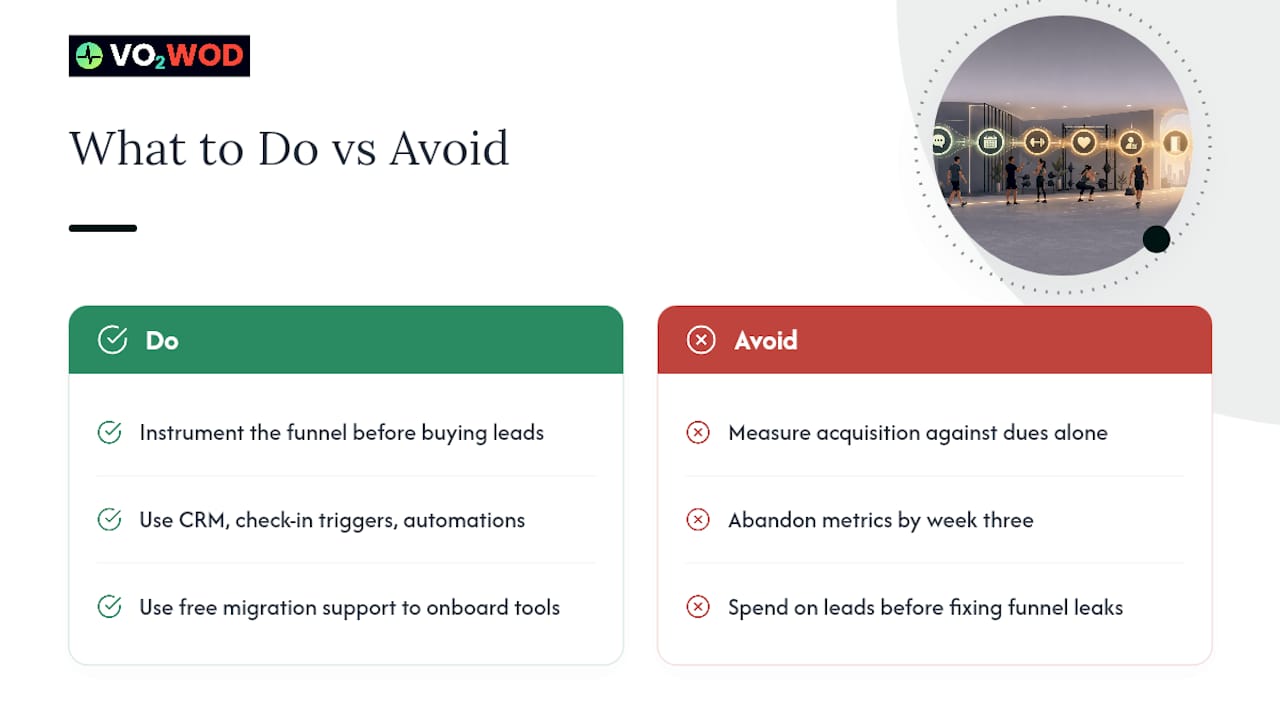
Instrumenting the funnel before spending on more leads is usually the higher-return move, since fixing an existing leak costs nothing in ad spend. Software built for lead CRM, attendance-based check-in triggers, and automated touchpoints removes the manual tracking that causes most gyms to abandon their metrics by week three, and free migration support removes the excuse to keep putting it off.
One nuance worth flagging: calculate your acquisition cost against total revenue per member, meaning dues plus ancillary spend like personal training or retail, not dues alone. A member who looks expensive to acquire on dues alone often pencils out fine once you include what they actually spend over their membership life.
A Practitioner's Take on Fixing the Funnel
The pipeline stages aren't complicated. What gyms get wrong is treating measurement as optional overhead instead of the actual job. Most owners can name their lead volume from memory but have no idea what their trial show rate is, which is exactly backward given how much more leverage sits in that stage.
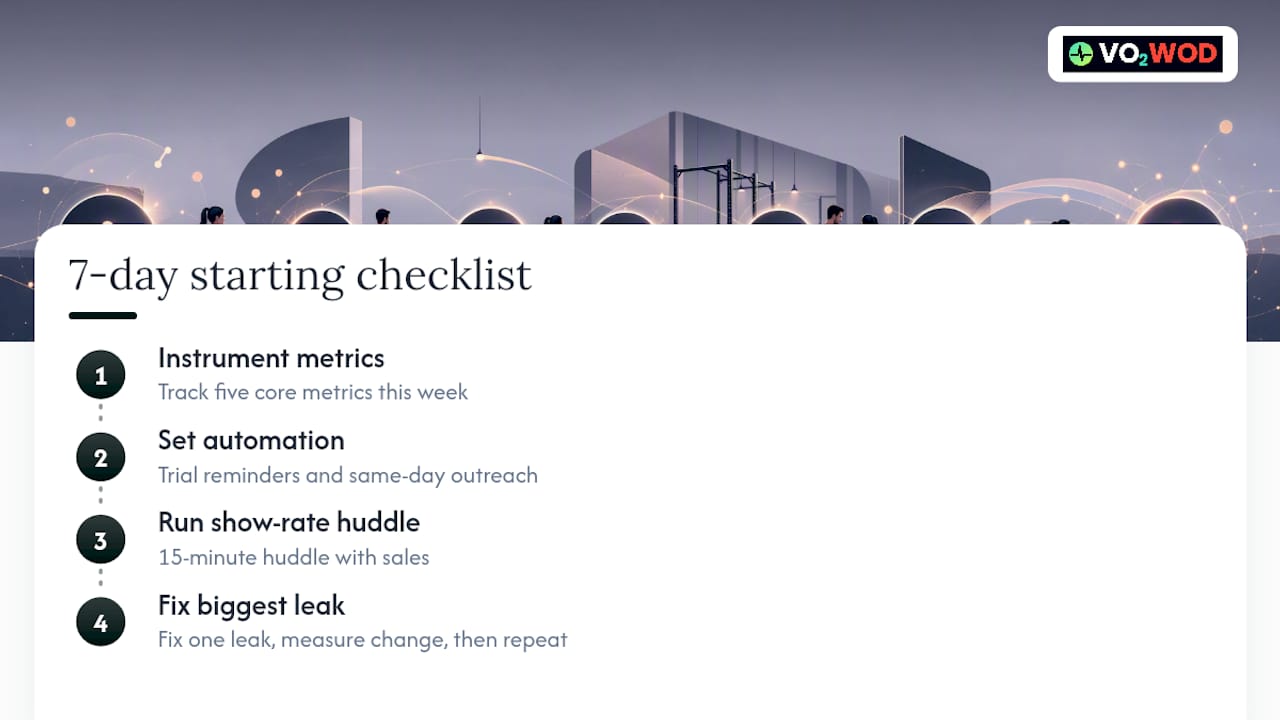
Here's a 7-day starting checklist: instrument the five core metrics this week, set up one automation for trial reminders and same-day no-show outreach, and run a 15-minute show-rate huddle with whoever handles sales. That's it. Don't try to fix all four leaks simultaneously. Fix the biggest one, measure the change, then move to the next.
— Marcus
How VO2WOD Runs This Pipeline for You
Vo2wod turns the model above into something you actually run instead of something you track in a spreadsheet that goes stale by March. It handles lead CRM intake, automated touchpoint sequences for trial nurture, and attendance-based triggers tied to live check-ins, so a missed class fires an alert instead of quietly disappearing into a gap in your funnel.

Because Vo2wod includes free data migration, one month of complimentary service, and a dedicated support team for the switch, you're not stuck rebuilding your pipeline from scratch while running classes at the same time. If you're already comparing platforms, the breakdown of alternatives shows exactly how stage automation differs across tools. Otherwise, the fastest path is to see it running against your own numbers. Book a demo and bring last week's trial show rate. That single number will tell you which stage to fix first.