
Personal record (PR) tracking works for a gym when every score lands in one place automatically, stays tied to the member's history, and reaches the coach while it still matters. A notebook or a spreadsheet can hold the numbers. It cannot tell a coach, in the middle of a class, that someone just hit a best. VO2WOD is built for this: automatic workout scoring, a movement library with personal-record tracking and live in-class heart rate data sit in the same platform that runs your schedule and billing.
This guide covers what a PR is in a functional fitness gym, what to record so the numbers can be trusted, how to track without manual entry, and how to use the data to keep members training.
TL;DR
- A PR is a member's best result on a specific lift, benchmark workout or conditioning piece, under defined conditions. It is only useful if the conditions are recorded too.
- Reliable PR data needs the same movement names, honest logging of every working set, and a reset of the baseline after a layoff or injury.
- Manual entry is where gym PR tracking breaks down. Automatic scoring and a movement library remove most of it.
- Coaches get the most from PRs by looking at trends over months, not single results, and by sharing progress with members.
- When you choose software, look for one platform that covers scoring, PR history, check-in, billing and messaging, plus a migration plan for your existing data.
Table of Contents
- What counts as a personal record in a gym
- What to record so a PR means something
- How to track PRs without manual data entry
- Turning PR data into coaching
- PR tracking and member retention
- What to look for in PR-tracking software
- A note on member data
- Start tracking PRs in VO2WOD
- Our perspective
- FAQ
- Sources
What counts as a personal record in a gym
A PR is the best performance an individual has achieved in a specific exercise or workout under defined conditions. According to Gym Gear's guide to PRs, that can be the heaviest weight for a single rep, the most reps at a given load, or the fastest time over a set distance. It applies to strength movements such as squats, deadlifts and bench presses, and to conditioning work such as a faster row or a more efficient circuit.
For a functional fitness gym, that means several kinds of record live side by side:
- Strength PRs: a one-rep max, a best set of five, a heaviest weight for a given rep count.
- Benchmark workout PRs: a named workout scored on time or on rounds and reps, repeated every few months to show change.
- Engine PRs: rowing, biking or running times and distances.
- Bodyweight PRs: max unbroken pull-ups, longest hold, most reps in a set time.
Member progress tracking is wider than PRs. It also includes attendance, milestones and effort in class. PRs are the most motivating part of it, because they are concrete: a member can see the number and remember the day.
If you want the benchmark side in more depth, our guide on benchmark workout tracking walks through logging and comparing scores.
Outside the gym matters too. Members who eat enough to support their training tend to set records more consistently, which is why some coaches point members to guidance on tracking progress for muscle gain alongside their lifting numbers.
What to record so a PR means something
A number without context is a weak record. Three habits make the data trustworthy.
Use one name for every movement
If one coach types "back squat," another "BS" and a third "squat (back)," the history splits into three lists and no one can see a trend. A fixed movement library fixes this at the source. Members and coaches pick from the same list, so every back squat lands in the same history.
Record the conditions
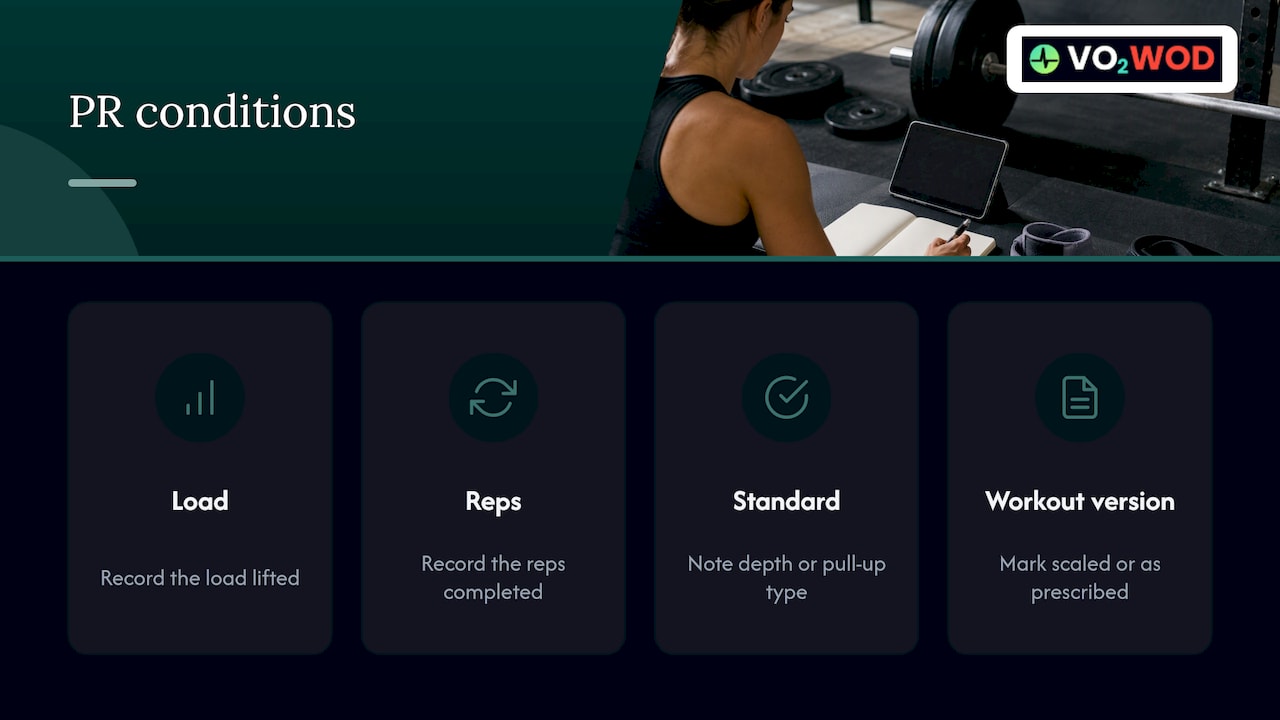
Gym Gear notes that consistency of equipment and setup is what makes PR comparisons meaningful in shared facilities. In practice that means recording the load, the reps, the standard used (for example, depth or the type of pull-up) and the version of a benchmark workout, such as scaled or as prescribed. A time on a scaled workout is not a PR against an as-prescribed time.
Log every working set, and reset after a break
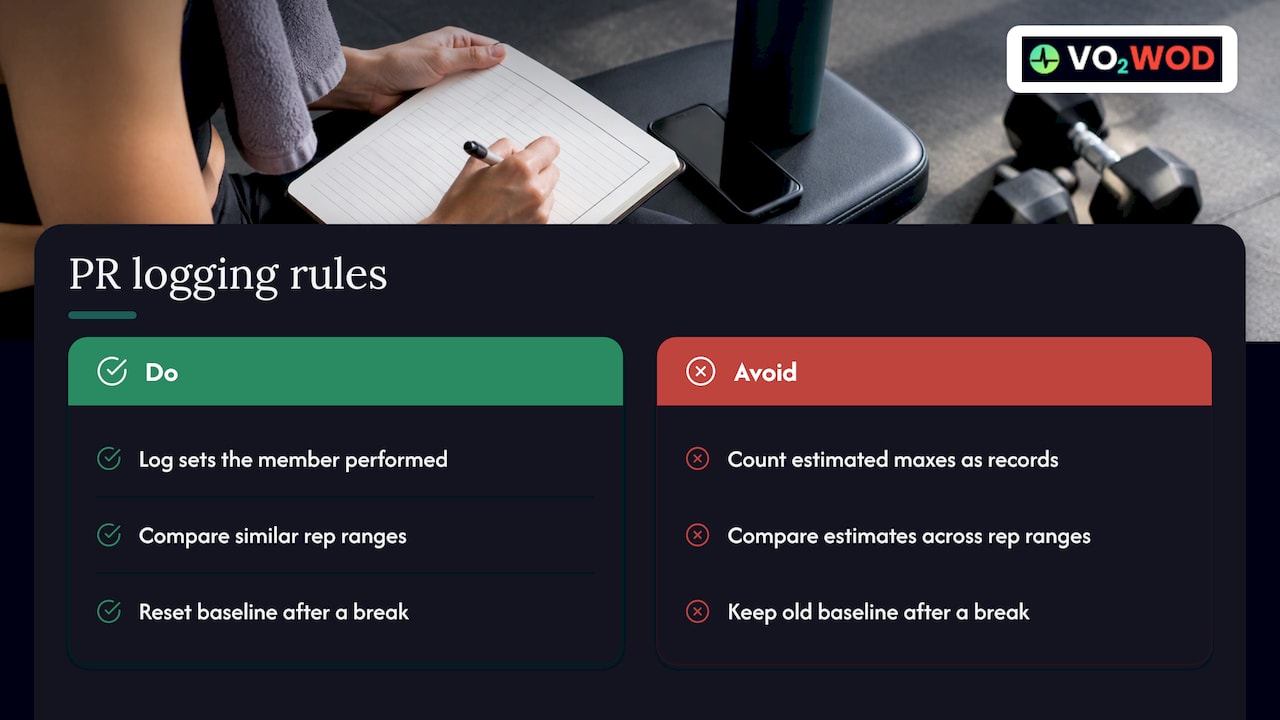
A record is a set the member actually performed. A calculated estimate of a one-rep max is a planning tool, not a record. Estimates are also most reliable on low-rep sets, so compare them only between similar rep ranges. Rep-count PRs, such as a best set of five or eight, tell a fuller story than top singles alone.
After a layoff, injury or change of equipment, start a fresh baseline. Otherwise a member returning from three months off watches their old numbers sit out of reach, and that is discouraging when it should be motivating.
How to track PRs without manual data entry
Most gyms start the same way: a whiteboard in the gym, a spreadsheet in the office. CrossFit's coaching resources say gyms can track members' data over time in a spreadsheet, a database or a member platform, starting with lift records or benchmark times and expanding later. That is a sound way to begin. The trouble comes with scale. At 150 members, someone has to copy scores from the board, fix typos and answer "what was my Fran time last year?" The routine below shows where it goes wrong and what changes when the platform does the work.
1. Decide which records you track
Pick a short list: three or four barbell lifts, five to eight benchmark workouts, and one or two engine tests. Too long a list means nobody maintains it. The common failure is tracking everything for two months and then giving up. In VO2WOD the movement library and personal-record tracking are part of the platform, so the list lives where members already log their work.
2. Capture scores at the source
The more steps between a finished workout and a stored score, the more scores go missing. Members forget, coaches are busy, and the whiteboard gets wiped. VO2WOD scores workouts automatically, so the result is attached to the member without anyone retyping it.
3. Attach effort, not only the result
Two members can post the same time with very different effort. VO2WOD offers live in-class biometric monitoring through heart rate tracking and integrates with Garmin, Apple, Fitbit and Samsung wearables. A PR shown next to the effort behind it is more informative than a bare number. For how wearables roll out in a functional fitness gym, see our guide to integrating wearables at your gym.
4. Keep history in one place
A PR is only a PR relative to what came before. That is why the history matters more than the latest score. Our piece on performance history benefits explains why gyms that keep it for years can show members a story, not a snapshot.
5. Move your old data over
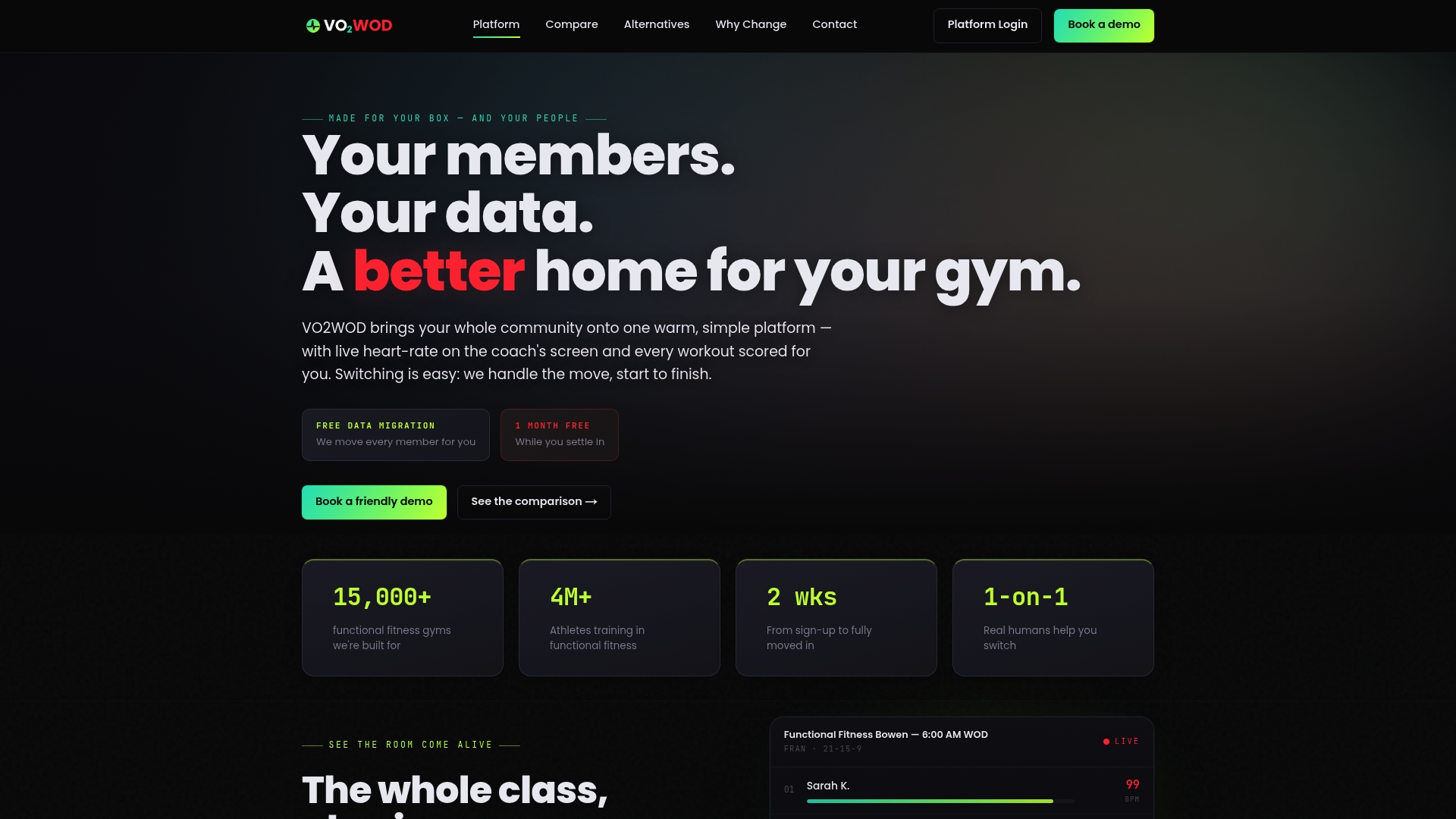
The usual reason gyms stay with a clumsy system is the years of results stored in it. VO2WOD includes free data migration and dedicated transition support, and a one-month free trial, so the switch does not mean starting every member's history from zero. If your records are messy, a practical data cleanup guide will help you tidy names and duplicates before the move.
Turning PR data into coaching
PR data pays off when coaches use it in conversations. CrossFit's guidance for coaches suggests tracking lifts and benchmark results over time, comparing individual progress with relevant group patterns, and using charts to discuss progress or plateaus. One of its examples is a member's max-lift trend over twelve months, which makes a stall or a gain obvious in a way a single score cannot.
A few practical uses:
- Celebrate in the moment. A PR announced in class or through in-app messaging costs nothing and is remembered. VO2WOD's in-app messaging includes milestones for this.
- Spot stalls early. Gym Gear points out that in a well-structured plan PRs should gradually improve, so stalled or declining numbers can point to poor recovery, badly planned sessions or inconsistent conditions. A coach who sees a flat line for eight weeks can ask what changed.
- Treat sudden drops as a prompt, not a verdict. CrossFit's guidance lists fatigue, overtraining, skill needs and injury risk as possible causes. Adjust workload or rest, share progress with the member, and look at the results again after the change.
- Pair results with feedback. Numbers tell you what happened, and coaching notes explain why. Our guide to coach feedback tracking shows how to keep both in the same record.
PR tracking and member retention
Members stay when they can see that they are getting better. A visible record of firsts, such as a first muscle-up, a first bodyweight deadlift or a first sub-ten-minute benchmark, gives a member a reason to come back next week. CrossFit's guidance recommends sharing progress transparently with members and revisiting results after programming or coaching changes to see whether the change is working.
A workable retention routine for a small gym:
- Review new PRs once a week and make sure each one is acknowledged by a coach.
- Look for members whose attendance has dropped and whose last PR was months ago. They are the ones to message first.
- Mark milestones, such as a 100th class or a first PR, so the member sees that the gym noticed. Our guide to member milestone tracking lists what to track.
This is where a single platform helps. When PRs, attendance, messaging and billing sit in different tools, nobody connects the dots. When they sit in one, the coach sees it all on one screen.
What to look for in PR-tracking software
Search results for this keyword are mostly personal apps for individual lifters. A gym has a different job: many members, many coaches, one shared history, and a business to run. Use these criteria.
| What a gym needs | Why it matters | What to check |
|---|---|---|
| Automatic workout scoring | Removes retyping and lost scores | Does a finished workout reach the member's record on its own? |
| Shared movement library | Keeps one history per movement | Can coaches add movements without creating duplicates? |
| PR and history views for members | Gives members the motivation | Can an athlete see their full history, not just the last entry? |
| Heart rate and wearable support | Shows effort behind a result | Which devices connect, and how long does the rollout take? |
| Scheduling, check-in, billing | Avoids separate tools that never match | Are class reservations, QR or wristband check-in and recurring billing in the same system? |
| Lead CRM and messaging | Connects PRs to retention and sales | Can coaches message members and mark milestones in the app? |
| Migration and onboarding | Protects years of history | Is the move free, and is there someone to help? |
A platform that covers all of these means one login for the owner, one for the coach and one for the athlete. That is the reasoning behind VO2WOD: we built it for functional fitness gyms so that core management and performance tracking live in one place instead of several disjointed tools. If you are comparing it with what you use now, our alternatives comparison lays it out.
A note on member data
Performance and heart rate data are personal. Tell members what you collect and why, and keep access limited to the coaches and staff who need it. Rules differ by state and by the kind of data, so ask your attorney how federal and state privacy law applies to your gym before you expand what you collect.
Start tracking PRs in VO2WOD
VO2WOD is management software for functional fitness gyms, boutique studios and strength and conditioning facilities. It scores workouts automatically, tracks PRs through a movement library, monitors heart rate live in class and handles scheduling, check-in, recurring billing, lead CRM and messaging. Moving over is free, our team helps with the transition, and the first month is free.
For gyms that want the hardware side as well, there is Vo2hub group-fitness hardware. To see how the platform fits your gym, start at vo2wod.com.
Our perspective
We built VO2WOD because the best moment in a gym is a member hitting a number they have chased for months, and too often nobody records it. The whiteboard gets wiped, the spreadsheet falls behind, and the coach was across the room.
Our view is that PR tracking should not be a task. It should be a by-product of training. When workouts are scored automatically, when the movement library keeps one history per lift, and when heart rate shows the effort behind a score, coaches stop doing data entry and start doing coaching.
We also think a gym should not need five tools to know its members. Billing, scheduling, check-in, messaging and performance belong together, because retention depends on connecting them. A member who has not trained in two weeks and a member who just set a PR are two prompts for the same coach, and they should appear in the same place.
That is why migration is free and why our team helps with the move. Your members' history is the most valuable thing your gym owns, and it should come with you.
Marcus
FAQ
What is the best way to track personal records at a gym?
Use a system that captures scores automatically and stores them against a fixed list of movements. That way every result joins the member's history, and coaches can see trends over months. A spreadsheet works for a handful of members but becomes hard to maintain as the gym grows.
Which PRs should a functional fitness gym track?
Start small: a few barbell lifts, a set of benchmark workouts and one or two engine tests such as a row or a run. Record the load, reps and workout version each time. You can add more once the routine holds.
How often should members retest their PRs?
Benchmark workouts are usually repeated every few months, so the gap shows real change. Lifts are logged every time they are trained, with a one-rep test only when the programming calls for it. After an injury or long layoff, reset the baseline so records reflect current ability.
Can I move my existing member results into new software?
Yes. VO2WOD offers free data migration with dedicated transition support, and the first month is free. Tidy duplicate movement names and member records first so the history arrives clean.