
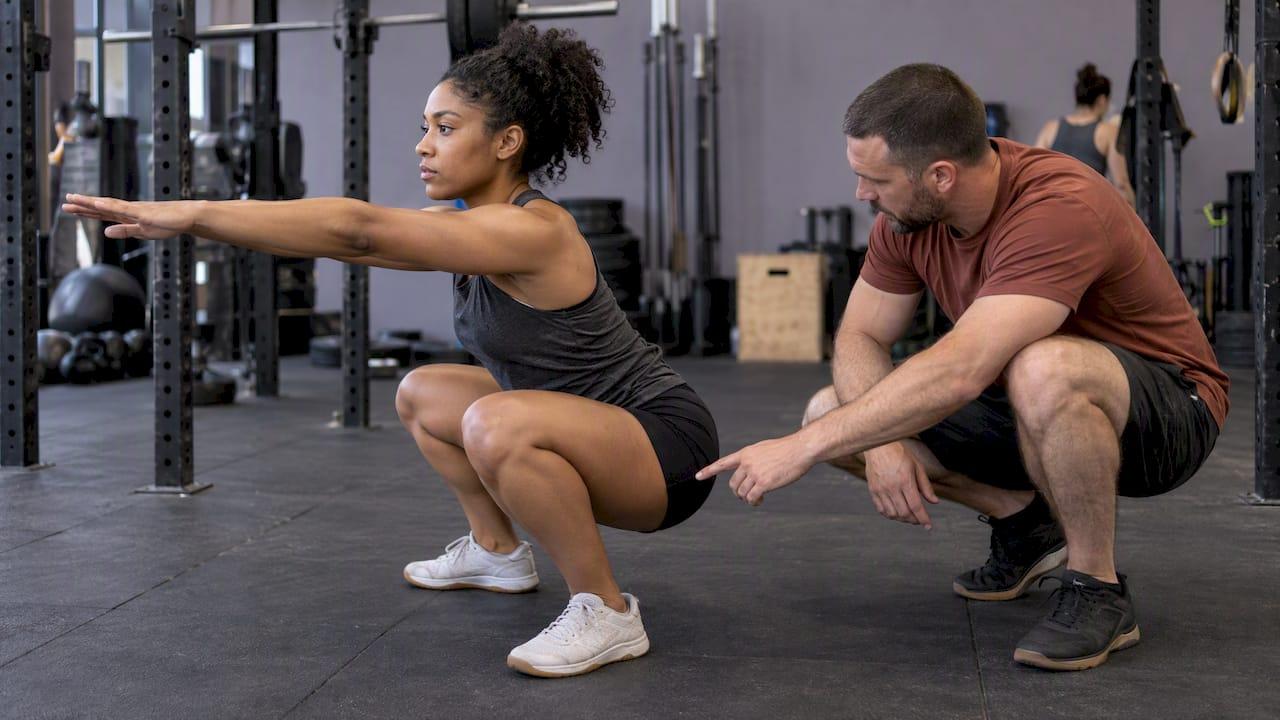
Movement standards are the written rules that define what a valid repetition looks like: where it starts, where it ends, and what must happen in between. If a rep meets the standard, it counts. If it doesn't, it doesn't. This guide explains how the standards work in competition, how judges apply them, and how you can turn them into a consistent, coachable system in your own gym.
TL;DR
- A movement standard defines the start position, end position and required checkpoints of a rep. A rep that misses any of them is not counted.
- Competition rulebooks put the responsibility on the athlete to perform every rep to the described standard, and judges enforce it.
- Standards differ between organizations and change from workout to workout, so always read the current document for the event you are running.
- In your gym, the real win is consistency: the same standard, taught the same way, scored the same way, every class.
- Software can remove the manual work of recording scores and keeping the movement library in one place.
Table of Contents
- What movement standards are
- Why standards matter in a gym
- What makes a rep count
- Standards for common movements
- How judges decide
- How to run standards in your gym
- Checking quality before a workout
- Our perspective
- Where VO2WOD fits
- FAQ
- Sources
What movement standards are
A standard is a rule for measuring a rep. In functional fitness, it answers one question: did this repetition happen the way the workout intended?
The CrossFit Games rulebook describes how an Open workout is specified: required movements, start and end ranges, repetitions, equipment, weights, time limits and scoring details are all part of the workout format. Put differently, a workout is not just "20 squats." It is 20 squats that each meet a defined range of motion.
The iF3 organization, which publishes its own rules for functional fitness competition, uses the term Points of Performance. Its 2026 Movement Standards document defines a valid rep through Points of Performance that set the start position, the end position and any mandatory requirements during the movement.
Whatever the name, every standard has the same three parts:
- Start position. Where the athlete, bar, bell or rope must be before the rep begins.
- Required checkpoints. What must happen during the movement, such as a lockout or a depth.
- End position. What the athlete must show to finish the rep and be ready for the next.
Why standards matter in a gym
Standards protect three things: fairness, safety and progress.

Fairness. If one athlete squats to full depth and another stops high, their scores are not comparable. A shared standard makes the leaderboard mean something.
Safety. Range-of-motion rules often keep the movement in positions the body handles well under load, and they stop fatigue from quietly eroding technique. Coaches who spot a shortened rep early can scale the load or the movement before form breaks down. If you are unsure how a standard should be modified for an athlete with an injury or a medical condition, that is a conversation for the athlete and a qualified clinician, not a rule you can settle on the whiteboard.
Progress. A personal record only matters if the movement was the same last time. When standards drift, members chase numbers that were never real, and trust in the whiteboard erodes. We cover how to keep scores comparable in our piece on benchmark workout tracking.
What makes a rep count
The core rule is simple. The CrossFit Games rulebook states that a repetition must meet the movement standards and range of motion in the workout format, and violations mean the rep is disallowed. The rulebook also makes athletes responsible for performing all required movements to the described standard, counting and completing every required rep, and meeting submission standards.
Three practical consequences follow:
- No credit for almost. A rep that is an inch short of the standard is not a rep. Coaches who allow it in class teach members that it is.
- The athlete owns the count. Judges confirm scores, but the athlete is responsible for knowing the standard before the clock starts.
- The workout page is the authority. The standard for a given workout lives in that workout's description, not in memory.
The unbroken rule
Some standards also govern how a set is performed. The iF3 2026 document defines its Unbroken Rule as a set of reps performed without breaking: the object may not rest on the ground for more than a fraction of a second, and the athlete may not rest outside the normal movement pattern. If you program unbroken sets, tell members exactly what counts as a break.
Standards for common movements
The exact wording changes by event and year, so treat the examples below as illustrations of how standards read, not as a universal rulebook.
Two examples come from the 2026 CrossFit Open workout 26.2 on its official workout page:
| Movement | What the standard asks for |
|---|---|
| Overhead dumbbell walking lunge | The dumbbell is overhead, hips and knees are fully extended, and both feet are in line and touching the ground clearly past the final mark. |
| Pull-up | Arms start fully extended at the bottom, and the rep is credited when the chin clearly breaks the horizontal plane of the bar. |
Notice what these have in common. Each names a visible position a judge can see from where they stand. That is the test of a good standard: two people watching the same rep should reach the same verdict.
For other movements, such as air squats, double-unders, presses and toes-to-bar, read the current standards document for your event. The same logic applies: a defined start, a defined end, and one or two checkpoints in between. Many documents also add notes on equipment and what is not allowed, so read the full entry, not only the headline description.
How judges decide
Judges are the people who apply the written standard in real time. According to the rulebook, judges enforce movement and workout standards and confirm the athlete's score, and violations lead to disallowed reps.
A few points are worth knowing:
- Credentials depend on the setting. For the 2026 Open, the rulebook says there is no credentialing requirement for judges at an affiliate, while video review judges must hold a current-year Judges Course or Advanced Judges certificate. In your own gym, you set the bar for who judges.
- Intent matters. The iF3 guidelines say Technical Officials may disallow reps in real time or after a test if someone uses a literal reading of a written standard to exploit the movement in an unintended way. A standard describes a movement, not a loophole.
- Judges call what they see. Good judges give clear, short cues ("no rep," plus the reason) so the athlete can fix the next one.
How to run standards in your gym
Competition documents are the reference. Your members need something simpler: a clear, repeatable way to learn the standard and be held to it. Here is a process that works for most functional fitness gyms.
1. Write one standard per movement
For each movement you program, write a short entry with three lines: start, checkpoint, end. Add a scaled version with its own standard. Keep the wording close to the source document for competition movements, so members who enter outside events are not surprised.
2. Keep them in one place
A standard on a laminated sheet is forgotten within a month. A movement library that members and coaches can both open from a phone gets used. If coaches ignore your library, the problem is usually format, not attitude; we explain how to fix that in making coaches use your movement library.
3. Brief the standard before the clock starts
The whiteboard says what the workout is. The briefing says what counts. Spend 60 seconds on the one or two movements where reps most often fall short that day. Demonstrate the standard and the common miss side by side.
4. Judge consistently
Pick a policy and keep it. Many gyms cue and correct in regular classes but enforce strictly in benchmark tests and in-house competitions. Either approach works if members know which mode they are in. Mixed signals do the damage.
5. Record what actually happened
If a member's score includes no-reps, the score should reflect the reps that counted. Write down the scaling and the load, too, so next time's comparison is honest.
6. Give feedback you can track
Coaches will see the same standard misses repeat across weeks. Capture them, so you can coach the pattern, not just the rep. Our guide to coach feedback tracking shows a simple way to do that.
Checking quality before a workout
Athletes and coaches can use the iF3 document as a pre-workout check: it lists Points of Performance, definitions, general rules and exercise-specific standards. A good routine before a test or competition:
- Read the standard for each movement in the workout, out loud if you are coaching.
- Do two or three warm-up reps of each movement, with a partner or coach watching for the checkpoint.
- Agree in advance on what the cue for a no-rep sounds like.
- Decide what the scaled option is and what its standard is, before fatigue makes the decision for you.
Our perspective
We build software for functional fitness gyms, and we hear one complaint from owners constantly: the standards are known, but they are not shared. The head coach knows exactly what a full rep looks like. The newest coach has a slightly different picture. Members have a third.

In our experience, the fix is not a thicker rulebook. It is fewer, clearer standards that live where people already look, plus scores that come from the workout itself, not from a number someone typed in afterward. When scoring is automatic, nobody has to reconstruct a result from memory, and the whiteboard stops being the only record of what happened. Standards then do what they are meant to do: make effort comparable from one week to the next.
We would also say this plainly: a standard is a teaching tool before it is a policing tool. Members who understand why a rep has a depth requirement will hold themselves to it. Members who feel policed will argue about it.
— Marcus
Where VO2WOD fits
VO2WOD is management software built specifically for functional fitness gyms. It combines a movement library and personal-record tracking with automatic workout scoring, class scheduling, billing, check-in and live in-class heart rate monitoring, so the standards your coaches teach and the scores your members log sit in the same system. We offer free data migration and one month of complimentary service, and a dedicated team helps you through the switch. If you want to see how it works for your gym, start at VO2WOD.
If you are weighing options, our 7 to 14 day evaluation guide lists what to test before you commit, and our piece on migrating workout history explains how to keep past scores intact.
FAQ
Are movement standards the same everywhere?
No. Different organizations publish their own documents, and individual workouts can add or change requirements. The CrossFit Games rulebook ties standards to each workout format, and iF3 publishes its own Points of Performance. Always check the document for the event you are running or entering.
What happens when a rep doesn't meet the standard?
It is disallowed, meaning it does not count toward the score. The athlete repeats the movement until the rep meets the standard, and the judge usually gives a short reason so the athlete can correct it.
Do I need certified judges in my gym?
For the 2026 Open, the rulebook says judges at an affiliate need no credentialing, though video review judges do. For in-house events, what matters is that your judges know the standards and apply them the same way for everyone.
How do I scale a movement without breaking the standard?
Give the scaled version its own written standard with a start, a checkpoint and an end. Then log it as scaled, so the result is never compared with the full movement. For athletes with injuries or medical conditions, ask a physician or physical therapist what is safe before choosing the scale.