
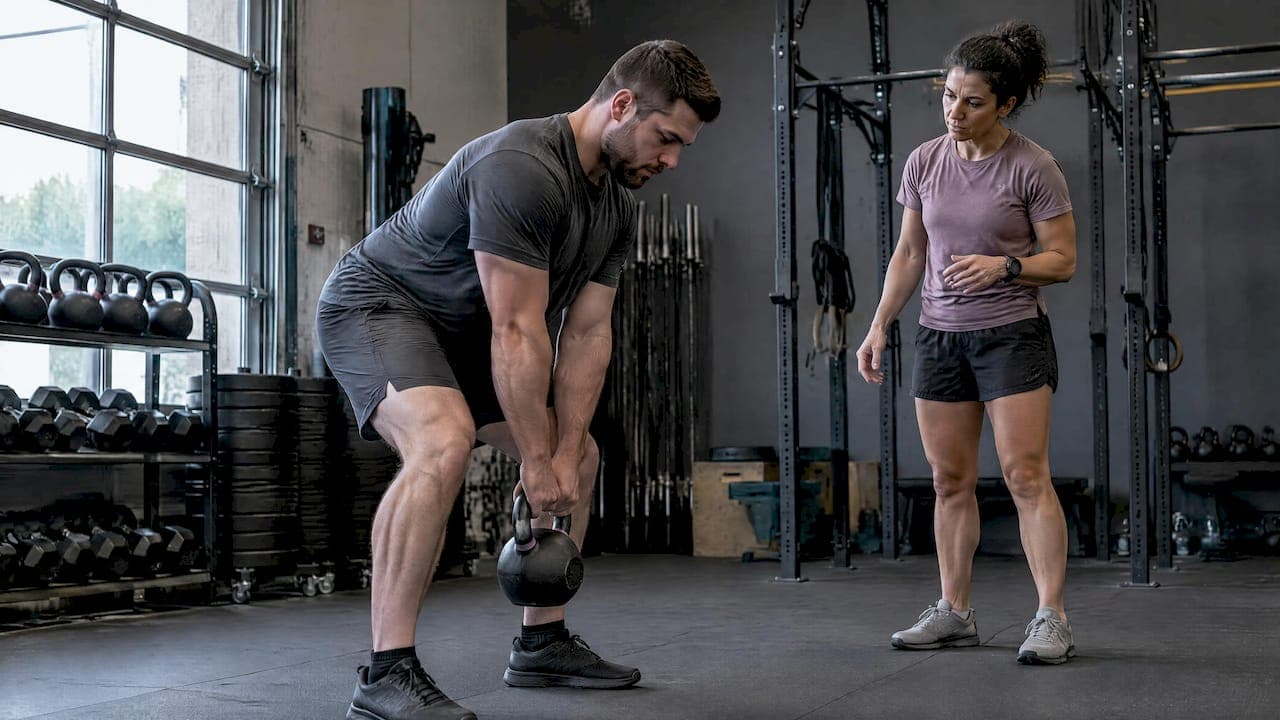
A movement library for gyms is a searchable set of demo media, concise coaching cues, and progression ladders that let coaches program consistently and scale safely. The single most useful move you can make is to build each entry with a demo clip, three to five cue bullets, two regressions, two progressions, and searchable tags from day one.
TL;DR:
- Building each movement library entry with a demo video, clear cues, regressions, progressions, and searchable tags enables quick teaching and consistency.
- Organize exercises by movement patterns or equipment and include a movement matrix across multiple planes to promote balanced development and safe progressions.
- Use standardized cues, fault corrections, and mapped regressions and progressions backed by evidence showing that structured training reduces injury risk by around 30 percent.
- Incorporate contraindications, medical clearance, and modifications into entries to prevent injuries and ensure safe progression for all athletes.
- Use integrated gym software that combines the movement library with scheduling, attendance, and tracking to streamline programming and improve library adoption.
Table of Contents
- What belongs in every movement library entry
- How to organize the library: taxonomies, tags, and the movement matrix
- Coaching cues, fault corrections, and progression ladders
- Using the movement library inside class and session planning
- Safety, contraindications, and the evidence behind movement selection
- Picking the right format: spreadsheets, video, open databases, or gym software
- How VO2WOD approaches movement libraries
- What actually moves the needle on library adoption
- Getting your movement library up and running
- FAQ
- Sources
What belongs in every movement library entry
A library entry only earns its place when a coach can read it in under a minute and teach from it immediately. The format matters as much as the content: short clips, plain language, and consistent naming keep the library usable instead of becoming a dumping ground of half-finished notes.
Each exercise entry should include:
- A demo video 15 to 60 seconds long, filmed from a consistent angle
- Three to five coaching cues written as short, teachable phrases
- Purpose, primary and secondary muscles worked, and required equipment
- Level (beginner, intermediate, advanced), movement plane, and common faults
- Contraindications, two regressions, and two progressions
- Searchable tags for quick filtering during class planning
Video length matters because longer clips get skipped during live coaching. Cue phrasing should mirror how a coach actually talks on the floor, not textbook anatomy language. A simple file-naming convention, exercise name, version date, and coach initials, prevents duplicate or outdated demos from piling up in a shared folder.
How to organize the library: taxonomies, tags, and the movement matrix
Two organizing models dominate gym movement libraries. A movement-pattern-first taxonomy groups exercises by squat, hinge, push, pull, carry, and rotate, which works well for programming variety across a week. An equipment-first taxonomy groups by barbell, dumbbell, kettlebell, and bodyweight, which works better for gyms juggling limited floor space or rotating stations.
Whichever model you pick, build a simple multiplanar movement matrix alongside it. ACE's movement variability matrix recommends teaching movements across sagittal, frontal, and transverse planes rather than training in one plane repeatedly, since a matrix approach helps prevent single-plane overuse patterns and supports progressions across different ability levels.
A basic matrix might look like: squat (sagittal: front squat, frontal: lateral lunge, transverse: rotational lunge), or push (sagittal: push-up, frontal: landmine press, transverse: chop press).
Tag each entry for fast filtering during class prep:
- Intensity: low, moderate, high
- Space required: minimal, moderate, full-floor
- Equipment needed: bodyweight, single implement, multiple stations
- Readiness flags: beginner-safe, requires clearance, coach-supervised only
Coaching cues, fault corrections, and progression ladders
Teachable entries rest on four pillars: shapes (what the body should look like at key positions), tension (where and when to brace), mobility and flexibility notes (what range the athlete needs), and strength prerequisites (what the athlete needs to load the movement safely). NSCA's guidance on teaching resistance training movement patterns recommends breaking complex lifts into progressions and keeping technique monitoring and gradual load increases central to how coaches teach.
A standardized cue template for every entry:
- Setup: how the athlete gets into position
- Execution: the one or two cues that drive the movement
- Correction: a single line fixing the most common fault
- Drill: a quick practice version to isolate the skill
Map regressions to drills to progressions with objective checks, not guesswork. A squat regression might require hitting depth with control for five reps before advancing; a pull-up progression might require a controlled negative before adding volume.
Pro Tip: Write every cue the way you'd say it out loud mid-class. If it sounds like a textbook, a new coach won't use it.
Using the movement library inside class and session planning

A library only pays off when coaches pull from it while building sessions, not just when reviewing it afterward. Tag-based filtering turns a long list of entries into a fast menu for whatever block is on the whiteboard.
Three templates cover most programming needs:
- Class-ready block (30 to 45 minutes): full session built from tagged movements matched to the day's training phase and available equipment
- Skill block (10 to 15 minutes): one movement pattern with its regression and progression ladder, used to teach or refine technique
- Scalable warm-up (8 to 12 minutes): low-intensity entries tagged for minimal space and bodyweight-only options
Choose movements by cross-referencing level, equipment, and training phase tags rather than picking from memory, especially when a substitute coach is running the room. Logging usage, which movements got assigned, how athletes scored, and any readiness flags triggered, turns the library into a record of what actually worked, not just a reference shelf.
Safety, contraindications, and the evidence behind movement selection
Movement selection carries real injury-prevention weight. A systematic review and meta-analysis of exercise interventions found that structured strength training can reduce overall sports injuries by about 30%, with some strength-training subgroups cutting overuse injuries by nearly half. That is a strong argument for building progression ladders instead of throwing advanced movements at unprepared athletes.
Structured strength training can cut overall sports injury rates by roughly 30%, according to pooled trial data, which is reason enough to gate advanced movements behind a documented progression.
Operational rules worth adopting:
- Require medical clearance before assigning any movement flagged high-risk for a given athlete's history
- Record contraindications directly on the entry, not in a separate coach notebook
- Keep standard modifications ready (box height, band assistance, range limits) rather than improvising on the spot
- Screen new athletes for basic movement competency before placing them in advanced class blocks
Pairing library data with outside screening support strengthens this approach. A chiropractic-backed injury prevention checklist offers a useful cross-check for gyms building their own intake and clearance process.
Picking the right format: spreadsheets, video, open databases, or gym software
Spreadsheets are fast to build and easy to edit but fall apart once video and tagging get complex. A dedicated video library teaches well but rarely connects to programming or attendance data. Open-source exercise databases offer rich starting structures, including classification fields, cues, and contraindications, that gyms can adapt instead of building from zero. Purpose-built gym software ties the library to scheduling, attendance, and performance tracking in one place.
Keep one canonical source of truth, staff see full fields including contraindications and coach notes, while members see demos and cues only. Before migrating tools, export a CSV with every metadata field intact so nothing gets lost in the switch.
How VO2WOD approaches movement libraries
Our platform includes a built-in movement library alongside wearable integrations and automatic workout scoring. Keeping demos, cues, and personal-record tracking inside one platform means coaches check a single system instead of juggling a spreadsheet, a video folder, and separate tracking software. That consolidation is the core idea behind VO2WOD's approach to functional fitness gym management, cutting the manual entry that eats into coaching time.
What actually moves the needle on library adoption
Start small: standardize language across five to ten core movements before building out the full catalog. Resist overloading entries with every possible detail, a clean demo and two solid regressions beat ten bullet points nobody reads. Coaches who get recognized for keeping entries current are the ones who keep the library alive past the first month.
— Marcus
Getting your movement library up and running
Setting up a movement library takes less effort when it is built into the software you already run class schedules and check-ins through, rather than bolted on as a separate tool. We handle free data migration and a month of complimentary service, so existing demos, cues, and progressions move over without the manual re-entry that usually kills these projects halfway through.

Our platform pairs that library with live biometric tracking and automatic workout scoring, so the same system holding your coaching content also tracks who used which movement and how they performed. Visit VO2WOD to see the movement library in action or request a migration walkthrough for your gym.
FAQ
What is the 3-3-3 rule in gym?
The 3-3-3 rule is an informal coaching guideline, not a standard tied to a single governing body, generally referring to structuring a session or warm-up around three movements, three sets, or three rounds. Definitions vary by gym and coach, so check how your own programming defines it before applying it as a rule.
Is there a free exercise library available?
Yes, open-source projects like the open exercise database on GitHub provide structured entries with classification, cues, and contraindications that gyms can adapt for free. These work well as a starting point before customizing cues and progressions to match your own coaching style.
What is the 70/30 rule in gym?
The 70/30 rule is not a standardized term with a single accepted definition in exercise science, so treat any specific claim about it with caution. Some coaches use informal splits to describe a general balance between strength work and conditioning, but the exact ratio varies by program.
What is the 5-3-1 rule in gym?
5/3/1 refers to a popular strength training program built around four-week cycles of percentage-based loading on main lifts, typically squat, bench press, deadlift, and overhead press. It is a specific programming method rather than a universal gym rule, and coaches adapt the percentages to the athlete's training history.
How many movements should a gym library include to start?
Most gyms get further starting with five to ten core movements fully built out, demo, cues, regressions, and progressions, than attempting a complete catalog on day one. NSCA guidance on teaching movement patterns supports building depth through progressions rather than breadth through volume.
Sources
- The effectiveness of exercise interventions to prevent sports injuries: systemic review and meta-analysis (PubMed summary / related literature)
- The movement variability matrix (ACE)
- Progressive strategies for teaching fundamental resistance training movement patterns (NSCA)