

Use push notifications for app-engaged users and rich, personalized interactions. Use SMS when a message absolutely has to land, especially for urgent or transactional content. The practical pattern most marketing teams settle on: send push first, then fall back to SMS as a fallback for critical messages if there's no engagement within a set window.
The reason this sequence works comes down to reliability versus reach economics. Push travels through Apple's APNs or Google's FCM and costs almost nothing per message, but it needs an installed app and an internet connection. SMS moves over the cellular network itself, sidestepping both dependencies, and carries an average open rate near 98%, with most texts read within minutes. That gap in reliability is exactly why the TCPA treats SMS consent so strictly: it's a channel people actually read.
Key Takeaways
Push notifications win on cost and interactivity for app-engaged users, while SMS wins on reliability and speed for time-sensitive messages, and the strongest strategy sequences both rather than choosing one.
| Point | Details |
|---|---|
| SMS open rate leads decisively | SMS holds roughly a 98% open rate versus push's reported 8% to 40% range. |
| Push depends on connectivity | Push notifications require an installed app or browser subscription plus an active internet connection. |
| Use fallback sequencing | Send push first, wait one to two hours, then send SMS to users who didn't engage. |
| Compliance rules differ sharply | SMS marketing needs explicit written opt-in under TCPA guidance; push relies on a device permission prompt. |
| VO2WOD applies this for gyms | VO2WOD combines in-app milestone messaging with real-time monitoring, plus free migration and a one-month trial for gym operators switching systems. |
Table of Contents
- SMS vs Push Notifications: What Each Channel Actually Is
- How SMS and Push Notifications Compare Side by Side
- What the Open Rate Data Says About Each Channel
- Budgeting for SMS and Push: Where the Real Costs Sit
- Consent Rules You Can't Skip for SMS and Push
- When to Use Push Notifications vs SMS
- How a Gym Would Sequence Push and SMS in Practice
- What the Data Actually Tells You to Prioritize
- An Option Worth Considering for Gym Operators
- Frequently Asked Questions
- Sources
SMS vs Push Notifications: What Each Channel Actually Is
Before comparing performance, it helps to know what you're actually choosing between. Four terms get used loosely in marketing meetings, and they're not interchangeable.
- App push notifications appear on a user's phone through an installed app, delivered via Apple's APNs or Google's FCM, and require the app to be installed with permission granted.
- Web push notifications work the same way but through a browser subscription, letting you message someone who visited your site without installing anything.
- SMS (Short Message Service) sends plain text over the cellular network through a carrier's SMSC, capped at 160 characters per plain-text message.
- MMS (Multimedia Messaging Service) extends SMS with images, audio, or video, but it costs more per send and isn't supported identically across every carrier.
The consent models diverge too. Push relies on a one-tap permission prompt inside the app or browser. SMS marketing in the United States requires explicit written opt-in under TCPA guidance, a meaningfully higher bar. And push has a hard requirement SMS doesn't: an active internet connection. No signal, no notification, no matter how well the campaign was built.
How SMS and Push Notifications Compare Side by Side
Once you understand the mechanics, the operational trade-offs become obvious. Here's where the two channels actually diverge for a marketing or product team building a messaging strategy.
Delivery mechanism. Push needs Wi-Fi or mobile data plus a live app or browser subscription. SMS needs only a phone number and cellular coverage, which is why it works in dead zones where push quietly fails.
Audience dependency. Push only reaches people who installed your app and granted permission, so your addressable audience shrinks to your install base. SMS reaches anyone whose number you've collected, phone owners without ever opening an app.
Content richness. Push wins on interactivity. It supports deep links straight into a specific screen, images in the notification preview, and action buttons that trigger without opening the app. SMS is mostly plain text at 160 characters, though MMS adds media at a cost premium, and two-way texting still beats push for actual conversation.
Measurement. Push gives you in-app analytics tied directly to conversion events, so you can watch a notification turn into a purchase in the same dashboard. SMS relies on delivery receipts and link click tracking, which is reliable but coarser.

A quick way to frame it: push measures engagement, SMS measures delivery. Those are different jobs, and confusing them is where a lot of campaign underperformance starts.
| Factor | Push notifications | SMS |
|---|---|---|
| Requires | Installed app/browser + internet | Phone number + cellular signal |
| Content limit | Rich media, deep links, buttons | 160 characters (MMS for media) |
| Reach | Install base only | Any phone number |
| Typical open rate | Roughly 8–40% depending on source | Around 98% |
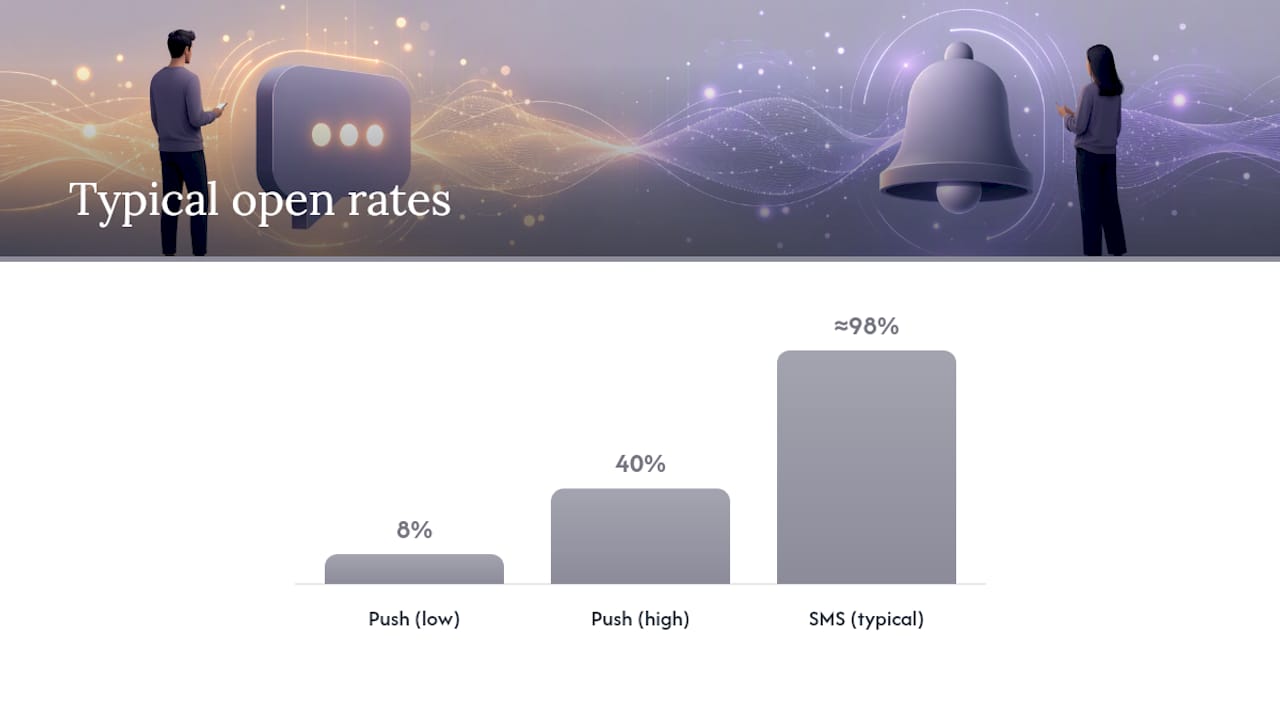
That open-rate spread on push isn't a typo. Reported ranges vary from roughly 8% to 40% depending on the source, the app category, and how aggressively the notification is targeted. SMS doesn't have that problem, and that consistency is the whole reason it exists as a fallback channel.
What the Open Rate Data Says About Each Channel
The numbers aren't close, and that matters more than most marketing decks let on. SMS holds a roughly 98% open rate, with about 90% of texts read within three minutes of arrival.
Three forces explain why push lags:
- Device power management. Aggressive battery savers on Android and iOS can delay or kill push delivery entirely, something SMS simply isn't subject to.
- Notification fatigue. Users who get bombarded by app alerts start swipe-dismissing entire batches without reading a single one.
- Do Not Disturb modes. Many users mute notification banners by default and only check apps on their own schedule, breaking the real-time promise push depends on.
Here's what that means practically: for transactional or time-critical messages, that speed and certainty gap is the whole argument for SMS. A password reset code or appointment reminder needs to be seen in minutes, not whenever someone happens to unlock their phone and notice a banner. For promotional nudges where a missed message costs you a little reach but not a broken transaction, push's near-zero marginal cost still makes it the better first move.
Budgeting for SMS and Push: Where the Real Costs Sit
Push looks free at first glance and SMS looks expensive, but that comparison misses where the actual money goes. Push carries no per-message fee, which sounds like a clear win until you account for the app itself. Someone has to build it, maintain it across iOS and Android updates, and manage the permission flows that determine whether users ever see a notification at all. That's ongoing engineering overhead, not a marketing line item, and it doesn't show up in a campaign budget the way SMS costs do.
SMS flips the equation: no app to maintain, but predictable per-message pricing that scales with volume, and international sends carry different carrier rates depending on the destination country. MMS adds a further premium on top of standard SMS rates.
A few practical budgeting notes worth flagging:
- Push's real cost center is app development and upkeep, not the notification send itself.
- SMS costs are transparent and quotable up front, which makes ROI modeling far simpler for a single campaign.
- International SMS pricing varies by carrier and country, so a campaign that scales globally needs per-market cost checks before launch, not after.
- High-volume SMS campaigns can get expensive fast in a way push simply doesn't, which is exactly why smart teams reserve texting for messages that need to land.
Consent Rules You Can't Skip for SMS and Push
Compliance isn't optional here, and the two channels play by different rulebooks. SMS marketing in the United States falls under TCPA guidance enforced by the FCC, which requires explicit written consent before you send marketing texts, plus clear opt-out instructions on every message and a recordkeeping trail proving consent was given.
Push works differently. Consent comes from a native permission prompt at the app or browser level, and a user can revoke it anytime through device settings without you ever knowing until your delivery numbers quietly drop.
- SMS: written opt-in required for marketing sends, with documented consent records kept on file.
- Push: permission granted through a one-tap app or browser prompt, revocable at any time in device settings.
- Both channels need visible, working opt-out paths, and losing that path is a compliance risk regardless of which channel you're using.
Pro Tip: Use a double opt-in for SMS whenever you're collecting numbers through a web form. A confirmation text that requires a reply doesn't just satisfy stricter consent expectations, it filters out mistyped numbers before they become deliverability problems.
When to Use Push Notifications vs SMS
Scenario should drive channel choice, not habit. Here's how the split actually plays out in practice.
Lead with push when:
- You're re-engaging someone already inside your app with a personalized product recommendation.
- You're sending an abandoned-cart nudge that benefits from a deep link straight to checkout.
- You're announcing a new feature to users who'll only care if they're already active in the app.
Lead with SMS when:
- You're sending a one-time passcode or login verification that has to arrive in seconds.
- You're pushing an emergency alert, delivery update, or logistics notification where missed delivery has real consequences.
- You're confirming an appointment or booking where a no-show costs you real revenue.
The fallback flow that ties both together: send push first, wait a window of one to two hours, then send SMS only to the users who never opened the push. That window isn't fixed. Test it against your own audience, because a fitness app's optimal wait time before a class reminder looks nothing like an ecommerce brand's cart-abandonment timing.
Pro Tip: Don't fallback to SMS for every unopened push. Reserve it for messages where a missed read actually costs you something, otherwise you'll burn through opt-ins and your SMS list's goodwill on low-stakes reminders nobody needed twice.
How a Gym Would Sequence Push and SMS in Practice
A functional fitness gym running its own app is a clean example of how this plays out day to day. A new member downloads the app and gets a welcome push with a deep link straight to their first class booking. Weeks later, hitting a personal record on a lift triggers a milestone push, the kind of in-app moment that keeps people opening the app on their own. But class reminders and booking confirmations, the messages where a no-show actually costs the gym money, fall back to SMS if the push goes unopened.
That kind of layered communication is where VO2WOD's in-app messaging fits for gym operators building this out. The platform pairs milestone alerts and community engagement tools with real-time performance monitoring, so a coach can see who's actually opening notifications and adjust without digging through spreadsheets.
A gym that captures phone numbers with proper opt-in consent, maps every push event back to an actual booking or renewal, and logs SMS replies for missed-class follow-ups isn't just messaging members. It's building a measurement system that tells you which channel earns its place for each type of message.
The checklist that makes this work: verify deep links actually route to the right screen, tie push events to revenue outcomes instead of just open rates, and treat SMS opt-in consent as seriously as any other compliance record.
What the Data Actually Tells You to Prioritize
The open-rate gap between SMS and push isn't close, and most marketing advice treats that gap as an argument for abandoning push entirely. That's the wrong read. Push's weakness isn't the channel, it's how lazily most teams use it. Behavioral segmentation based on actual in-app actions dramatically improves push performance compared with generic broadcast blasts, and most brands never bother building those triggers.
Where conventional advice falls short is treating this as a channel competition at all. The real skill is sequencing, not picking a winner. SMS's near-98% open rate isn't a reason to text everything; it's a reason to protect that channel for the handful of messages where a missed read genuinely costs money. Burn that trust on promotional noise and the open rate collapses to something closer to push's.
If you take one thing from this: build your push segmentation before you build your SMS fallback. A well-targeted push campaign with a smart SMS safety net for the messages that truly can't be missed will outperform either channel used alone, every time.
An Option Worth Considering for Gym Operators
If you run a functional fitness gym and you're piecing together push notifications, SMS reminders, and member engagement across three different tools, that's the exact operational drag this article has been describing, minus the app-development budget of a consumer tech company.
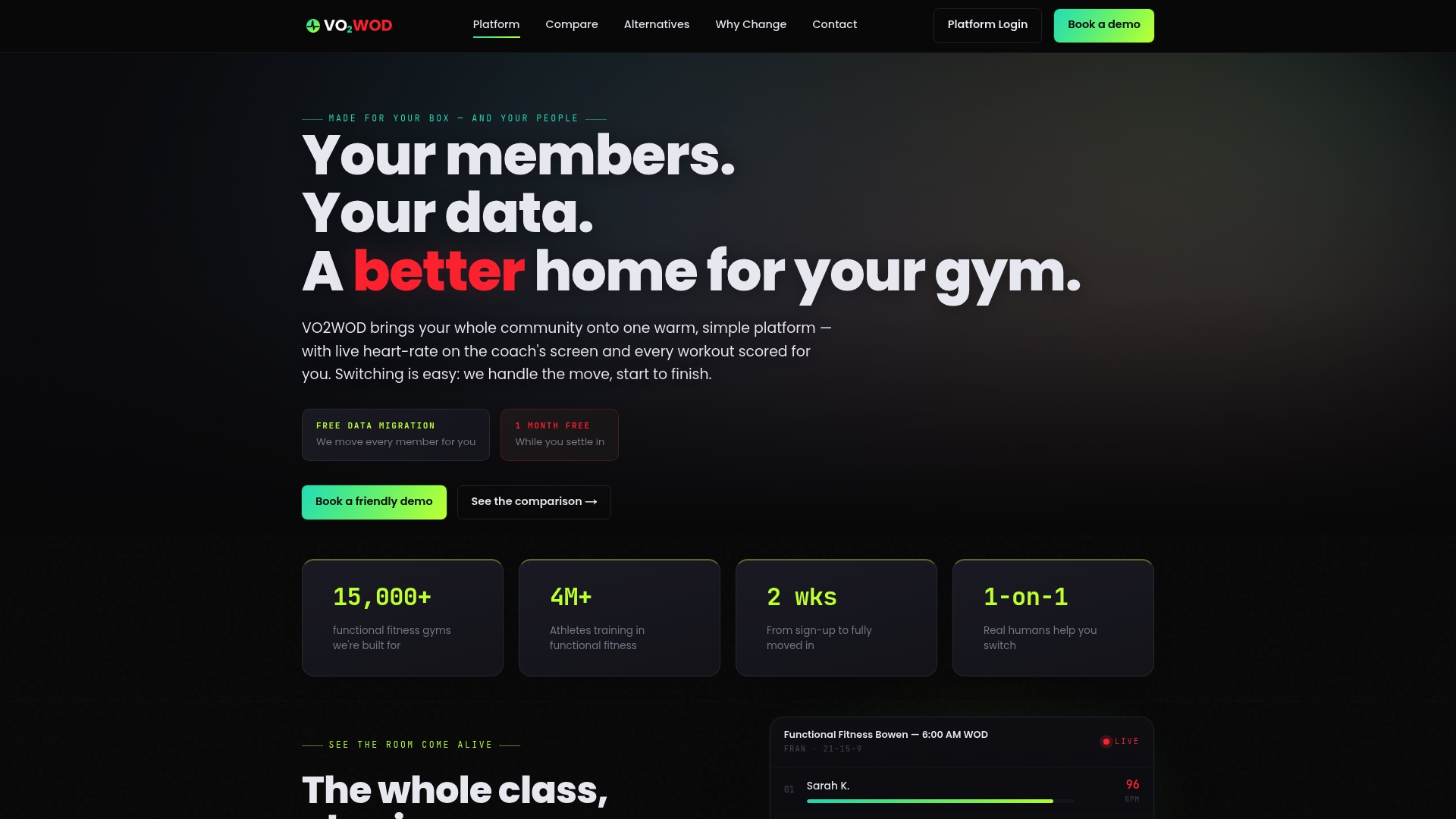
VO2WOD builds in-app messaging with milestone alerts directly into gym management software, alongside real-time heart rate monitoring and automatic workout scoring, so coaches see engagement data without manually reconciling three platforms. If you're currently on Wodify, PushPress, Mindbody, Zen Planner, Gymdesk, or Kicksite and wondering whether a switch is worth the hassle, VO2WOD includes free data migration and a full month of complimentary service to make that transition low-risk. You can compare VO2WOD against your current gym software to see where the fit is stronger, or start a free trial directly if you're ready to see the in-app messaging and monitoring tools in action.
Frequently Asked Questions
Is SMS or push notifications better for marketing? Neither wins outright. Push notifications work better for ongoing engagement with app users because they're free per message and support rich content. SMS works better for urgent or transactional marketing messages where guaranteed delivery matters more than cost.
Why do push notifications have such a low open rate compared to SMS? Push notifications compete with battery-saving settings, Do Not Disturb modes, and general notification fatigue, all of which suppress delivery or attention. SMS bypasses those obstacles by landing directly in a user's native messaging inbox.
Do I need separate consent for SMS and push notifications? Yes. SMS marketing requires explicit written opt-in under TCPA rules in the United States, while push relies on an app or browser permission prompt that users can revoke through their device settings at any time.
When should a business use SMS instead of email or push? Use SMS when a message is time-critical and delivery certainty outweighs cost, such as one-time passcodes, appointment confirmations, or delivery alerts. Push and email both work better for lower-stakes, higher-volume messaging where occasional missed opens aren't costly.
Can SMS and push notifications work together? Yes, and that combination is the most common practitioner pattern. Sending push first and falling back to SMS for users who don't engage within a set window balances cost against guaranteed delivery without over-relying on either channel alone.
Sources
- Push Notifications vs. SMS Texts: What’s the Difference? | Twilio
- Push notifications vs. SMS: comparison, use cases & how to combine both | Pushwoosh
- Reminder via Text vs App Notification: Which Works Better? | YouGot
- TCPA rules | FCC
- SMS vs. Push Notifications - Cost, UX & More | Voxie