

The highest-leverage move for member retention is building repeat engagement before members ever think about canceling: a structured onboarding sequence paired with an engagement scoring system that flags disengagement weeks before renewal. Everything else, from event calendars to loyalty perks, works better once that foundation exists.
If you manage a membership organization or gym and need results this quarter, start here:
- Deploy a staged welcome sequence (Day 1, Day 7, Day 30) so new members hit a real milestone before their novelty wears off.
- Set up basic engagement scoring using logins, event attendance, and app activity, even a simple spreadsheet works for month one.
- Fix involuntary churn first. Payment failures account for up to 50% of cancellations, and that's the cheapest fix on this entire list.
Check your first-year retention rate today, not your overall rate. It's the number that tells you whether new members are actually sticking, and it's usually the fastest lever to pull.
Pro Tip: If you only fix one thing this month, fix payment retry logic. It requires zero behavior change from members and typically recovers revenue within days.
Key Takeaways
Member retention improves fastest when organizations pair structured onboarding with engagement scoring that triggers outreach before members disengage completely.
| Point | Details |
|---|---|
| Fix involuntary churn first | Up to 50% of cancellations come from failed payments, not dissatisfaction, so retry logic is the cheapest win available. |
| Track first-year retention separately | New members churn at different rates than veterans, so blending the numbers hides your real onboarding problem. |
| Score engagement, don't just measure renewal | Logins, event attendance, and benefit usage predict churn months before a renewal date arrives. |
| Start with three plays if resources are tight | Structured onboarding, segmented communications, and a centralized member hub deliver the best return for the least setup effort. |
| Automate what you can, gyms included | Platforms like Vo2wod turn heart rate data and workout scoring into automatic engagement signals, removing manual tracking from the equation. |
Table of Contents
- Why Member Retention Strategies Matter More Than Growth Tactics
- How Do You Measure Member Retention and Spot Risk Early?
- Ranked Member Retention Strategies With Step-by-Step Tactics
- A 90-Day Plan to Improve Member Retention Fast
- Which Tools Support These Retention Tactics?
- How to Prioritize Retention Plays for Your Organization
- What Membership Leaders Get Wrong About Retention
- If You Run a Gym or Fitness Studio, Here's a Practical Option
- Frequently Asked Questions
- Sources
Why Member Retention Strategies Matter More Than Growth Tactics
Retaining an existing member costs 5 to 7 times less than acquiring a new one, and a 5% improvement in retention can lift profits by roughly 25% to 95%. That spread is enormous, and it's why a mediocre retention program quietly costs more than most marketing budgets combined.
Most membership organizations chase new sign-ups because it feels like progress. But a leaking bucket doesn't get fuller no matter how fast you pour. If you're losing 20% of members annually and only adding 15% in new sign-ups, you're shrinking, and no amount of acquisition spend fixes that math.
Here's what "good" looks like in practice:
- Overall annual retention: Many associations and membership groups target 75% to 85% as a healthy range.
- First-year retention: This number is almost always lower than overall retention and deserves its own tracking, since new members churn at a different rate than veterans.
- Excellent performance: Organizations hitting 90%+ retention typically have strong onboarding and active community engagement built in from day one.
The financial case is simple. A membership base of 1,000 people paying $50 a month generates $600,000 annually. Move retention from 75% to 80%, and you're not just keeping 50 more people. You're keeping the members most likely to renew again next year, refer others, and spend more on add-on programs. Retention compounds. Acquisition doesn't.
How Do You Measure Member Retention and Spot Risk Early?
Retention rate has a specific formula, and most organizations either skip calculating it correctly or confuse it with churn rate. Here's the math: retention rate = [(members at end of period − new members added) / members at start of period] × 100%, according to Joinit's membership guide.
Say you start the year with 500 members. You end with 480, and 40 of those are new sign-ups. Churn rate is just the inverse, 12% in this case.
Building an engagement scoring framework
Renewal rate tells you what already happened. Engagement scoring tells you what's about to happen, which is why it's the more useful number for a manager trying to act early. The approach: assign point values to specific behaviors, then use those totals to sort members into risk bands.
- Pick 4 to 6 trackable activities. Logins, event attendance, forum posts, resource downloads, class check-ins, or app usage all work depending on your organization type.
- Weight them by predictive value. Event attendance usually predicts renewal better than a login, so weight it higher.
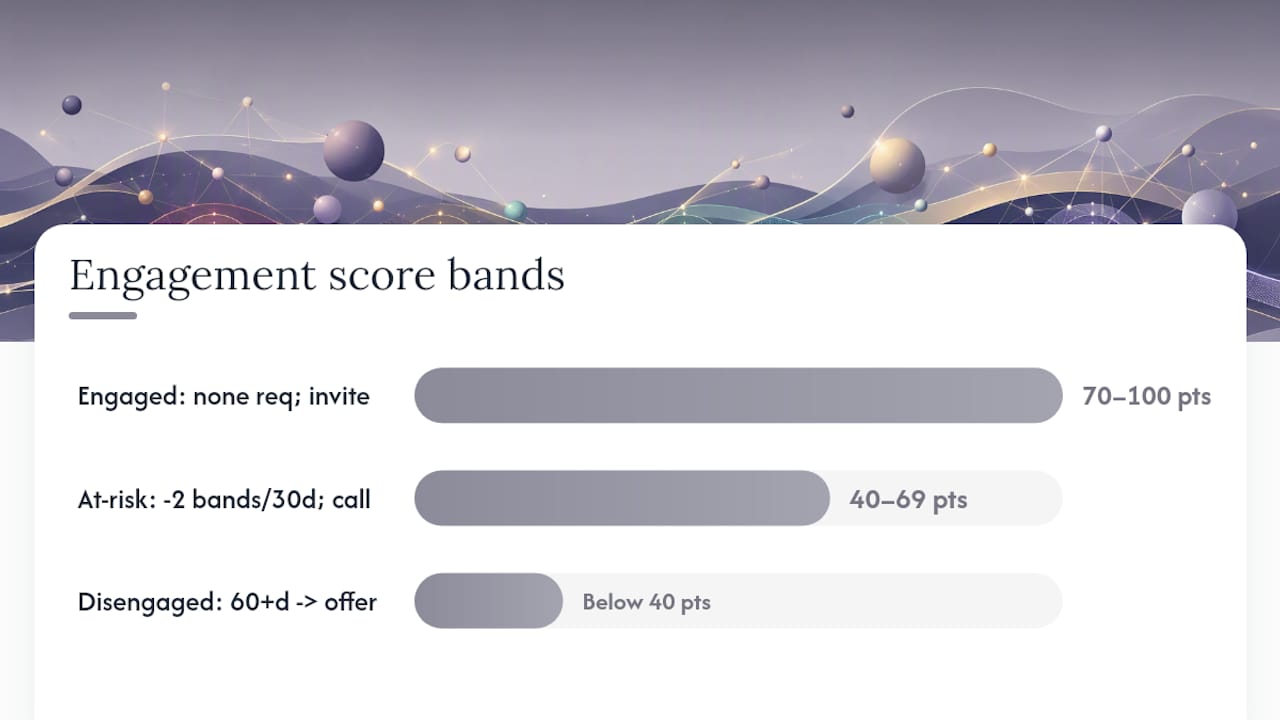
- Set threshold bands. A common structure uses 70 to 100 points as engaged, 40 to 69 as at-risk, and below 40 as disengaged.
- Recalculate monthly, or weekly for higher-touch organizations like gyms and studios where engagement shifts fast.
- Attach an automatic trigger to each band drop, not just a report nobody reads.
This is the single practical way to get ahead of churn instead of reacting to it after a cancellation email arrives. Engagement is also a leading indicator in its own right. Tracking logins, content consumption, and benefit usage predicts renewal months before a lagging metric like renewal rate would show the same warning.
| Score Band | Points | Trigger | Action |
|---|---|---|---|
| Engaged | 70 to 100 | None required | Invite to leadership or ambassador roles |
| At-risk | 40 to 69 | Score drops 2 bands in 30 days | Personal outreach call or email within 48 hours |
| Disengaged | Below 40 | 60+ days of no activity | Reactivation offer or exit survey |
Ranked Member Retention Strategies With Step-by-Step Tactics
Not every tactic deserves equal attention. The list below is ordered roughly by impact-to-effort ratio, so start near the top if you're resource-constrained.
1. Structured onboarding and welcome sequences
New members decide whether they belong within the first 30 days, often within the first week. An unstructured welcome (a single email, then silence) is the single biggest reason first-year retention lags behind overall retention.

Build a staged cadence: Day 1, Day 7, Day 30, Day 60, Day 90, each with a specific goal rather than a generic check-in, a structure recommended by i4a's association engagement research.
Launch checklist:
- Map every touchpoint from sign-up to 90 days.
- Assign one clear "first win" for Day 7 (a completed class, a forum post, a benefit claimed).
- Automate the emails so no manual step can be forgotten.
Impact vs. effort: High impact, low to medium effort. Cost: low if you already have email automation.
Sample email: Subject: "You're in! Here's your first step." "Welcome aboard. Most members who stick around long-term do one thing in their first week: [claim your first benefit / book your first class]. Takes two minutes."
2. Benefits package assessment
Members cancel when the perceived value gap closes, meaning the benefits no longer feel worth the price. Run a benefits audit twice a year: which perks get used, which get ignored, and which competitors now offer for free.
Checklist:
- Pull usage data on every named benefit.
- Cut or rebrand anything under 10% utilization.
- Ask at renewal time specifically what almost made them leave.
Impact vs. effort: High impact, medium effort (requires data pulling and honest internal review).
3. Community platforms and active engagement spaces
A member who has one friend inside your organization is dramatically harder to lose than one who doesn't. Forums, private groups, and member directories create that social gravity, but only if someone actively moderates and seeds discussion.
Checklist:
- Pick one platform (don't fragment across three).
- Assign a moderator with weekly posting responsibilities.
- Make the directory searchable by interest or specialty, not just alphabetical.
Impact vs. effort: Medium to high impact, medium effort ongoing (moderation is a real time cost, not a set-and-forget task).
4. Events and programming, virtual and in-person
Events are your highest-visibility engagement lever, and they double as a natural excuse for personalized outreach ("we missed you at last month's session"). Mix formats: a low-barrier virtual session monthly, plus a higher-commitment in-person event quarterly.
Checklist:
- Track attendance as an engagement score input, not just a headcount.
- Follow up within 48 hours with no-shows using a different message than attendees get.
- Survey attendees while the experience is fresh, not a month later.
Impact vs. effort: High impact, medium to high effort and cost depending on format.
5. Personalized communications and segmentation
Generic newsletters get ignored. Segmented communications based on engagement score, tenure, or interest get opened. Split your list into at minimum: new members (first 90 days), core engaged members, and at-risk members, then write different messages for each.
Sample subject lines by segment:
- New members: "Your first 30 days: here's what to try next."
- At-risk: "We noticed you haven't logged in, everything okay?"
- Core: "You've been here a year. Here's what you've unlocked."
Impact vs. effort: High impact, low effort once segmentation is set up in your platform.
6. Automated renewals, flexible billing, and payment-failure fixes
This is the highest ROI item on the entire list because it fixes losses that have nothing to do with member satisfaction. As many as 50% of cancellations are involuntary, caused by expired cards or failed payments, not members choosing to leave.
Checklist:
- Turn on automatic card-updater services if your payment processor supports them.
- Set up retry logic (attempt 3 times over 5 to 7 days before flagging as canceled).
- Offer flexible billing: monthly, annual, or a short pause option instead of a hard cancel.
Impact vs. effort: Very high impact, low effort (mostly a settings change, not a program).
Pro Tip: A pause option converts far more "I need to cancel" conversations into "see you in three months" than any discount ever will. It costs you nothing and keeps the relationship warm.
7. Feedback loops and regular surveys
You can't fix what you don't measure, and exit surveys arrive too late to save the relationship. Run a short pulse survey at 30 days, 6 months, and annually, three questions maximum, and actually close the loop by telling members what changed because of their answers.
Checklist:
- Keep surveys under 5 questions or completion rates collapse.
- Ask one open-ended question: "What almost made you consider leaving?"
- Publish a short "you said, we did" update quarterly.
Impact vs. effort: Medium impact, low effort.
8. Mentorship and career services
Career support is consistently underused and consistently underrated by staff who assume members don't need it. Members rate job-related help far higher than most organizations expect, and it creates recurring reasons to log back in, per Cavuno's engagement research.
Structured mentorship programs with clear 3 to 6 month timelines deepen the bond for mentors and mentees alike, rather than an open-ended pairing that fizzles out.
Checklist:
- Set a defined program length, not "ongoing."
- Match on specific criteria, not just availability.
- Check in at the midpoint, not just at kickoff and completion.
Impact vs. effort: Medium to high impact, medium effort (requires matching and light coordination).
9. Recognition and ambassador programs
People stay where they feel seen. A simple recognition system, member spotlights, milestone badges, an ambassador tier for your most engaged members, moves loyalty programs beyond pure transaction and into genuine participation. Deloitte's research on loyalty program design points to the same principle: modern programs work better when they're personalized and easy to access, not just point-accumulation schemes.
Impact vs. effort: Medium impact, low effort.
10. Re-engagement and win-back campaigns
For members who've slipped into the disengaged band, a targeted win-back sequence beats a generic renewal reminder. Offer something specific: a free guest pass, a personal call from staff, or a short-term discount tied to a concrete action (attend one event, we'll extend your rate).
Impact vs. effort: Medium impact, low effort, but only works if you caught the disengagement early via scoring.
A 90-Day Plan to Improve Member Retention Fast
You don't need a year to see movement. Three parallel streams over 90 days, onboarding, engagement scoring, and billing fixes, produce measurable change well before the quarter ends.
- Weeks 1 to 2: Audit current onboarding, pull retention numbers using the formula above, and turn on payment retry logic. This step alone often produces visible savings within days.
- Weeks 3 to 4: Build the staged welcome sequence (Day 1, 7, 30) and set up basic engagement scoring, even a spreadsheet counting logins and event attendance works to start.
- Weeks 5 to 8: Launch segmented communications for new, core, and at-risk members. Begin automated at-risk outreach when scores drop two bands.
- Weeks 9 to 12: Run your first pulse survey, review 30-day cohort data from the new onboarding sequence, and adjust based on what's underperforming.
| Resource Profile | Staff Hours per Week | What You Can Realistically Launch |
|---|---|---|
| Low (solo manager, part-time) | 3 to 5 hours | Payment retry fix, basic 3-email onboarding sequence |
| Medium (small team) | 8 to 12 hours | Full onboarding cadence, spreadsheet engagement scoring, segmented emails |
| High (dedicated team) | 20+ hours | Automated scoring in software, event programming, mentorship matching |
Quick-win templates:
- Welcome series outline: Day 1 (confirm sign-up, set expectations), Day 7 (drive first meaningful action), Day 30 (check in, ask what's working).
- At-risk outreach: "Hey [name], noticed you haven't been around lately. Anything we can help with before your renewal?"
- Reactivation offer: A free class, guest session, or 30-day extension tied to one specific action, not a blanket discount.
By day 30, expect early signals in your onboarding cohort's activity. By day 60, your engagement scores should be flagging real at-risk members. By day 90, you should have a first-year retention number that's measurably different from the quarter before.
Which Tools Support These Retention Tactics?
You don't need six separate platforms. You need one system that talks to itself. Look across five categories: a membership management or portal system, a community platform, event and registration tools, payment retry and billing services, and engagement analytics.
Vendor-selection checklist:
- Does it integrate with your existing payment processor and calendar tools?
- Can you export your member data without a fight if you switch later?
- Does it support automated triggers (score drops, payment failures) out of the box?
- Does pricing scale sensibly as your membership grows, or does it jump in awkward tiers?
- Start with billing and payment retry, since that's your fastest ROI and needs the least behavioral change.
- Add engagement analytics next, so scoring stops living in a spreadsheet.
- Layer in community and event tools last, once the operational basics are solid.
How to Prioritize Retention Plays for Your Organization
Not every organization should run all ten strategies above at once. Use a quick impact versus effort filter to pick your first one to three pilots.
- High impact, low effort: Payment retry fixes, segmented communications. Start here regardless of organization size.
- High impact, higher effort: Onboarding redesign, engagement scoring. Worth the investment once quick wins are running.
- Segment-specific priority: New members respond best to onboarding sequences; at-risk members need personal outreach triggered by score drops; core members respond to recognition and ambassador tracks.
A simple test structure keeps you honest about what's actually working. Appdeck's research suggests starting with three plays specifically: structured onboarding, a centralized member hub, and segmented communications, since they require the least infrastructure for the return they generate.
One-page experiment template:
- Hypothesis: "A Day 7 email with one specific action increases 30-day activity by X."
- Sample: New members joining over the next 4 weeks.
- Metric: 30-day engagement score or first-benefit-claimed rate.
- Timeline: 60 days minimum before judging results.
- Decision rule: If activity rises meaningfully, roll out permanently; if flat, test a different Day 7 action.
What Membership Leaders Get Wrong About Retention
Most organizations treat retention as a renewal-season problem. It isn't. By the time a member is deciding whether to renew, that decision was mostly made months earlier, shaped by whether they felt engaged, not by a well-timed reminder email.
The mistake I see most often is trying to move a passive member straight to "leader" or "ambassador" in one jump, skipping every step in between. That almost never works. Build the ladder instead: passive member, occasional participant, regular attendee, contributor, leader. Each rung needs its own easy next action, not a giant leap.
If you take one thing from this article and start it this week, make it engagement scoring, even a rough spreadsheet version. It's the difference between finding out someone's leaving from a cancellation notice and finding out three months earlier, while you can still do something about it.
If You Run a Gym or Fitness Studio, Here's a Practical Option
This section reflects that Vo2wod, the publisher of this article, builds software for functional fitness gyms, so take the recommendation with that context in mind. The retention tactics above, onboarding sequences, engagement scoring, billing automation, all map directly onto what gym operators struggle to execute manually.
Manual data entry is the reason most gyms never get past spreadsheet-level engagement tracking. Vo2wod handles the heavy lifting automatically: real-time heart rate monitoring during class feeds directly into automatic workout scoring, so coaches see effort and performance history without anyone typing a single number in after the fact. That data becomes your engagement signal. A member whose attendance and effort scores are dropping shows up in the system before they stop showing up at the gym.
Membership billing, recurring payments, and pause options run through the same platform, which closes the involuntary churn gap covered earlier in this article. If you're currently comparing gym management systems, Vo2wod's alternatives page walks through how it stacks up on migration support and onboarding, including a free data migration and a full month of complimentary service to test it against your current setup before committing.
Frequently Asked Questions
What is the single most effective member retention strategy? Structured onboarding paired with engagement scoring produces the biggest lift because it catches disengagement early, before a member has already mentally checked out. Fixing payment failures is a close second since it recovers members who never intended to leave.
How do you calculate member retention rate? This isolates how many of your original members actually stayed, separate from new sign-ups.
What's a good member retention rate benchmark? First-year retention typically runs lower and should be tracked as its own number.
How often should you recalculate engagement scores? Monthly works for most organizations; weekly suits higher-touch environments like gyms and studios where member behavior shifts faster and a two-week gap can mean a missed intervention window.
What causes most involuntary membership cancellations? Expired cards and failed payment attempts account for a large share of cancellations, up to half in some analyses, which is why automated retry logic and card-updater services deliver such a fast return.
Do loyalty programs actually improve retention marketing outcomes? Yes, when designed for participation rather than pure transactions.
Sources
- 15 Member Retention Strategies | Outseta
- Member Retention: 15 Strategies That Actually Work
- Member retention strategies: engagement scoring and playbooks (Cavuno)