

A late cancellation policy sets a deadline, usually 24 hours before an appointment, after which a canceled booking triggers a fee instead of a clean refund. Businesses charge a flat rate, a percentage of the service price, or the full session cost depending on how hard the slot is to refill. If you were just charged one, your first move is pulling your booking confirmation and any timestamped cancellation record before you contact the provider.
TL;DR:
- Businesses typically set a 24 to 48-hour notice window for cancellations depending on how hard it is to refill slots, with longer periods for specialized services.
- Using tiered fee structures that vary based on how close to the appointment time cancellation occurs improves fairness and revenue recovery.
- Clear, specific cancellation policies with written acknowledgment at booking reduce disputes and help enforce fees consistently.
- Automated booking software timestamping and fee application ensure fairness and cut down on arguments about cancellations or charges.
- Valid exceptions like medical emergencies require documented proof, and disputing fees involves direct contact, formal review, or platform escalation.
Table of Contents
- Late Cancellation vs. No-Show: What's the Difference?
- Why Do Businesses Use 24, 48, or 72-Hour Windows?
- How Do You Write a Cancellation Policy People Actually Follow?
- How Do You Enforce the Policy Without Constant Arguments?
- What Counts as a Valid Exception, and How Do You Dispute a Fee?
- Are Late Cancellation Fees Actually Legal to Charge?
- How Software Keeps Cancellation Rules Consistent
- A Fair Policy Protects Everyone, Not Just the Business
- Sources
Late Cancellation vs. No-Show: What's the Difference?
A late cancellation happens when you notify the business, but after the cutoff written into the policy. A no-show is different: you never notify anyone, and the appointment slot sits empty until someone on staff marks it. Both usually cost you money, but a no-show almost always carries the steeper penalty because the business had zero warning to fill the spot.
Timing gets decided by the booking system's clock, not your memory of when you called. If you cancel a 9:00 AM appointment at 9:05 AM the day before, most software logs that as inside a 24-hour window and charges nothing. Cancel at 9:15 AM the same day, and you're 15 minutes late, fee applied. The method matters too. A cancellation submitted through an online portal or app timestamps automatically. A voicemail left after hours might not register until a staff member checks messages the next morning, which can push your "cancellation time" later than when you actually called.
A few situations create real confusion around timing and method of cancellation, such as delayed voicemail timestamps, unofficial messaging channels, time zone issues, and different treatments of reschedules versus cancellations.
If you're disputing a charge later, screenshots of your cancellation confirmation, email timestamps, or app notifications are your strongest evidence. Verbal confirmations are the weakest.
Why Do Businesses Use 24, 48, or 72-Hour Windows?
The notice window a business picks usually tracks how hard the slot is to refill and how much money sits on the line. A group fitness class with a waitlist can often get away with 24 hours because someone else slides in fast. A single-provider therapy session or a specialized personal training slot often needs 48 to 72 hours because there's no waitlist and no substitute client waiting.

Common notice windows run 24 to 48 hours for appointment-based businesses and around 30 days for subscription cancellations, a range that shows up across service industries for a simple reason: it balances giving customers real flexibility against giving the business enough runway to fill the gap.
Statistic callout: Booking-software guidance consistently points to that same 24 to 48-hour bracket as the default recommendation for appointment businesses, with subscription and membership cancellations running on a longer, roughly 30-day clock.
Fee structures vary by how much risk the business is absorbing, including options like flat fees, percentage fees, full session charges, deposit forfeiture, and tiered fees depending on notice timing.
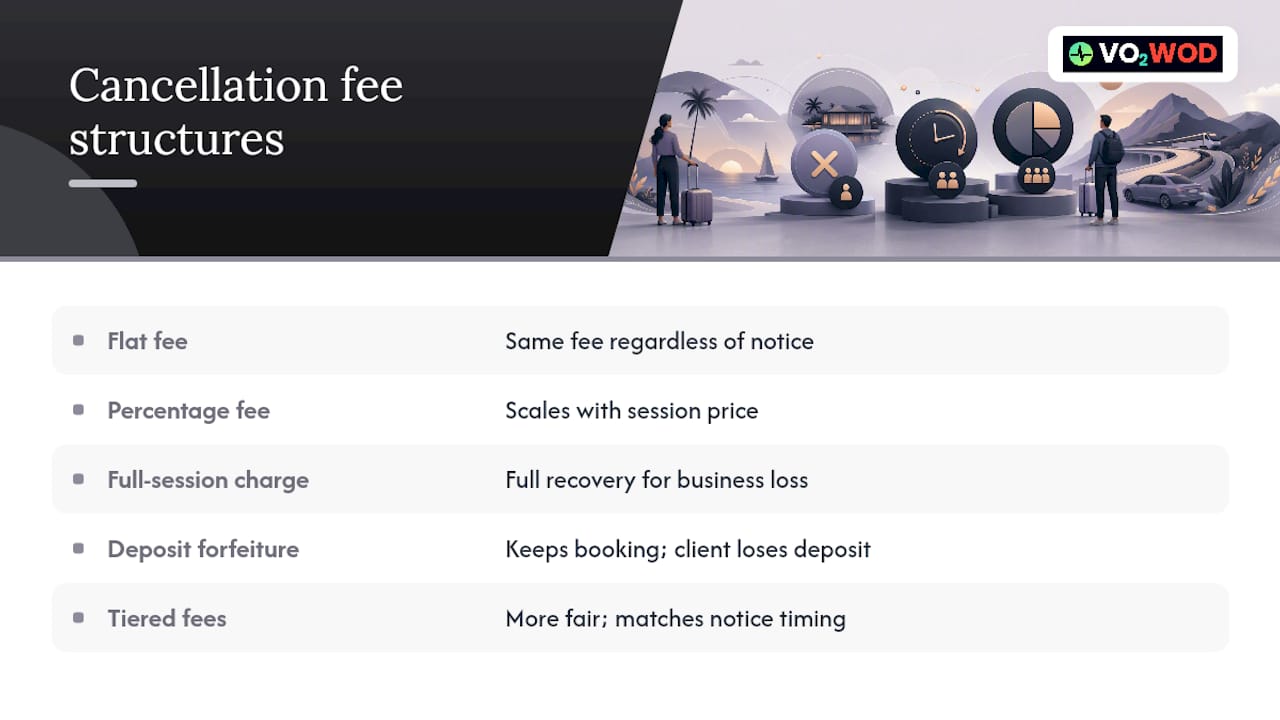
Tiered structures tend to age better than flat rules. A single 24-hour cutoff with one fee treats a cancellation at 23 hours the same as one at five minutes, which feels unfair to customers and leaves money on the table for businesses when the gap really is unrecoverable.
How Do You Write a Cancellation Policy People Actually Follow?
A policy only works if it's specific enough that nobody has to guess what happens next. Vague language like "please give advance notice" invites arguments. Specific language, spelled out in writing before someone books, prevents them.
Every enforceable policy needs six pieces:
- The notice window, stated in hours, not vague terms like "a day or so."
- The fee calculation, whether that's a flat amount, a percentage, or full price.
- Accepted cancellation methods, naming the exact channel (app, portal, phone line) that counts.
- Rescheduling rules, clarifying whether a reschedule dodges the fee or triggers a different one.
- Exceptions, naming what qualifies (medical emergency, provider error) and what proof is needed.
- Dispute instructions, telling the customer exactly who to contact and within what timeframe.
Here are three versions you can adapt directly, scaled by how much detail your business needs:
One-sentence version: "Cancellations made less than 24 hours before your appointment will be charged 50% of the service price."
Medium version: "We require 24 hours' notice to cancel or reschedule any appointment. Cancellations made within 24 hours are charged 50% of the session fee; no-shows are charged the full amount. Emergencies are reviewed case by case with documentation."
Detailed version: "Appointments canceled or rescheduled with at least 24 hours' notice incur no fee. Cancellations made less than 12 hours before, or no-shows, are charged the full session fee. Cancellations must be submitted through our online portal or by calling the front desk during business hours; texts and voicemails are not accepted as valid cancellation notice. Medical emergencies and provider-side scheduling errors are exempt with supporting documentation submitted within 48 hours. To dispute a charge, email billing@yourbusiness.com within seven days of the charge date."
Publish the policy everywhere someone could book: the booking page itself, the confirmation email, and ideally a checkout checkbox that requires active acknowledgment before payment. Requiring a visible acknowledgment at checkout is one of the simplest ways to cut down on "I never saw that" disputes later.
Pro Tip: Give front-desk staff one line of discretion they can use without asking a manager: "First-time cancellations inside the window get a one-time courtesy waiver." It costs you almost nothing and defuses most first-offense arguments before they escalate.
How Do You Enforce the Policy Without Constant Arguments?
Consistency is what actually protects a policy. The fastest way to lose customer trust isn't having a strict cancellation rule. It's applying that rule to some customers and quietly waiving it for others.
Automated reminders sent 24 to 48 hours before an appointment cut down on cancellations before they even happen, simply because people forget appointments more often than they deliberately blow them off. Pair that reminder with a one-click cancellation link, and you remove the friction that causes people to no-show instead of canceling properly, since a no-show is worse for everyone involved.

Letting booking software apply the timestamp and calculate the fee automatically, rather than leaving it to a staff member's judgment call in the moment, is what keeps enforcement fair. Framing the policy as a scheduling safeguard rather than a punishment also changes how customers receive it when a fee does apply.
Front-desk staff need scripts for the moments that actually happen:
- Inside the window, no issue: "You're all set, no charge for canceling with this much notice."
- Outside the window, first offense: "This falls inside our 24-hour policy, so a fee applies, but since this is your first time, we'll waive it this once."
- Outside the window, repeat: "This is inside the cancellation window, so the standard fee applies as outlined in your booking confirmation."
- Claimed emergency: "I'm sorry to hear that. Send documentation within 48 hours and we'll review the charge."
Pro Tip: Set your waitlist release clock to fire during hours people actually check their phones, not at 3:00 AM. A canceled 10:00 AM slot released to the waitlist at 7:00 AM has a far better shot at getting refilled than one released overnight.
What Counts as a Valid Exception, and How Do You Dispute a Fee?
Most providers recognize a short list of legitimate exceptions: documented medical emergencies, a death in the family, severe weather that closes roads or the business itself, and provider-side errors like double-booking. Proof usually means a doctor's note, a screenshot of a closure notice, or the business's own scheduling record showing the mistake was on their end.
If you were charged and believe it was unfair, work through these steps in order:
- Contact the provider directly and reference your exact cancellation timestamp, not just your memory of when you canceled.
- Request a formal review, ideally in writing, so there's a paper trail if you need to escalate.
- Escalate to the payment processor or platform if the business doesn't respond within a reasonable window, generally five to seven business days.
- File a dispute with your card issuer as a last resort if the provider and platform both fail to resolve it.
Refunds or reversals typically take one to two billing cycles to appear once approved, since most processors batch these transactions rather than processing them instantly.
Are Late Cancellation Fees Actually Legal to Charge?
Yes, generally, but only when the business handles disclosure correctly. U.S. rules require that material terms, including cancellation fees, be clear and conspicuous before a customer pays, which is why burying the fee in fine print or making cancellation harder than sign-up creates real legal exposure for the business, not just customer frustration.
The legal test that matters most is the difference between a reasonable fee and a punitive one. A cancellation fee holds up when it's specified in a written contract and reflects the business's actual likely loss; courts have refused to enforce fees that function as punishment rather than compensation for lost revenue.
Statistic callout: The FTC's general framework on clear and conspicuous disclosure, along with a growing number of state-level "click to cancel" rules, means cancellation methods increasingly have to be at least as easy as the sign-up process itself.
Practical compliance steps that keep a policy defensible:
- State the fee amount and trigger condition in plain language, not legal jargon.
- Require active acknowledgment (a checkbox, not a buried link) before charging anything.
- Keep the cancellation method as easy to use as the booking method.
- Base fee amounts on a real estimate of lost revenue, not a round number picked to discourage cancellations.
How Software Keeps Cancellation Rules Consistent
Manual enforcement is where most cancellation policies quietly fall apart. A staff member under pressure waives a fee for one customer and charges another for the identical situation, and now the business has a fairness problem it created for itself.
Booking software removes that inconsistency by timestamping every cancellation automatically and applying the fee rule the same way every time, with no room for an in-the-moment judgment call. Platforms built for functional fitness gyms, including Vo2wod, combine that automated timestamping with reminders, waitlist management, and one-tap rescheduling, all of which lower the raw number of late cancellations before fees even become a conversation. Automating exception handling rather than deciding case by case in real time is generally the most reliable way to keep enforcement consistent across every coach and every shift.
If you're moving from spreadsheets or an older system, migrating your existing cancellation history and policy settings matters, so the new platform enforces the same rules your members already expect. Three numbers worth tracking monthly once automation is in place:
- Late-cancel rate: the percentage of bookings canceled inside your notice window.
- Dispute rate: how many charged fees get contested.
- Collected fee total: how much of the built policy actually gets enforced versus waived.
A Fair Policy Protects Everyone, Not Just the Business
The instinct to make a cancellation policy as strict as possible is understandable, but it usually backfires. Customers who feel ambushed by a fee they never saw coming don't just dispute the charge, they leave and tell other people why. The policies that actually hold up over time are specific, visible before payment, and applied the same way for every single customer.
Start most appointment-based businesses at a 24-hour baseline, then tier upward for anything genuinely hard to refill, a specialized session, a high-demand time slot, a solo provider with no backup client waiting. Automation and a visible disclosure at booking do more to prevent conflict than any strongly worded policy paragraph ever will. The businesses with the fewest disputes aren't the ones with the harshest rules. They're the ones where nobody is ever surprised.
— Marcus
Sources
- Cancellation policy: practical terms for US digital businesses — Sprintlaw
- How to Create a Cancellation Policy for Small Business Templates + Examples — Thryv
- Can a Contractor Charge a Cancellation Fee? Know Your Rights — LegalClarity
- Last-minute cancellation policy: how to protect the schedule without sounding harsh — Solvea