

Heart rate zones are intensity bands, usually five of them, tied to a percentage of your maximum or reserve heart rate. Each zone corresponds to a specific training goal, from recovery to VO2max, and using them turns guesswork into a repeatable system. Start by picking a calculation method below, then check your numbers against how hard the effort actually feels using RPE or the talk test.
TL;DR:
- Using the Karvonen method with resting heart rate yields more personalized and accurate heart rate zones for most individuals.
- Heart rate monitors on wrist devices tend to lag during rapid effort changes, so chest straps provide more reliable data during high-intensity intervals.
- Training primarily in Zones 1 and 2 promotes mitochondrial growth and fat oxidation, while Zones 4 and 5 induce faster but short-lived fitness gains.
- Relying solely on age-based formulas can misrepresent true max heart rate, especially for those with atypical resting heart rates or at higher ages.
- Avoid consistently training in Zone 3, as it causes fatigue without maximizing either aerobic or threshold adaptations, limiting long-term progress.
Table of Contents
- What Heart Rate Zones Training Actually Targets
- How to Calculate Your Heart Rate Zones
- Wearables, Chest Straps, and Getting Accurate Readings
- Building a Weekly Plan Around Your Zones
- Cautions, Warning Signs, and When to Retest
- How Coaches And Gyms Apply Zone Monitoring In Group Classes
- Combining Heart Rate Zones With Other Training
- What Each Zone Actually Changes in Your Body
- Mistakes That Undermine Heart Rate Zone Training
- Altitude, Illness, and Adjusting Your Zones
- Why Balanced Zone Training Beats Constant Intensity
- Sources
What Heart Rate Zones Training Actually Targets
Each of the five zones asks something different of your body, and knowing the difference is what separates structured training from just moving fast until you're tired. Cleveland Clinic frames the zones as bands running from roughly 50% to 100% of max heart rate (MHR), each tied to a distinct physiological outcome.
Here's how the five zones break down in practice:
- Zone 1 (50 to 60% MHR): Recovery pace. You can hold a full conversation without pausing for breath. Used for warm-ups, cooldowns, and active recovery days.
- Zone 2 (60 to 70% MHR): Aerobic base. Talking is still easy but you notice your breathing. This is the zone for long, easy runs or rides that build mitochondrial density and fat oxidation over time.
- Zone 3 (70 to 80% MHR): Tempo. Conversation gets choppy, sentences shorten. This is "comfortably hard," the pace you could sustain for 30 to 60 minutes but wouldn't choose to.
- Zone 4 (80 to 90% MHR): Threshold. You can manage single words, not sentences. This is where lactate starts accumulating faster than your body clears it, and it's the zone most associated with race-pace training.
- Zone 5 (90 to 100% MHR): VO2max. Talking is out of the question. Sessions here are short, hard intervals, with full recovery between reps.
Polar's guide to the five zones lines up closely with this breakdown and is worth checking if your device uses slightly different labels. Rate of perceived exertion (RPE) on a 1 to 10 scale maps well onto these bands too: Zone 1 feels like a 2 or 3, Zone 3 sits around 5 to 6, and Zone 5 is a 9 or 10. Harvard Health Publishing recommends pairing RPE with heart rate specifically because it catches days when your heart rate runs high or low for reasons that have nothing to do with fitness, like poor sleep or heat.
How to Calculate Your Heart Rate Zones
Three methods dominate real-world coaching, and they trade off simplicity against accuracy. Pick based on how much effort you're willing to put in versus how precise you need the numbers to be.
- Age-based (220 minus age). Subtract your age from 220 to estimate MHR, then multiply by each zone's percentage. A 40-year-old gets an estimated MHR of 180. It's fast, requires no equipment, and may be off by several beats in either direction for any given person.
- Tanaka formula (208 minus 0.7 times age). Research-derived and generally considered a better population-level estimate than the 220 formula, especially for older adults. Same 40-year-old: 208 minus (0.7 times 40) equals 180, which happens to match here but diverges more at older ages.
- Karvonen / Heart Rate Reserve (HRR). This is the one McMillan Running highlights as more personalized because it factors in your resting heart rate, not just your age. The formula: Target HR equals ((MHR minus resting HR) times zone percentage) plus resting HR.
Pro Tip: Take your resting heart rate first thing in the morning, before coffee, before checking your phone, ideally averaged over three days for a stable number.
Here's the Karvonen math worked out. Say you're 40 with an estimated MHR of 180 and a resting HR of 60. Your heart rate reserve is 180 minus 60, or 120 beats.
HRR shifts the numbers meaningfully. For a fit person with a low resting heart rate, the Karvonen method typically produces higher zone floors than the simple percentage-of-max approach, which is why serious runners and cyclists tend to prefer it.
For readers who want a field-tested anchor rather than a formula, lactate threshold heart rate (LTHR) and the MAF (Maximum Aerobic Function) method both use real performance data instead of estimates. LTHR usually comes from a 30-minute time-trial effort where your average heart rate over the last 20 minutes approximates threshold. MAF asks you to hold 180 minus your age (with adjustments for health history) for extended aerobic sessions and track pace improvement at that fixed heart rate over months.
If you're just starting out, use Karvonen. It takes five extra minutes and produces numbers you'll actually trust once you start training with them.
Wearables, Chest Straps, and Getting Accurate Readings
Not all heart rate data is created equal, and the gap matters most exactly when you need it least: during hard intervals. Runner's World notes that wrist-based optical sensors lag behind actual heart rate during rapid changes, which is precisely what happens when you surge into a Zone 5 interval or recover hard into Zone 1.
Chest straps read electrical activity directly off your skin, the same principle as an EKG, and respond to sudden changes faster than optical sensors, which often have a lag.
A few habits fix most of the accuracy problems people run into:
- Wet the electrode pads on a chest strap before putting it on; dry contact gives spotty readings for the first few minutes.
- Wear wrist optical sensors higher up the forearm, not directly over the wrist bone, and snug but not tight.
- Update your device's firmware and confirm the paired app synced your latest workout before trusting the summary numbers.
- Check resting heart rate at the same time each morning; a spike of 5 to 10 beats above your baseline is often the first sign your body is under stress.
Heat, dehydration, caffeine, and certain medications can all affect heart rate readings independent of effort. On days when the numbers seem to disagree with how you feel, trust the talk test or RPE instead of chasing a target number that heat or a poor night's sleep has thrown off.
Building a Weekly Plan Around Your Zones
Most of your training should feel easy. That's not a hedge, it's the actual model elite endurance coaches use. Runner's World describes the polarized approach as emphasizing mostly easy training in Zones 1 and 2, with a smaller portion of genuinely hard Zone 4 and 5 work, and minimal time spent in the intermediate Zone 3.
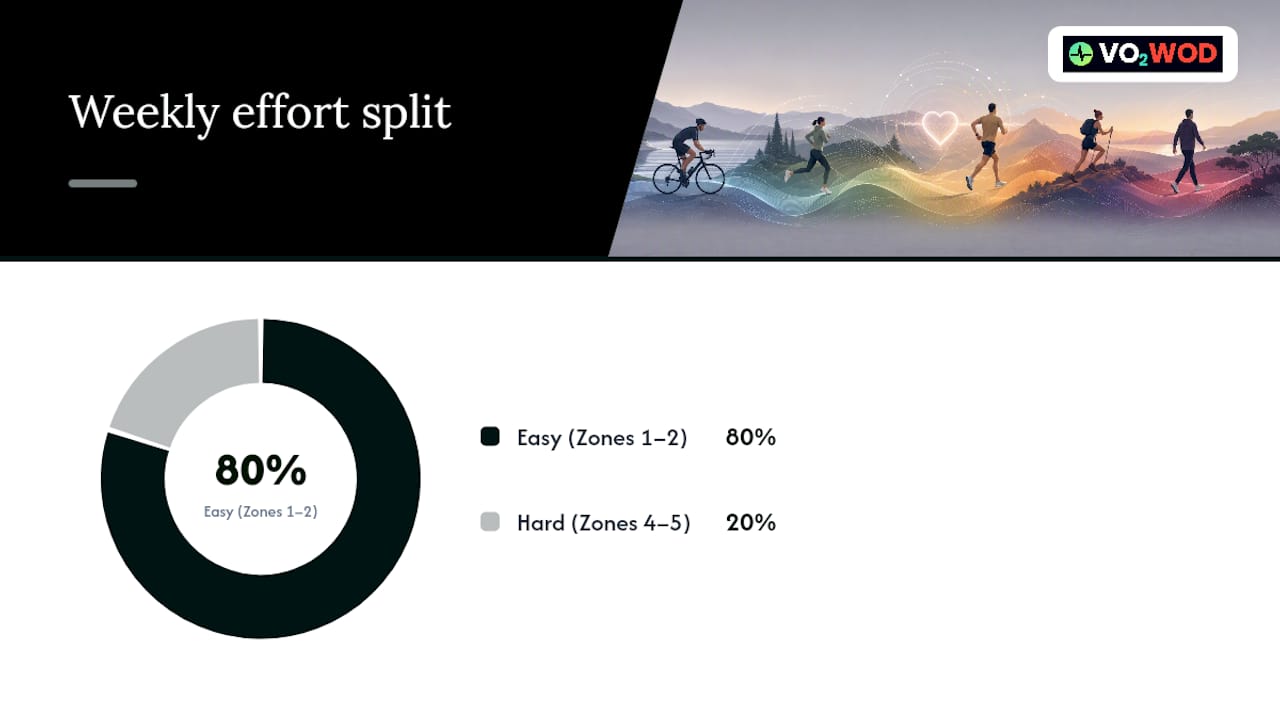
That gray zone is the trap. Zone 3 feels productive because you're breathing hard, but it's too easy to build real threshold fitness and too hard to recover from quickly, so it just accumulates fatigue without a clear payoff.
Here's how that translates into actual sessions:
- Recovery session (Zone 1, 20 to 30 minutes): Easy spin, walk, or jog. Purpose is blood flow, not fitness gain. If your heart rate creeps into Zone 2, slow down.
- Long aerobic session (Zone 2, 45 to 90 minutes): The backbone of the week. Should feel almost too easy for the first 15 minutes. This is where fat oxidation and capillary density improve.
- Tempo session (Zone 3, 20 to 40 minutes continuous): Used sparingly, maybe once every 10 to 14 days, to bridge aerobic and threshold work.
- Threshold intervals (Zone 4, 4 to 6 reps of 4 to 8 minutes): Rest 2 to 3 minutes between reps. Pace by heart rate target and time, not by speed, since speed drifts with fatigue, terrain, and weather.
- VO2max intervals (Zone 5, 6 to 10 reps of 30 seconds to 3 minutes): Full recovery between reps, often equal to or longer than the work interval.
A beginner's week might run three sessions: two Zone 2 efforts of 30 to 40 minutes and one short Zone 4 session with three 4 minute intervals. An intermediate week scales to five sessions: three Zone 2 days, one tempo day, and one interval day mixing Zone 4 and Zone 5 work, still keeping the 80/20 easy-to-hard ratio intact across the week.
Cautions, Warning Signs, and When to Retest
Your heart rate tells you when you've pushed too far, if you're paying attention. Watch for a resting heart rate elevated above your normal baseline for several mornings in a row, combined with poor sleep and a drop in performance at paces that used to feel manageable. That combination is the clearest signal of accumulated fatigue.
- Skip max-effort field tests if you're sick, dehydrated, or new to structured exercise; talk to a physician first if you have any cardiac risk factors.
- Heat and dehydration both push heart rate up at a given pace, so slow down and trust RPE over the number on race day or in a heat wave.
- McMillan recommends retesting your zones every 6 to 8 weeks or after any meaningful fitness shift, since resting heart rate drops as aerobic fitness improves.
- A simple retest can be a 20 to 30 minute steady effort rather than a full max-effort test.
How Coaches And Gyms Apply Zone Monitoring In Group Classes
Coaching a room of 15 athletes at wildly different fitness levels used to mean guessing who was actually working at threshold and who was cruising. Live biometric monitoring solves that by putting real heart rate data on a screen the coach can see mid-class, not after the fact.
Vo2wod builds this directly into gym management software with real-time heart rate tracking synced to wearables from Garmin, Apple, Fitbit, and Samsung, so a coach can call out a member drifting below their target zone without interrupting the whole class. The platform also automates workout scoring, which removes the manual data entry that usually keeps coaches from tracking zone-based progress over time. Gyms switching over get free data migration, one month of complimentary service, and dedicated support through the transition, addressing the biggest reason gym owners hesitate to change management software in the first place.
Combining Heart Rate Zones With Other Training
Zone training isn't a replacement for interval work or strength training, it's the framework that makes both of them precise. When you run interval repeats, heart rate zones tell you whether you actually hit VO2max intensity or just ran fast without reaching the physiological target the interval was designed for.
Strength training complicates the picture because heart rate response during lifting doesn't map cleanly onto the same zones built for steady cardio. A heavy squat set can spike your heart rate into Zone 4 territory for reasons that have nothing to do with aerobic conditioning, mostly the Valsalva maneuver and short bursts of maximal muscular effort. Don't judge lifting intensity by heart rate the way you'd judge a bike interval.
The practical approach: use zones to structure your cardio work, then schedule strength sessions on separate days from your hardest Zone 4 and 5 cardio sessions, or at minimum keep them apart within the same day with several hours between. Stacking a heavy lower-body lift on top of a threshold run day compounds fatigue in ways that show up as an elevated resting heart rate the next morning.
For athletes doing both regularly, a common pattern is two to three quality cardio sessions (one threshold or VO2max, the rest easy) alongside two to three strength sessions, with at least one full recovery day where heart rate stays in Zone 1 territory or you skip structured training entirely.
What Each Zone Actually Changes in Your Body
Zone 1 and 2 work drives mitochondrial growth inside muscle cells and increases capillary density, the network of small blood vessels that deliver oxygen to working muscle. This is slow-building fitness. You won't feel it after one session, but after eight to twelve weeks of consistent Zone 2 volume, your pace at a given heart rate typically improves noticeably, a marker coaches call aerobic decoupling improvement.

Zone 3 sits at the edge of what's often called the "gray zone" precisely because the adaptations here overlap with both aerobic base work and threshold training without maximizing either. It has a place, just not a large one.
Zone 4 training raises your lactate threshold, meaning you can sustain a faster pace before lactate starts accumulating faster than your body clears it. This is the zone most closely tied to race performance improvements in events lasting 20 minutes to 2 hours.
Zone 5 work targets VO2max directly, the maximum rate your body can use oxygen during exercise. These adaptations come fastest but also fade fastest without maintenance, which is part of why the polarized model keeps Zone 5 volume intentionally small and concentrated rather than spread across every session.
Mistakes That Undermine Heart Rate Zone Training
The single most common mistake is running every easy day in Zone 3 instead of Zone 2. It feels like you're working harder, which feels productive, but it accumulates fatigue without building the aerobic base that easier, more patient training would.
Relying on a single age-based formula without ever adjusting it is another frequent error, particularly for people whose resting heart rate is unusually low or high relative to their age group. Two 45-year-olds can have genuinely different max heart rates and reserve capacities; using an identical 220-minus-age number for both ignores that variation entirely.
Ignoring day-to-day context is a subtler pitfall. Heart rate that runs 10 beats higher than usual on a hot, humid morning doesn't mean your fitness dropped, it means the environment is taxing your cardiovascular system more for the same output. Training strictly to the number on a day like that just pushes you into unnecessary fatigue.
Finally, some people never retest, running the same zone numbers for years even as fitness (and resting heart rate) changes. Zones calculated when you started training six months ago may no longer reflect where your actual thresholds sit today.
Altitude, Illness, and Adjusting Your Zones
Heart rate behaves differently at altitude because lower oxygen availability forces your heart to work harder at any given pace to deliver the same amount of oxygen to working muscle. Expect your heart rate to run higher than at sea level for the same perceived effort during the first weeks at elevation, gradually normalizing as partial acclimatization sets in. Training by pace at altitude is misleading; training by heart rate zone, or better yet by RPE, keeps effort honest even as the numbers shift.
Illness, even a mild cold, elevates resting heart rate and blunts your ability to reach normal peak heart rates during hard efforts. Pushing into Zone 4 or 5 while sick, or in the days right after, extends recovery time and can worsen the illness. The safer approach is to drop to Zone 1 and 2 work only until resting heart rate returns to baseline for at least two consecutive mornings.
Why Balanced Zone Training Beats Constant Intensity
The instinct to go hard every session is understandable, and it's also the fastest route to a plateau. A plan weighted toward Zone 1 and 2, with hard efforts used deliberately rather than constantly, produces better long-term results because it lets adaptation happen instead of just accumulating fatigue.
Treat your zones as guardrails, not a scoreboard. Recovery is where fitness actually gets built. Pick a calculation method today, train with it, and reassess in six to eight weeks.
— Marcus
Sources
- What To Know About Exercise and Heart Rate Zones — Cleveland Clinic
- Understanding exercise heart rate zones — Harvard Health Publishing
- Heart rate training (Runner's World)
- How to Calculate Heart Rate Zones: 3 Methods | McMillan Running
- Heart Rate Zones | Polar
Gym owners exploring live heart rate monitoring for group coaching can compare options on the Vo2wod alternatives page, or see the full feature set at Vo2wod.
This article is general information, not a substitute for advice from a qualified doctor. Consult a qualified healthcare professional about your own circumstances before acting on anything here.