
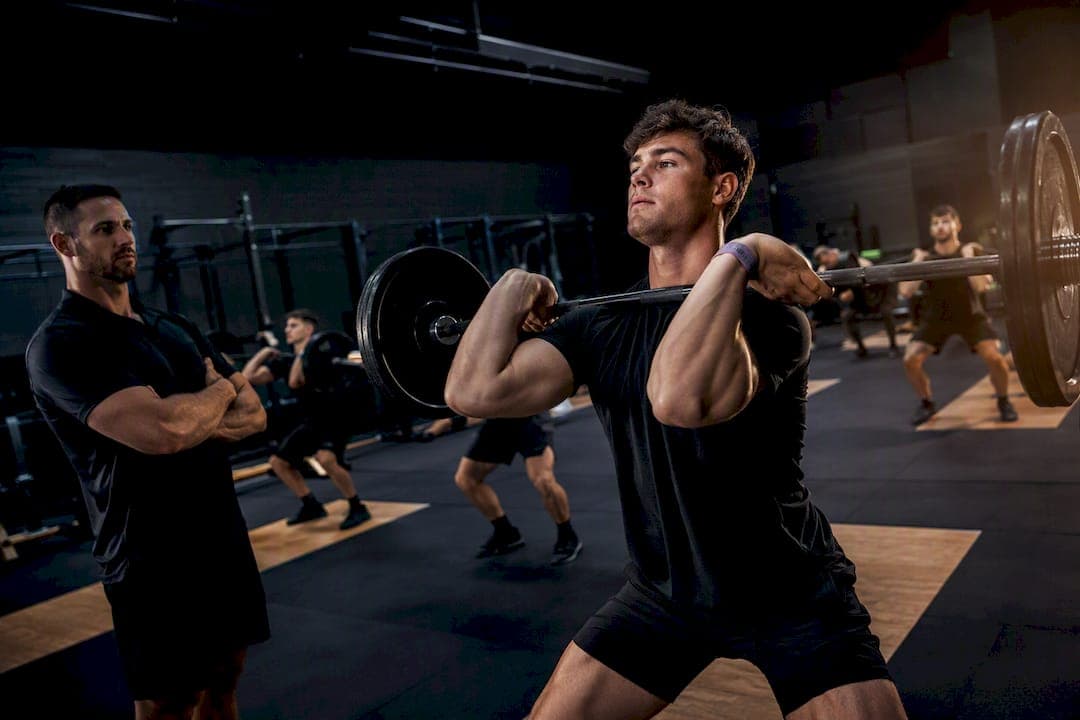
The right coach to athlete ratio starts at roughly 1 coach per 10 athletes in junior high, 1 per 15 in high school, and 1 per 20 in college, according to NSCA standards. Those numbers are a floor, not a target: tighten them for younger athletes, novice lifters, complex barbell movements, or contact sports, and document your reasoning the way a peer-reviewed supervision study and OCR/Title IX guidance both suggest you should.
TL;DR:
- Coaches should adjust ratios based on athlete age, skill level, sport contact, and lift complexity, often tightening group sizes from baseline standards.
- Small-group training for technical lifts and youth athletes should be limited to 6 to 8 athletes per coach to ensure proper correction and safety.
- Tighter supervision ratios are especially critical for high-risk lifts like Olympic-style movements, with recommended drops from 20 to 12 athletes per coach in college.
- Staff scheduling and population management are key, as it is possible to meet ratios on paper while running unsafe practices if multiple cohorts overlap in the same space.
- Software tools that track attendance and coaching presence can help verify compliance and improve enforcement of staffing ratios throughout the season.
Table of Contents
- What Is the Ideal Coach to Athlete Ratio at Each Level?
- How Do You Adjust Ratios by Age, Skill, and Sport?
- Why Do Complex Lifts and High-Risk Training Need Tighter Ratios?
- How Does Title IX Affect Coach Staffing Decisions?
- How Do You Calculate the Coaches You Actually Need?
- What Does the Research Actually Support?
- What Coaches Actually Get Wrong About Ratios
- How Software Helps You Actually Enforce Your Staffing Plan
- Sources
- FAQ
What Is the Ideal Coach to Athlete Ratio at Each Level?
The numbers below come from NSCA's professional standards, which treat coach counts as a safety and liability issue as much as a coaching-quality one. Think of them as the minimum staffing you'd want to defend in a facility audit or after an injury report, not the staffing you'd choose if budget were unlimited.
| Setting | Recommended Ratio | Notes |
|---|---|---|
| Junior high | About 1:10 | Tighten for first-year lifters or contact sports |
| High school | About 1:15 | Tighten to about 1:10 or below for novice weight rooms |
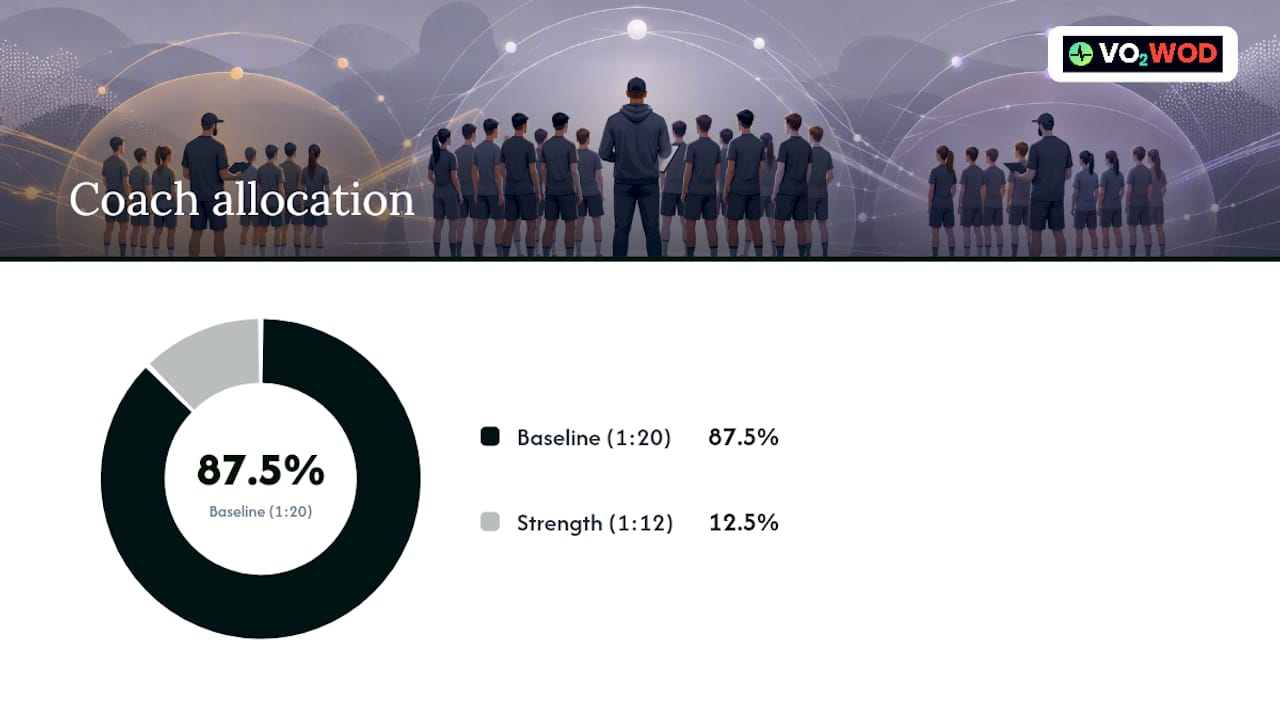
| College | About 1:20 | Tighten to about 1:12 for technical/complex lifts |
| Elite/academy programs | Often tighter than about 1:10 | Higher injury stakes and technical demand justify smaller groups |
| Clinical/rehab settings | Typically between 1:1 and 1:4 | Individualized progression and monitoring required |
A few conditions override the baseline every time, illustrating the role of coaching in tennis matches and other sports where coaching needs vary significantly:
- Age: younger athletes need closer supervision regardless of sport.
- Skill level: novices in any age group require tighter ratios than experienced athletes doing the same drill.
- Contact or collision sports: football, wrestling, and rugby carry injury profiles that justify smaller groups per coach.
- Complex lifts: Olympic-style lifts and heavy barbell work demand closer one-on-one attention than machine-based circuits.
- Volunteer staff: unpaid volunteer coaches are generally excluded when calculating compliance ratios for Title IX purposes, even though they may still count for practical supervision.
How Do You Adjust Ratios by Age, Skill, and Sport?
Baseline numbers describe an entire program, not a single practice session. The real staffing decision happens at the station or drill level, where group size drives how much correction each athlete actually gets.
- Highly technical small-group work: cap groups at 6 to 8 athletes per coach. That range comes from small-group training research often called the 10-minute rule, the idea that a coach can only give meaningful individual feedback to about that many people inside a 60-minute session.
- Beginner or youth cohorts: cut group size roughly in half compared to what you'd run for advanced athletes doing the same drill.
- Multi-station team practice: split a 60-athlete roster across four stations of 15 with one coach per station, then rotate a lead coach through all four to spot-check technique.
- Position groups: a 22-player football roster split into offensive line, skill positions, and defensive line naturally creates three groups of 6 to 9, close to the ideal small-group range without any extra planning.
- Rehab and specialist clinics: these run far tighter than any team-sport ratio, often 1:1 to 1:3, because load progression has to be monitored in real time.
Run the math before the season starts, not after an injury forces the question.
Why Do Complex Lifts and High-Risk Training Need Tighter Ratios?
NSCA standards single out technical barbell movements as the clearest case for cutting group size. A college program running a general strength class at 1:20 should drop closer to 1:12 for cleans, snatches, and other technical lifts, according to NSCA's full standards document. The reasoning is straightforward: a missed cue on a back squat rarely ends a season, but a missed cue on a heavy clean pull can.
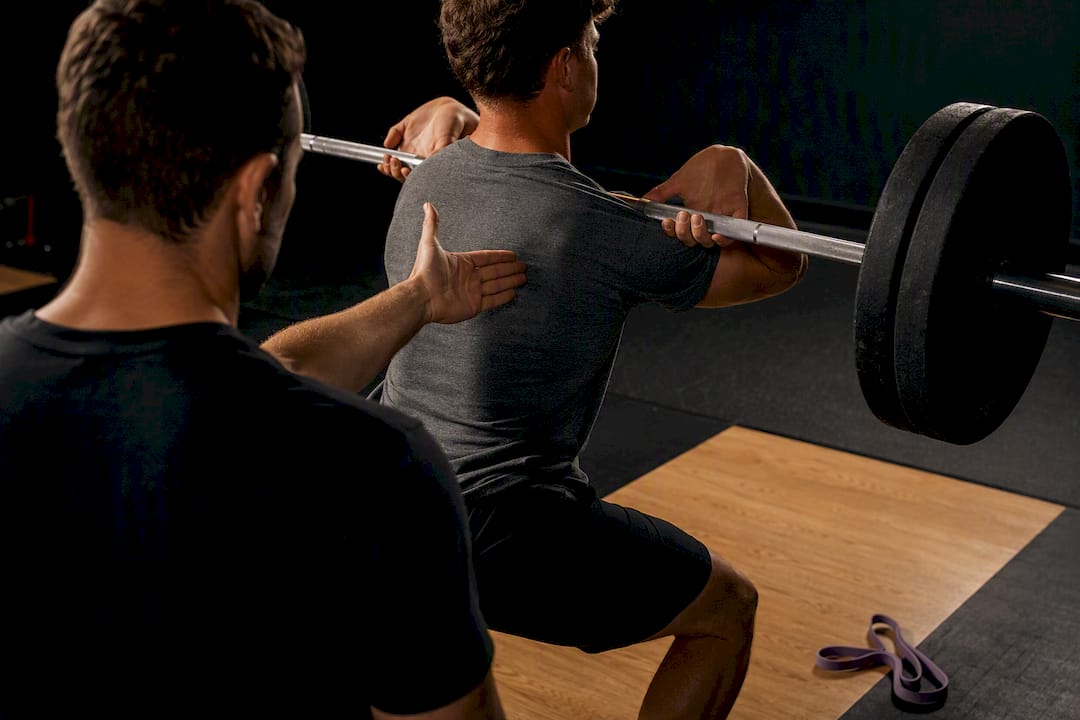
Facility planning backs the same logic. The NSCA site-evaluation worksheet ties minimum floor space, roughly 100 square feet per participant, and training-station counts directly to how many athletes one coach can safely watch at once. More stations packed into the same square footage means either more coaches or smaller groups per rack.
A randomized trial found athletes supervised at a 1:5 ratio posted greater strength gains and trained at higher intensity than a matched group supervised at 1:25, over an 11-week resistance training program. That gap isn't just about safety. Coaches watching fewer lifters push loads harder because they can correct form in real time instead of scanning a crowded weight room.
- Reduce group size for any lift involving a barbell overhead or behind the neck.
- Add a spotter or second coach for max-effort attempts, regardless of the baseline ratio.
- Treat plyometric and speed work involving deceleration as higher risk than steady-state conditioning.
How Does Title IX Affect Coach Staffing Decisions?
Coach counts aren't just a safety question. The Office for Civil Rights evaluates coach availability, contact time, and compensation as part of equitable athletic opportunity between men's and women's programs, and raw headcounts alone won't satisfy that test.
Run an internal audit before OCR ever asks for one:
- Count paid coaching FTEs by sport, not just bodies on a sideline.
- Compare contact hours and season length across men's and women's programs with similar participation numbers.
- Check compensation and stipends as a proportion of roster size, not a flat number per sport.
- Note where volunteer coaches fill gaps, since volunteers are typically excluded from formal compliance counts unless they receive incentives.
Pro Tip: Document every staffing decision with a reason attached, even a good one.
When a gap shows up, the fix is usually budget reallocation rather than headcount growth: shift an assistant position, adjust a stipend line, or restructure practice blocks so contact time evens out.
How Do You Calculate the Coaches You Actually Need?
Staffing math gets simple once you fix the inputs. You need: athlete headcount by cohort, sessions per week, session length, peak-overlap windows, an activity-risk multiplier, and whether volunteers count toward your ratio.
- Divide athlete headcount by your target ratio for that cohort's risk level (1:10, 1:15, 1:20, or tighter).
- Multiply by an overlap factor if multiple cohorts train at the same time in the same space.
- Round up, never down, when a session mixes skill levels or includes complex lifts.
- Convert the coach count into FTE hours by multiplying sessions per week by session length, then dividing by a full-time coach's available hours.
Scholastic example: 90 high school athletes at 1:15 need 6 coaches for practice. If weight room sessions involve technical lifts, tighten to 1:12, pushing the requirement to 8 coaches for that block alone.
Collegiate example: 140 athletes across three overlapping team practices at 1:20 need 7 coaches minimum, plus one additional strength coach dedicated to Olympic-lift instruction at a 1:12 ratio.
Once you have coach FTEs, converting to a budget line is a matter of multiplying by your standard stipend or salary rate and prioritizing hires around whichever cohort carries the highest injury risk or the widest Title IX gap.
What Does the Research Actually Support?
The strongest empirical support for tighter ratios comes from a controlled comparison showing greater strength gains and higher training intensity at a 1:5 supervision ratio than at 1:25, over an 11-week program. NSCA's own standards translate that finding into operational numbers: 1:10 for junior high, 1:15 for high school, 1:20 for college, tightened further for complex lifts.
- The evidence base is thin outside strength training, with few controlled trials covering team-sport skill instruction directly.
- Ratios that work for a swim team don't automatically transfer to a wrestling room, so context and coach judgment still matter.
- Sources cited here lean on published standards, one peer-reviewed trial, and federal guidance rather than marketing claims or anecdote.
Treat the numbers as a starting point that professional judgment refines, not a rule that removes judgment entirely.
What Coaches Actually Get Wrong About Ratios
Most programs treat coach to athlete ratio as a hiring problem when it's really a scheduling problem. You can hit every NSCA benchmark on paper and still run an unsafe weight room if three cohorts train at the same time in the same space with staggered risk levels.
The three things worth protecting even on a tight budget: supervision density for anything involving a loaded barbell overhead, Title IX parity in contact hours and stipends, and small-group ratios for skill work with athletes under 16. Everything else, from uniform budgets to travel logistics, can flex. Those three can't, because the cost of getting them wrong (an injury, a compliance finding, a kid who never develops technique) outlasts whatever you saved on payroll.
— Marcus
How Software Helps You Actually Enforce Your Staffing Plan
Setting a ratio on paper is easy. Proving you held it every session, for every cohort, all season, is where most programs fall apart during a compliance review or after an injury claim. Some gym management platforms give owners and program managers a way to verify staffing decisions instead of guessing at them after the fact.

Some platforms track class attendance, biometric data, and workout scoring in real time, allowing review of athlete and coach presence during sessions. They may also offer data migration and trial periods to ease switching without losing historical attendance and performance records. If you're currently comparing options, the Vo2wod alternatives page breaks down how it stacks up against other gym management tools, and the full feature overview shows what onboarding looks like from day one. Start by pulling your current attendance data and mapping it against your ratio targets.
Sources
- NSCA Strength and Conditioning Professional Standards and Guidelines (Executive Summary)
- Influence of supervision ratio on muscle adaptations to resistance training in nontrained subjects (J Strength Cond Res, 2010)
- Why group size matters | FORM
FAQ
What Is the 70/30 Rule in Coaching?
The 70/30 rule generally refers to coaches spending roughly 70% of session time on athlete-led activity and feedback and 30% on direct instruction, though exact splits vary by sport and skill level.
What Is the 4-2-1 Rule for Athletes?
Definitions of the 4-2-1 rule vary across training programs, and it isn't part of the NSCA supervision standards covered in this guide, so check with your specific program's methodology before applying it.
What Is the 80/20 Rule in Coaching?
The 80/20 rule typically describes the idea that roughly 80% of an athlete's development comes from a small set of high-value drills or habits, prioritizing depth over breadth in practice design.
Is There a Power Imbalance Between a Coach and an Athlete?
Yes, coaching relationships involve an inherent power imbalance because coaches control playing time, feedback, and advancement, which is part of why OCR/Title IX guidance treats coaching access and quality as equity issues, not just staffing numbers.
What Coach to Athlete Ratio Should a High School Weight Room Use?
NSCA recommends 1:15 as the baseline for high school settings, tightened to roughly 1:10 or lower for novice lifters or complex barbell movements.
Can Software Help Track Whether We're Meeting Our Ratio Targets?
Yes, platforms like Vo2wod log attendance and session data in real time, giving program managers a documented record to compare against NSCA and Title IX staffing targets.