
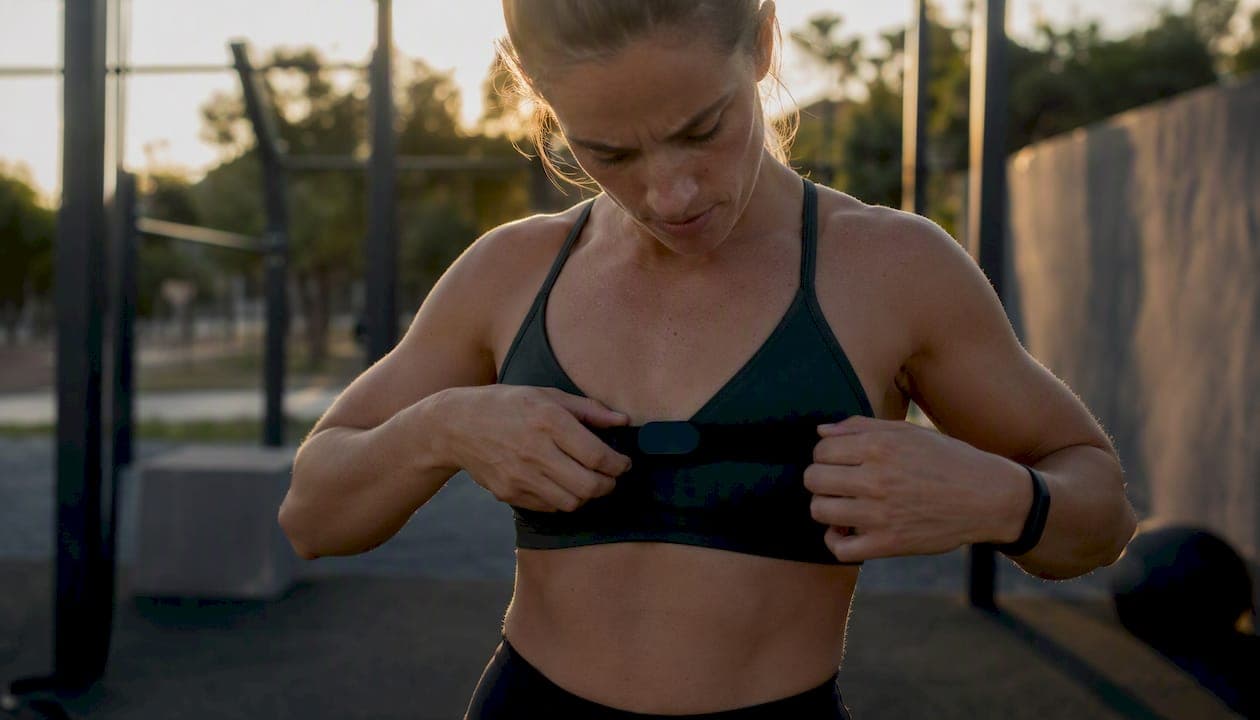
For athletes who need training-grade heart-rate data, a chest strap generally provides the most accurate heart rate data. Watches are adequate for daily trends and general awareness, though their readings may lag during intense activity. Optical armbands offer a compromise, often approaching strap-level accuracy without the chest hardware.
TL;DR:
- Chest straps are nearly perfect in accuracy, with a correlation coefficient of 0.99 against ECG, making them ideal for high-intensity interval training and recovery monitoring.
- Wrist devices using optical sensors show wider variability, with the best only reaching an rc of 0.89 and errors up to 15 bpm during intense movements.
- Placing optical sensors on the forearm or upper arm reduces error margins significantly, improving reliability during activities like running or cycling.
- For periodic validation, cross-check device readings against a chest strap during warm-up and intervals to ensure accuracy, especially in high-demand workouts.
- Gyms using chest straps for high-intensity classes get the most reliable effort data, while watches suffice for steady-state cardio and general tracking.
Table of Contents
- Chest Strap vs. Watch Heart Rate: A Quick Comparison
- How Chest Straps and Watches Actually Measure Your Heartbeat
- What the Research Says About Chest Strap Accuracy
- Which Sensor Fits Your Training Goal
- Does Sensor Placement Change Accuracy That Much?
- How to Get Cleaner Heart Rate Data From Any Device
- How Gyms Put Wearable Heart Rate Data to Work
- An Athlete's Honest Take on Strap vs. Watch
- Get More Out of Wearable Heart Rate Data in Your Gym
- Sources
Chest Strap vs. Watch Heart Rate: A Quick Comparison
The decision usually comes down to four factors: how fast the sensor reacts, how comfortable it is over hours of wear, how it holds up during violent movement, and whether it talks to your gym's display or head unit.
- Accuracy and response time: Chest straps lead by a wide margin. Armbands come close during steady efforts. Wristwatches lag and swing the most, especially during sprints or lifting.
- Comfort: Watches win for all-day wear. Armbands are a close second. Chest straps are the most accurate but the most likely to be forgotten in a gym bag.
- Best use case: Chest strap for intervals and testing. Watch for long steady runs and sleep tracking. Armband when you want strap-level trust without the strap.
- Connectivity: Most chest straps broadcast on both ANT+ and Bluetooth, which covers nearly every gym display, bike computer, and class-scoring system. Confirm compatibility before buying if your gym's platform is picky about protocols.
Nobody needs all three devices, but plenty of serious athletes end up owning two.
How Chest Straps and Watches Actually Measure Your Heartbeat
A chest strap works like a simplified electrocardiogram (ECG). Two electrodes press against your skin and pick up the electrical signal your heart generates with every beat, the same signal a hospital monitor reads, just without the twelve leads. That direct detection method is why chest straps respond almost instantly and rarely get confused.
Watches and armbands use photoplethysmography (PPG): an LED shines light into the skin, and a sensor measures how much bounces back as blood volume changes with each pulse. It is a clever workaround, but it is indirect. Movement, sweat, tattoo ink, skin tone, and even how tight the band sits can distort the optical signal. Add rapid arm motion into a burpee or a barbell clean, and the algorithm has to guess. On your screen, that guesswork shows up as spikes, sudden dropouts, or a heart rate that visibly lags a few seconds behind reality during a hard interval.
What the Research Says About Chest Strap Accuracy
The numbers back up what your eyes already tell you during a sprint set. Clinical testing on chest straps like the Polar H7 and Polar H10 found a concordance correlation coefficient (rc) of roughly 0.99 against ECG. That is about as close to a perfect match as wearable tech gets. Wrist devices in the same body of research showed rc values ranging from 0.52 to 0.89 depending on the device and activity, a much wider and less predictable spread.
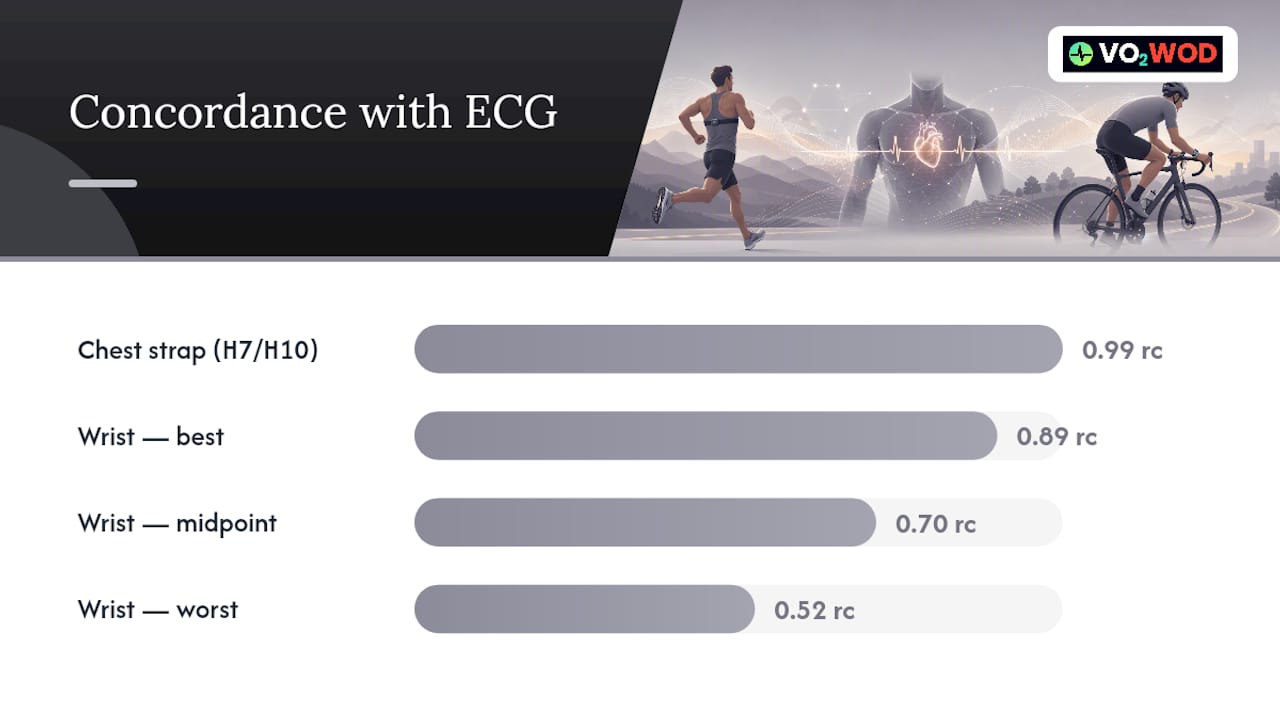
By the numbers: Chest straps hit an rc of about 0.99 against ECG across rest, treadmill, and cycling trials. Wrist-worn PPG devices, tested under the same conditions, ranged from 0.52 to 0.89. That gap is the difference between a device you can trust mid-interval and one you have to double-check.
Separate testing on wrist PPG prototypes found a mean absolute error of 3 beats per minute or less across many activities, which sounds solid until you look at the limits of agreement, the range where 95% of real-world readings actually fall. In some gym-style movements, that range widened to roughly plus or minus 15 bpm. A 15 bpm swing is the difference between training in Zone 2 and unknowingly redlining in Zone 5.
Proximal placements, meaning the forearm or upper arm instead of the wrist, tell a better story. Because the tissue there moves less and sits closer to major arteries, error rates drop and limits of agreement tighten considerably compared to wrist placement, even though some overestimation during max-effort intervals still shows up. For zone-based training, that ±5 to ±10 bpm spread from a wrist device is enough to nudge you into the wrong zone during a threshold set without you ever knowing it.
Which Sensor Fits Your Training Goal
Match the device to what you are actually trying to measure, not just what is comfortable.
- Structured intervals, HRV tracking, and recovery analytics. Use a chest strap. The direct electrical signal keeps pace with rapid heart-rate swings, which matters when you are pacing a 400-meter repeat or reading recovery between sets.
- Indoor cycling and trainer sessions. Chest straps remain the top choice because vibration and hand position on the bars can throw off wrist PPG. An armband is an acceptable backup if a strap feels restrictive during long rides.
- Long steady runs, daily tracking, and sleep. A watch is genuinely fine here. Steady-state cardio is where wrist PPG performs closest to its rated accuracy, and you get sleep and daily trend data as a bonus.
- Cardiac rehab or clinical monitoring. Stick with electrode-based chest monitoring and follow your clinician's guidance directly. This is not a place to substitute consumer-grade optical tracking.
If you only own one device, a chest strap covers the widest range of these scenarios. If comfort during long sessions is your main complaint, that is where an armband earns its keep.
Does Sensor Placement Change Accuracy That Much?
Yes, and it is one of the most underused tricks in wearable tech. Moving a PPG sensor from the wrist to the forearm or upper arm cuts down on the joint motion and skin shift that scramble optical readings. Multiple studies confirm proximal placements produce more stable readings than wrist-based sensors, which is exactly why armbands have gained ground with runners and cyclists who find chest straps irritating.
They are not flawless. During very high-intensity efforts, armbands can still overestimate heart rate by around 5 bpm compared to a chest strap. Real-world testing on the Coros armband found readings often landing within 1 to 2 bpm of a hospital-grade Holter monitor, a much tighter margin than most watches managed in the same runs.
- Sweat and slippage matter more on an armband than a chest strap, so check tightness mid-workout.
- Loose clothing over the band can shift its position and introduce drift.
- For cycling, an armband under a sleeve avoids the grip and vibration issues that plague wrist units.
How to Get Cleaner Heart Rate Data From Any Device
Bad readings are often a fit problem, not a hardware problem.
For a chest strap: snug it enough that it doesn't slide, wet the electrode pads if the manufacturer recommends it, and pair and test the connection before you start intervals, not after you notice a dropout.
For a watch or armband: wear it snug, two finger-widths above the wrist bone for watches, and keep firmware updated since manufacturers regularly patch their PPG algorithms. Many devices display a signal-quality indicator. Trust it.
Give any device 30 to 60 seconds after starting an interval before trusting the number. That warm-up window lets both electrical and optical sensors stabilize.
Pro Tip: Before a key session, run a 5-minute steady warm-up followed by three 30-second efforts while wearing your usual device alongside a chest strap. Compare the lag and the peak values. That one comparison tells you more about your device's real-world accuracy than any spec sheet.
- Cross-check periodically, not constantly. A quarterly validation session is enough to catch drift.
- If your watch and strap disagree by more than 10 bpm during hard efforts, trust the strap for that session's data.
How Gyms Put Wearable Heart Rate Data to Work
Group fitness coaches face a version of this same accuracy problem, multiplied across a full class. Live effort tracking during a WOD depends on clean heart-rate input from whatever device each athlete happens to be wearing, chest strap, watch, or armband.
Vo2wod pulls in wearable heart-rate data for real-time class scoring and automatic workout scoring, so coaches see effort levels without chasing down spreadsheets after the fact. Because accuracy varies by device type, as this whole comparison shows, gyms that standardize on chest straps for high-intensity classes tend to get the cleanest scoring data, while watches remain fine for members tracking general engagement.
An Athlete's Honest Take on Strap vs. Watch
If you are pacing intervals or chasing a specific heart-rate zone, wear a strap. Save the watch for long, steady miles where comfort matters more than split-second accuracy, and treat an armband as the compromise when a strap feels like overkill.
Run your own short validation session before trusting any device for a key workout. Compare readings, note the gaps, and share what you find with training partners. Collective data from a few dozen athletes teaches you more about real-world accuracy than any single review ever will.
— Marcus
Get More Out of Wearable Heart Rate Data in Your Gym
Knowing which device gives accurate numbers only matters if that data actually shows up somewhere useful during class. Vo2wod is built for gyms that want live heart-rate input feeding directly into class scoring, not sitting locked inside a personal fitness app nobody checks until after the workout.

Vo2wod connects wearable data from Garmin, Apple, Fitbit, and Samsung devices into automatic workout scoring, so coaches see real effort levels mid-class instead of guessing from RPE alone. Switching over comes with free data migration and one month of complimentary service, which removes the usual friction of moving a gym's member history and class records to a new platform. Gym owners weighing their options can see how it stacks up against other gym management software or read more about why gyms are making the switch. If your current setup can't tell the difference between a member coasting and one pushing a personal record, see what Vo2wod can track for your gym and get your first month free.
Sources
- Accuracy of wearable heart rate monitors in cardiac rehabilitation — PMC (2019)
- Impact of Anatomical Placement on the Accuracy of Wearable Heart Rate Monitors During Rest and Various Exercise Intensities — MDPI (2024)
- Coros armband HRM review — Runner's World (2026-03-26)
This article is general information, not a substitute for advice from a qualified doctor. Consult a qualified healthcare professional about your own circumstances before acting on anything here.