

For most gyms, AI's highest leverage in 2026 is the back office: predictive churn detection paired with automated outreach that closes the follow-up gap. Start with one workflow, whether that's flagging missed sessions or answering leads within minutes, and assign it a single owner before touching anything else. Vo2wod is built as an operations-first platform, so these use cases map directly onto its existing features rather than requiring a bolt-on tool.
TL;DR:
- Predictive churn detection with about 92% accuracy in behavior signals can reduce gym membership loss when rapidly followed up with automated messaging.
- Automating responses to missed sessions, leads, and no-shows can cut churn by up to 36% and recover a significant portion of lost revenue annually.
- AI-driven scheduling, equipment maintenance, and sentiment analysis improve operational efficiency and member satisfaction through data-informed decisions.
- Minimal data requirements include attendance, booking, payment, and contact preferences; integrating with existing CRMs is typically sufficient to start.
- Response speed is more crucial than model precision, with immediate outreach within 48 hours being the key driver of retention and revenue recovery.
Table of Contents
- High-impact AI use cases for gym operations
- How do you start implementing AI in your gym?
- What data and integrations does AI actually require?
- Which metrics actually prove AI is working?
- How AI supports equipment maintenance and management
- Turning member feedback into a signal, not noise
- Smarter staff scheduling with AI
- Data privacy and ethics you need to think about now
- Why the follow-up gap is where gyms actually lose money
- Getting started with Vo2wod
- Sources
High-impact AI use cases for gym operations
Predictive churn detection works because visit frequency is the strongest signal you have. Models trained on behavioral inputs like check-in cadence, recency, and payment friction can identify at-risk members with roughly 92% accuracy. That number is impressive, but it's useless if nobody acts on the flag within a day or two. The real value shows up when a prediction triggers an immediate response instead of sitting in a dashboard.
That's where automated outreach earns its keep. Onboarding sequences that message new members over their first two weeks, win-back flows for lapsed accounts, and no-show recovery texts all run without a staff member lifting a finger. Automated, behavior-triggered messaging has been shown to cut churn by up to 36% and lift satisfaction scores by 33% in studies of AI-driven engagement. Instant lead response matters just as much. Agents that reply to a new inquiry within minutes, rather than hours, help gyms recover 15 to 30 percent of leads that would otherwise go cold.
Beyond retention, AI helps on the scheduling and admin side too:
- Class capacity forecasting predicts which time slots will fill up, so you can adjust staffing or open a waitlist before members even notice a crunch.
- Intelligent waitlists automatically rebook a spot the moment someone cancels, instead of relying on a front desk staffer checking a spreadsheet.
- Billing and dunning automation catches failed payments and sends a reminder before a membership lapses over a expired card.
- AI front-desk receptionists answer routine questions (hours, pricing, class times) so your staff isn't fielding the same five questions all day.
An intelligence layer sitting on top of your existing CRM often beats ripping out your core system entirely, since it adds automation without forcing you to relearn a new platform overnight.
How do you start implementing AI in your gym?
You don't need a six-month rollout plan. You need one workflow, running well, before you add a second.
- Audit your current follow-up process. Who owns it today? Is it the front desk, a coach, or nobody in particular? Look at your booking and attendance data to find the timing gaps, like leads that sit unanswered overnight or no-shows that never get a callback.
- Pick one trigger and one channel. Don't try to automate everything at once. A common starting point is "member misses a scheduled class for 7+ days" triggering an SMS or WhatsApp check-in. Keep it narrow.
- Connect it and keep a human in the loop. Use an intelligence layer that reads your existing booking data, or lean on built-in automation inside a platform like Vo2wod. Early on, have a staff member approve outreach drafts before they send. This catches tone problems and builds trust in the system.
- Measure, then iterate. Set a baseline for no-show rate, trial-to-member conversion, and 30 and 90-day retention before you flip the switch. Review results every 30 days. When the numbers move in the right direction, add a second workflow.
Pro Tip: Simple sequences beat clever ones. A three-touch no-show reminder and a five-message, 14-day onboarding flow are templates you can build in an afternoon, and both have a track record of reducing no-shows and improving conversion for small operators.
What data and integrations does AI actually require?
You need less than most software vendors imply. The minimum dataset is attendance history, booking timestamps, payment events, contact preferences, and a basic member profile. That's it. Everything else is optional polish.
- Attendance and booking history feed the churn model and tell you who's drifting away.
- Payment events flag billing friction before it turns into a cancellation.
- Contact preferences determine whether outreach lands as a text, an email, or an in-app message members actually read.
On integrations, you have two real choices. An intelligence layer that reads your existing CRM is the lower-risk path for most studios, since it adds automation without a data migration or a learning curve for your staff. A full platform migration takes longer and disrupts operations temporarily, but it consolidates everything into one system, which is often worth it if your current setup is fragmented across three or four tools.
Wearable and biometric data, like heart rate tracking during a workout, is genuinely useful for member engagement and coaching insight. It is not necessary to get your first operational win. Save it for phase two.
Whatever you automate, tell members plainly what's happening: a short line like "we use automated check-ins to help our coaches follow up faster" covers most transparency needs, and keeping a person reviewing outreach before it sends keeps the system accountable.
Which metrics actually prove AI is working?
Four numbers tell you almost everything: no-show rate, trial-to-member conversion, 30 and 90-day retention, and recovered revenue from win-backs and prevented no-shows. Skip vanity metrics like "messages sent."
A quick ROI you can run today: if your gym averages 20 no-shows a month at $15 in lost class value each, and automated reminders cut that rate by even a conservative third, that's roughly $1,200 a year recovered from one workflow alone. Layer in even a handful of retained memberships from a win-back sequence, and the math compounds fast. Deployed automation sequences have been shown to cut no-show rates by 55 to 65 percent in some gyms, which makes even a conservative estimate look modest.
At 30 days, expect early signal: fewer no-shows, faster lead responses. At 90 days, retention trends should start shifting. By 180 days, if follow-up completion rates are high and 90-day retention is climbing, that's your signal to add a second or third workflow.
How AI supports equipment maintenance and management
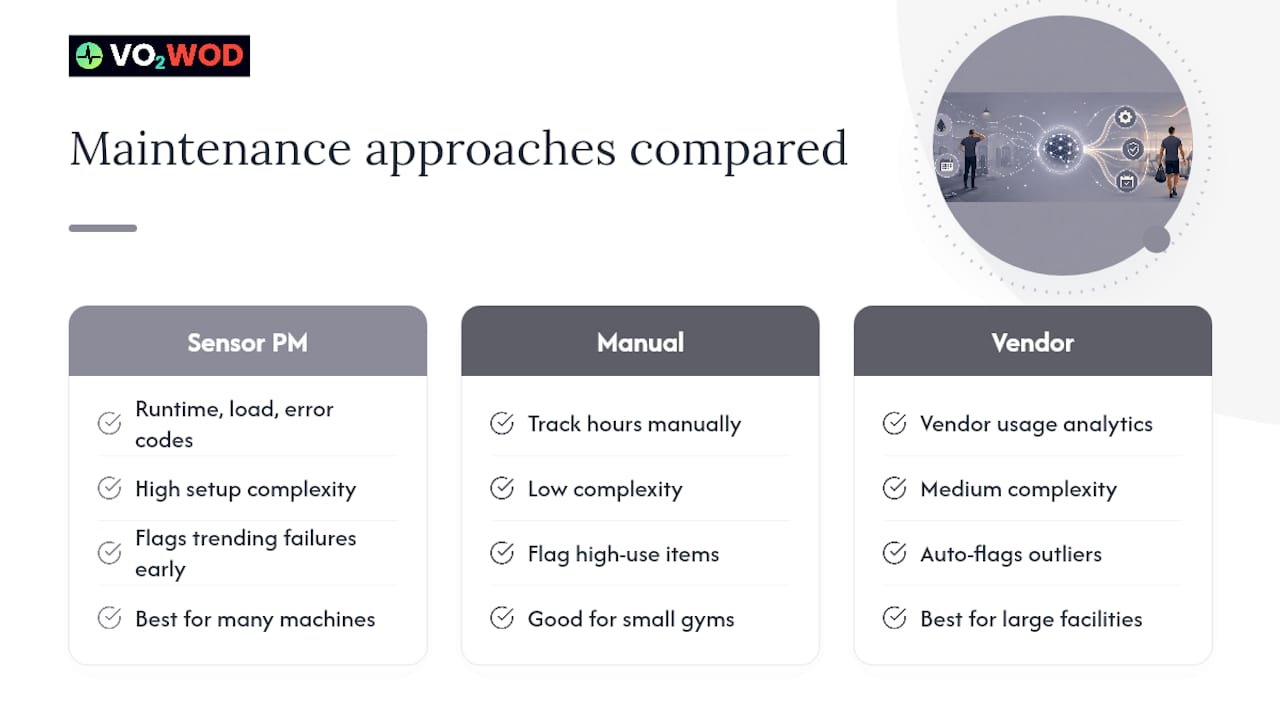
Predictive maintenance isn't just for factories. Gym equipment, especially treadmills, bikes, and cable machines with usage sensors, generates data on run time, load cycles, and error codes. AI models can flag a machine trending toward failure before it breaks down mid-class, based on usage patterns rather than a fixed calendar schedule.
For most independent gyms and functional fitness boxes, full sensor-based predictive maintenance is overkill. A simpler version works nearly as well: track usage hours per piece of equipment manually or through connected fitness equipment your vendor already supports, then flag high-use items for inspection on a rotating schedule instead of waiting for a member complaint. If you run a large facility with dozens of cardio machines, vendor-supplied usage analytics (many treadmill and bike manufacturers now bundle this) can automatically flag outliers.
The bigger win is scheduling around maintenance instead of reacting to it. If a machine needs to come offline, knowing that three days ahead, rather than five minutes before a class, lets you adjust programming or notify members before it becomes a visible problem. That's a small operational fix, but it's the kind of thing that quietly protects your reviews and member trust over time.
Don't over-invest here before you've nailed member-facing automation. Equipment uptime matters, but a broken treadmill rarely costs you a membership the way an ignored missed-class notification does.
Turning member feedback into a signal, not noise
Most gyms collect feedback and let it die in a spreadsheet or a stack of comment cards. Sentiment analysis tools change that by scanning surveys, app reviews, and even class check-in comments to flag patterns, like a specific coach's classes trending negative, or repeated complaints about a particular time slot being overcrowded.
The practical value isn't in reading every comment. It's in catching a trend before it shows up as cancellations. If sentiment around your 6 a.m. class drops two weeks running, that's worth investigating before three members quietly stop showing up. AI-driven sentiment tracking essentially does the pattern recognition a busy owner doesn't have time to do manually across hundreds of data points a month.
Keep this in proportion. Sentiment scoring is directional, not diagnostic. It tells you where to look, not why. A dip in sentiment around a new class format might mean the format is bad, or it might mean one coach needs coaching. You still need a human conversation to close the loop, whether that's a manager checking in with a coach or a quick survey follow-up asking what specifically felt off.
The gyms getting the most out of this pair automated sentiment flags with a simple response protocol: someone reviews flagged trends weekly and decides whether it needs action. Without that step, sentiment tracking is just another dashboard nobody opens.
Smarter staff scheduling with AI
Staffing a gym is a demand-matching problem, and it's one AI handles well because the inputs are already in your booking system. Class attendance history, seasonal patterns (January surges, summer dips), and peak-hour trends all feed into a forecast that tells you when you're overstaffed and when you're one no-show away from a chaotic front desk.
The practical application is straightforward: instead of building schedules from gut feel or last month's template, AI-assisted scheduling tools flag which shifts historically run under-attended versus which ones need a second coach on the floor. For gyms running multiple locations, this matters even more, since multi-unit operators tend to see the clearest ROI on automation because the scheduling complexity multiplies faster than a manual process can keep up with.
This doesn't mean handing shift decisions to an algorithm outright. Coaches have preferences, seniority matters, and member relationships with specific coaches often outweigh whatever a forecast says is "optimal." Treat AI scheduling suggestions as a starting draft a manager adjusts, not a final answer. The time savings come from not building the schedule from scratch every week, not from removing judgment entirely.
Data privacy and ethics you need to think about now
Every workflow above runs on member data, and that comes with responsibilities most gyms haven't formalized. Attendance patterns, payment history, and biometric data from wearables are sensitive, even if they don't feel as sensitive as medical records.
A few practical rules keep you on solid ground. Only collect data you actually use for a specific workflow, don't gather heart rate or biometric data "just in case" if you have no plan to act on it. Be transparent with members about what's automated: a simple line in your onboarding materials or app messaging, noting that check-in reminders and outreach are automated, builds trust rather than eroding it. And keep a human reviewing anything member-facing before it goes out, at least until you've built confidence in your outreach templates.
There's also a fairness dimension worth taking seriously. Churn models trained on visit frequency can inadvertently penalize members with legitimate reasons for irregular attendance, like injury recovery or travel for work. Treat a churn flag as a prompt for a human check-in, not an automatic downgrade in how that member gets treated. The goal is closing the follow-up gap with empathy, not running members through a scoring system that feels cold or punitive.
Why the follow-up gap is where gyms actually lose money
Most owners I talk to fixate on the wrong number. They want to know how accurate a churn prediction model is, when the real question is what happens in the 48 hours after that flag fires. A rough model that triggers a same-day text from a coach is worth real money. Response speed, not predictive precision, is the metric that determines whether AI actually saves a membership.
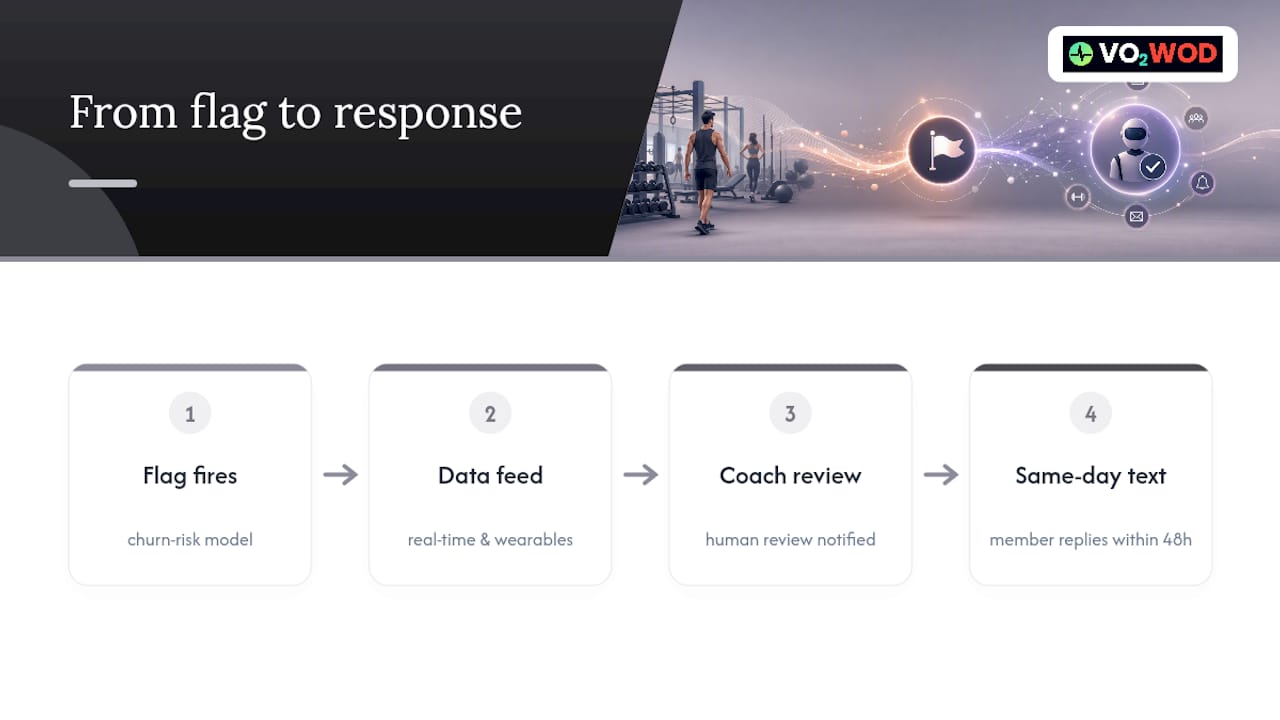
The industry conversation around AI in fitness leans heavily toward flashy features: personalized workout generation, biometric dashboards, sentiment scoring. Those matter, but they're not where most gyms are bleeding revenue. The bleed is in the gap between "we noticed this member is at risk" and "someone actually reached out." Vo2wod's approach, built around real-time monitoring, automatic workout scoring, and wearable integration with Garmin, Apple, Fitbit, and Samsung, works because it feeds that follow-up loop with data your coaches already trust, rather than asking them to learn a parallel system.
If you're a small studio owner reading this wondering where to start, ignore the temptation to automate everything at once. Pick the workflow costing you the most silent revenue right now, probably no-shows or unanswered trial leads, and fix that one thing well.
— Marcus
Getting started with Vo2wod
Everything covered here, predictive churn signals, automated outreach, real-time performance data, only works if your underlying system captures clean attendance and engagement data in the first place. That's the gap Vo2wod is built to close for functional fitness gyms specifically, with live heart rate tracking during classes and automatic workout scoring that removes manual data entry from your coaches' plates entirely.

Switching software is usually the excuse owners use to avoid doing any of this. Vo2wod removes that excuse with free data migration, one month of complimentary service, and a dedicated support team walking you through the transition. If you're currently comparing platforms, the feature and cost breakdown shows exactly what changes on day one. Book a demo and see how your own attendance data looks inside the system before you commit to anything.
Sources
- How AI Is Transforming Studio Operations in 2026 — Nutripy
- 2026 State of AI in the Fitness Industry (Multi-Unit Operators & Franchises) | Treetop
- AI Automation for Gyms: Memberships & Bookings | Jogi AI