

For most U.S. businesses, credit cards win at the point of sale and ACH wins on anything recurring, large, or B2B. That split isn't a guess. ACH settlement typically takes 1 to 3 business days, while card authorization is instant, and Nacha's network moved tens of billions of payments with Same Day ACH adoption accelerating. Match the rail to the transaction:
- Retail checkout, one-off purchases: cards, for instant authorization and conversion
- Subscriptions, memberships, recurring billing: ACH, for lower cost and fewer failed renewals
- B2B invoices, payroll, large-ticket transfers: ACH, for predictable batching and lower fees
Start here: pull your average transaction size and monthly volume before deciding anything else.
Key Takeaways
ACH wins on cost and predictability for recurring or large-value payments, while credit cards win on speed and conversion at the point of sale.
| Point | Details |
|---|---|
| Match rail to transaction type | Use cards for retail checkout and ACH for subscriptions, B2B invoices, and payroll. |
| ACH settles slower, costs less | Standard ACH takes 1 to 3 business days but charges a low fixed fee per transaction rather than a percentage. |
| Fewer disputes on ACH | ACH returns follow a specific set of Nacha rules with fewer reversals than card chargebacks, reducing revenue volatility. |
| Build a fallback system | Route failed ACH debits to card automatically to cut involuntary churn. |
| Reconciliation favors ACH | Addenda fields on ACH transactions simplify automated matching against your ledger. |
Table of Contents
- ACH vs Credit Card: How the ACH Network Actually Works
- How Credit Card Authorization, Clearing, and Settlement Work
- ACH vs Credit Card vs Debit Card: A Side-by-Side Look
- What ACH and Credit Card Fees Actually Cost You
- Settlement Timing and What It Means for Cash Flow
- Disputes, Chargebacks, and Returns: Comparing Merchant Risk
- When to Use ACH vs Credit Card: A Quick Decision Checklist
- Setting Up ACH Acceptance for a U.S. Business
- Your Next 30 Days: A Short Action Checklist
- An Editorial Take on Picking Your Payment Rails
- Frequently Asked Questions
- Sources
ACH vs Credit Card: How the ACH Network Actually Works
ACH moves money two ways. ACH credit pushes funds out, think payroll or vendor payments. ACH debit pulls funds in, think a gym charging monthly dues. Both run through the ACH Network, governed by Nacha's operating rules, which set authorization requirements, return codes, and processing windows.
Transactions move in batches rather than one at a time, which is why standard ACH settles in a few business days. Same Day ACH exists for time-sensitive transfers, and Nacha's Same Day ACH volumes have grown quickly as more originators adopt it for payroll corrections and urgent vendor payments.
- Batch processing means predictable settlement windows, not instant availability.
- Future-dating a debit lets you align charges with a customer's payday
- Same Day ACH costs more per transaction but closes the speed gap with cards
That predictability is exactly why treasury teams like ACH for cash-flow planning: you know when money lands, not just that it eventually will.
How Credit Card Authorization, Clearing, and Settlement Work
A card swipe triggers an instant authorization check, the issuing bank confirms funds or credit are available, and the sale goes through in seconds. That's the entire appeal for checkout conversion: the customer sees "approved" immediately. Settlement, when the money actually moves into your account, happens separately, typically one to two business days later.
Card fees stack in layers. Interchange goes to the issuing bank, assessments go to the card network (Visa, Mastercard), and your processor adds its own markup on top. Combined, that's why card fees usually land between 1.5% and 3.5% per transaction.
- Authorization is instant; settlement is not, the two get conflated constantly
- Interchange, assessments, and processor markup are three separate charges bundled into one rate
- Chargebacks give cardholders strong dispute rights, which shifts risk onto merchants when a customer disputes a charge
ACH vs Credit Card vs Debit Card: A Side-by-Side Look
| Dimension | Credit Card | ACH |
|---|---|---|
| Typical fees | 1.5%–3.5% + per-transaction fee | Flat cents to ~$1.50, or a low capped percentage |
| Settlement speed | Instant authorization; funds post in 1–2 days | 1–3 business days standard; Same Day ACH available |
| Customer experience | Instant approval, familiar checkout flow | Slight delay, best for recurring or invoice payments |
| Fraud & disputes | Chargebacks favor the cardholder | Narrower Nacha return windows, fewer reversals |
| Best use cases | Retail, one-off online purchases | Subscriptions, B2B invoices, payroll, high-ticket sales |
| Integration complexity | Widely supported, plug-and-play | Requires account verification, slightly more setup |
| Predictability | Variable, subject to disputes | Batch-based, highly predictable for recurring revenue |
A few things jump out once you see it laid side by side:
- ACH's cost advantage grows with ticket size, a flat $0.50 fee on a $2,000 invoice beats 2.9% every time
- Cards win when speed and familiarity at checkout matter more than the fee
- ACH generally sees fewer disputes and reversals than card payments, which stabilizes revenue for subscription businesses
Pro Tip: Offer a small cash-discount or ACH-discount rate instead of a card surcharge. Steering customers toward ACH with a modest incentive avoids the legal gray areas around surcharging in several states and still cuts your processing cost.
What ACH and Credit Card Fees Actually Cost You
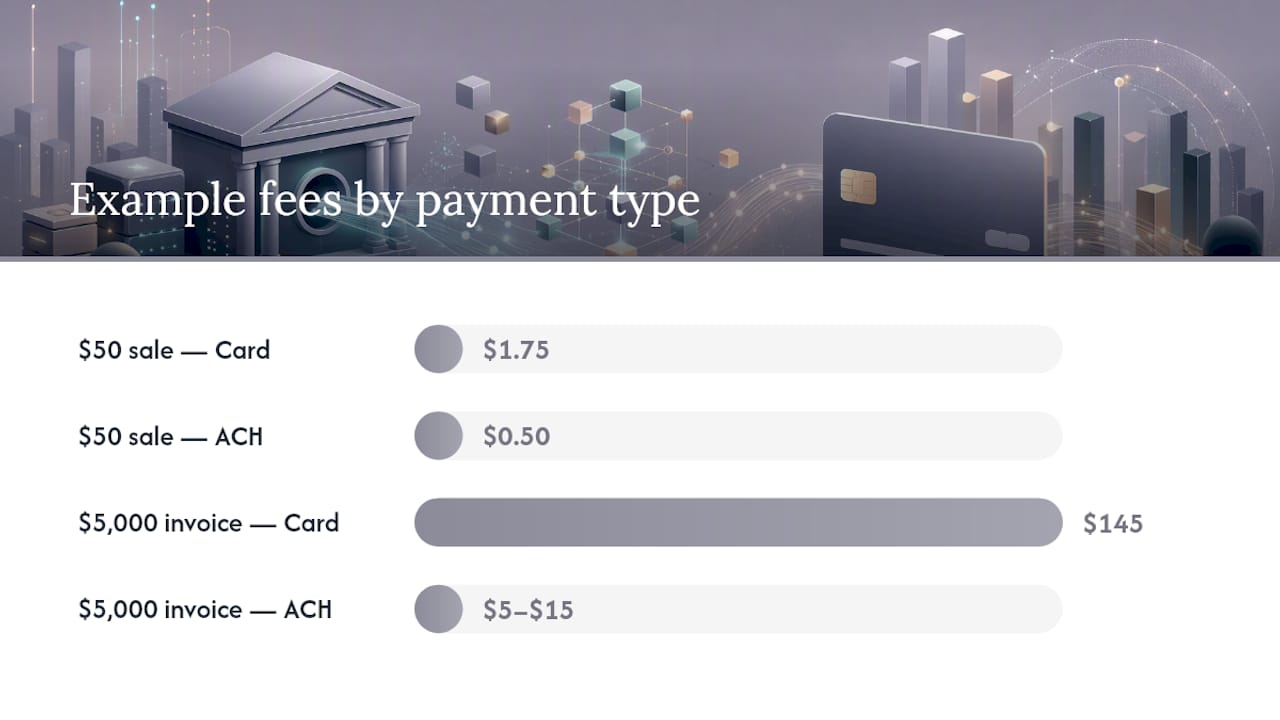
Card processing commonly runs 1.5% to 3.5% plus a per-transaction fee, often $0.10 to $0.30. ACH pricing usually looks completely different: a flat fee per transaction, often a few cents up to around $1.50, or a low capped percentage.
Run the math on two scenarios. A $50 retail sale at 2.9% plus $0.30 costs you $1.75 on a card. The same $50 on ACH at a flat $0.50 costs a third of that. Now scale up: a $5,000 B2B invoice at 2.9% costs $145 on a card. On ACH with a capped fee, that same invoice might cost $5 to $15 total.
- Small-ticket sales: ACH savings are real but modest in dollar terms
- Large-ticket or recurring invoices: ACH savings compound fast
- Same Day ACH usually adds a small per-transaction premium, worth it only when timing matters
Settlement Timing and What It Means for Cash Flow
Cards authorize instantly but typically settle into your bank account in one to two business days. Standard ACH settles in one to three business days, with Same Day ACH available for a premium when timing is critical.
Bank cut-off times matter more than people expect. Submit a batch after your processor's daily cutoff, and it slides to the next business day, weekends and federal holidays push it further. Build that lag into your forecasting model rather than assuming funds are available the day a customer pays.
- ACH's structured remittance data (addenda fields) makes automated reconciliation easier than piecing together fragmented card settlement reports
- Finance teams forecasting weekly cash flow should model ACH's 1 to 3 day lag explicitly, not assume same-day availability
- Same Day ACH narrows the gap with cards but rarely eliminates it entirely
Disputes, Chargebacks, and Returns: Comparing Merchant Risk
Credit cards carry strong consumer chargeback protections, which is great for shoppers and a real cost center for merchants. Disputed charges, friendly fraud, and processing delays during a chargeback all land on your side of the ledger.
ACH returns work differently. Nacha's rules define specific return reason codes (insufficient funds, unauthorized debit, account closed) with narrower windows than card disputes, generally leading to fewer reversals overall.
- Card chargeback reasons skew toward fraud claims and "item not as described" disputes
- ACH returns skew toward insufficient funds and authorization errors, both preventable with better verification
- Pro Tip: Layer account verification (micro-deposits or instant bank auth) with ACH positive pay, and pair card tokenization with 3D Secure, to cut fraud exposure on both rails at once.
When to Use ACH vs Credit Card: A Quick Decision Checklist
Match the payment method to the transaction type, not to habit:
- Recurring memberships and subscriptions: ACH first, card as backup
- B2B invoices and payroll: ACH, almost always
- Point-of-sale and one-off retail: cards, for conversion and familiarity
- High-fraud-risk categories: cards, for the chargeback protection layer
Run this checklist before switching anything:
- What's your average ticket size?
- What percentage of monthly volume is ACH-eligible (recurring or B2B)?
- How conversion-sensitive is your checkout flow?
- What's your fraud tolerance and current chargeback rate?
- What do your customers actually prefer paying with?
Most operators land on a hybrid: ACH for recurring and high-value transactions, cards everywhere else, exactly what payment guides broadly recommend.
Setting Up ACH Acceptance for a U.S. Business
Processors fall into a few buckets: full payment gateways, ACH specialists, and platforms like Stripe and GoCardless that support both cards and ACH rails through one integration.
Getting ACH running takes a few concrete steps. Tokenize bank account data at collection, use micro-deposit or instant account-verification APIs to confirm the account is real, then originate payments in batches with remittance addenda attached for clean reconciliation. Webhooks handle status updates and returns.
- Confirm Nacha-compliant authorization language on every ACH mandate
- Run annual ACH audits per Nacha requirements
- Set up ACH positive pay and automated retry logic for failed debits
- Monitor return rates monthly, not quarterly
Pro Tip: Use the addenda field on every ACH transaction for invoice numbers or customer IDs. Automated matching against your ledger gets dramatically easier, and structured remittance data speeds reconciliation compared to fragmented card settlement reports.
A Gym's Playbook: Blending ACH and Card Billing
Functional fitness gyms live and die by recurring revenue, which makes the ACH/card split especially relevant. A typical setup: monthly membership dues run on ACH, while walk-in retail purchases (apparel, supplements, day passes) run on card for instant checkout.
- Get explicit opt-in ACH authorization at sign-up, not buried in fine print
- Verify bank accounts before the first debit attempt
- Fall back to card automatically if an ACH debit fails, reducing involuntary churn from expired or misrouted bank details
- VO2WOD supports this kind of dual-rail billing alongside its scoring and attendance tools, so gym owners aren't stitching together separate systems for payments and performance tracking
Your Next 30 Days: A Short Action Checklist
Pull your last 90 days of transactions and split them by ticket size and recurrence. That single exercise tells you more than any fee comparison chart.
- Review average ticket size and monthly volume by payment type
- Run a fee-savings model comparing current card costs to projected ACH costs
- Enable ACH for recurring and B2B invoices first
- Build return and reconciliation workflows before scaling ACH volume
- Loop in finance, ops, and engineering early, this touches billing, forecasting, and integrations all at once
Track payment success rate, involuntary churn, and net processing cost monthly after rollout.
An Editorial Take on Picking Your Payment Rails

Most advice on this topic treats it like a religious war, cards versus ACH, pick a side. That's backwards. The real skill is routing transactions to the rail that fits their shape: card familiarity for a stranger buying a t-shirt at checkout, ACH predictability for a member who's been paying the same $150 a month for three years.
What gets underrated is churn. Everyone fixates on the fee difference, 2.9% versus a flat fifty cents, and misses that cards expire every few years on average while bank accounts don't. That's involuntary churn hiding in plain sight, and it costs subscription businesses far more than interchange ever will.
If you run a subscription or membership model, the priority isn't finding the cheapest processor. It's building a fallback system: ACH first, card as backup when a debit fails, so a stale account number never silently kills a customer relationship you spent months earning.
Frequently Asked Questions
Is ACH cheaper than a credit card for a small business? Usually, yes, especially on larger transactions. ACH fees are often flat cents or a low capped percentage, while cards charge a percentage of the transaction amount plus a small per-transaction fee. The gap widens as ticket size grows.
How long does ACH take compared to a debit card transaction? Standard ACH settles in one to three business days. Debit card transactions authorize instantly at the point of sale, similar to credit cards, though the underlying network and dispute rules differ from ACH entirely.
What's the maximum ACH transaction amount? Nacha doesn't set a single universal dollar cap; limits are typically set by your bank or payment processor and vary by account type and risk profile. Check with your ACH originator for your specific limit.
Do ACH payments require special customer authorization? Yes. Nacha rules require clear, documented authorization for every ACH debit, whether written, verbal and recorded, or through a web-based sign-up flow. This differs from card payments, which rely on card network authorization rather than a signed mandate.
Can a U.S. business use ACH for international payments? ACH is built for domestic U.S. transactions. Cross-border payments typically require wire transfers or international payment rails, not the standard ACH network.
Should a subscription business accept both ACH and credit cards? Most should. A hybrid approach, ACH for recurring billing with card as an automatic fallback, balances lower processing costs against checkout familiarity and reduces involuntary churn from failed payments.
This article is general information, not a substitute for advice from a qualified financial advisor. Consult a qualified financial professional about your own circumstances before acting on anything here.
Sources
- Plaid — ACH payments guide
- Stripe — Advantages of ACH payments for recurring billing, payroll, and B2B
- Nacha — Payment Power: How ACH optimizes speed, cost, and control
- Paymotile — ACH vs credit cards: payment rails guide